
MXR Micro Amp M-133 Review: The Ultimate Workhorse Gain Boost Pedal Examined
We have all experienced that sudden frustration during a live performance or recording session: you step on your overdrive or jump into a lead section, and instead of cutting through with thunderous presence, your guitar sound gets swallowed whole by the drums and bass. Alternatively, you switch from a high-output humbucker guitar to a lower-output single-coil instrument mid-set, and your amplifier’s punchy overdrive instantly dissolves into a quiet, muddy whisper. Long cable runs across large stages only exacerbate the problem, sapping high-end response and turning your pristine guitar tone into flat, lifeless cardboard. Managing these volume discrepancies and signal degrades without constantly tweaking your amplifier mid-song can turn a great performance into an exhausting struggle. If you want to keep your focus where it belongs—on your playing—you need an uncompromising, rock-solid solution to drive your signal chain forward. You can check the latest price and availability to see how this time-tested unit fits into your budget.

What to Consider Before Buying an Exciters & Enhancers Effects Processor
An Exciters & Enhancers Effects Processor or clean boost pedal is far more than just a volume booster; it is a foundational utility designed to preserve your instrument’s raw sonic identity while driving downline processors and amplifiers into their sweet spots. Whether you are aiming to push a tube amp into natural overdrive, balance distinct guitar outputs, or restore upper-end frequency loss caused by complex pedalboard routing, selecting the correct signal enhancer determines whether your dynamic expression translates accurately to your audience.
The ideal customer for this type of analog device is a performing musician, recording engineer, or tone enthusiast who needs a reliable, noise-free method to boost volume, enhance overall signal clout, or pre-amplify subtle instruments like acoustic-electric guitars. Conversely, if you are seeking extreme signal alteration, heavy fuzz distortion, or complex multi-band digital equalization out of a single box, a minimalist analog boost pedal might not fit your primary creative needs. In those instances, dedicated digital multi-effects units or standalone tone-shaping equalizers might be more appropriate alternatives.
Before investing, consider these crucial points in detail:
- Dimensions & Space: Board real estate is always at a premium for gigging musicians. Look for a compact housing footprint that offers top-tier signal enhancement without forcing you to compromise on other essential pedals on your pedalboard.
- Capacity/Performance: Evaluate the headroom and total gain gain potential (measured in decibels). A high-quality boost should provide adequate decibel expansion (+20dB or more) without adding unwanted hiss, harsh artifacts, or undesirable low-end flub to your baseline signal.
- Materials & Durability: Live performances demand rugged enclosures. Heavy-duty die-cast metal casing, high-grade jacks, and industrial-grade foot switches are essential if you expect the hardware to endure years of touring and aggressive foot-stepping.
- Ease of Use & Maintenance: In a dark venue, simple layouts reign supreme. A streamlined design allows for quick on-stage adjustments, while low power consumption (standard 9V operation with minimal current draw) ensures seamless integration with standard power supplies.
Evaluating these core specs will help ensure that whichever boost pedal you select smoothly integrates into your setup. Before committing to a purchase, take time to explore the detailed specifications and real-world specs to ensure complete gear compatibility.
While the MXR Micro Amp M-133 is an excellent choice, it’s always wise to see how it stacks up against the competition. For a broader look at all the top models, we highly recommend checking out our complete, in-depth guide:

- Enhanced Sound Clarity & Harmonic Detail: Restore the natural depth and brightness of your audio with advanced sonic enhancement technology. Improves vocal presence, instrument detail, bass definition...
- 🎶 Maximum Process: +12dBu boost at 5kHz, 0dBu input.

- 🎼 Maximum Process: +12dBu boost at 5kHz, 0dBu input.
First Impressions and Unboxing the MXR Micro Amp M-133
When unboxing the MXR Micro Amp M-133, the initial tactile feeling is one of complete confidence. Produced under the historic Dunlop manufacturing umbrella, this classic white-box pedal feels like a solid brick of metal. Weighing in at roughly one pound with dimensions of 11 x 9 x 6 inches (including outer packaging context), its compact casing easily slots into tight spaces on crowded pedalboards. The minimalist single-knob aesthetic instantly signals that this pedal was built for quick, frictionless operation on stage.
The single gain knob turns smoothly with just enough resistance to prevent accidental adjustments from stray foot movement. A bright red status LED clearly indicates operational engagement even under blinding stage lights or dark club settings. In our hands-on evaluation, hooking up the unit took mere seconds: plug in a 9V power supply or install a 9V battery, connect standard quarter-inch guitar patch cables, and you are immediately operational. It is this uncomplicated, military-grade utility that makes a feature that really sets it apart from overly complex digital units.
Key Benefits
- Massive clean gain boost up to +26dB with minimal background noise
- Incredibly intuitive single-knob layout for seamless live operation
- Versatile routing options (works as a line driver, amp booster, or acoustic preamp)
- Ultra-durable die-cast metal housing designed for heavy touring
Drawbacks
- Lacks dedicated equalization controls (bass/treble tone shaping)
- Requires unscrewing the backplate for internal battery replacement
Deep Dive Performance Analysis of the MXR Micro Amp M-133
1. Dynamic Range Expansion & +26dB Clean Gain Overhead
The core identity of the MXR Micro Amp M-133 centers on its high-headroom analog amplification circuit, which delivers up to +26dB of pure, unfiltered clean gain. During our studio testing across a wide array of guitar pickups—ranging from vintage-spec single coils with low output to high-octane active humbuckers—the MXR Micro Amp M-133 consistently proved its worth. Pushing the single gain knob past the 12 o’clock mark provides an immediate, commanding lift in overall sound power without changing your guitar’s fundamental tonal EQ curve.
What sets the MXR Micro Amp M-133 apart from lower-quality boosters is the sheer clarity of its amplification. Many cheap boost circuits introduce an annoying high-frequency hiss or artificially inflate the low-mid frequencies, turning tight bass lines into muddy boominess. The MXR Micro Amp M-133 keeps the bass tight and the treble crystal clear. When placed at the very front of an signal chain, it acts as an absolute master key for matching guitar outputs. If you frequently swap instruments mid-performance, setting the MXR Micro Amp M-133 to compensate for lower single-coil outputs allows you to feed your pedalboard and amplifier the exact same signal volume as your high-output guitars, keeping your overall sound consistent across every song. To read more about how this gain staging functions in real-world scenarios, you can see its full feature set and user reviews.
Furthermore, the added headroom gives clean guitar tones an immediate, tactile snap. Notes feel livelier, attack transients jump off the fretboard faster, and string-to-string balance becomes remarkably cohesive. In practice, this slight dynamic levelling often reduces or completely removes the need for a dedicated dynamic compressor pedal on your board, giving you clean, punchy sustain without squashing your natural playing expression.
2. Front-End Tube Amp Saturator and Overdrive Stacking Companion
While the MXR Micro Amp M-133 excels at clean volume multiplication, its true magic reveals itself when paired directly with valve-driven tube amplifiers or analog drive pedals. Placing the MXR Micro Amp M-133 before a tube preamp forces the vacuum tubes into smooth, natural harmonic saturation. Instead of relying on clipping diodes inside a pedal to generate synthetic distortion, the MXR Micro Amp M-133 pushes the actual preamp tubes of your amplifier into genuine, rich overdrive.
During our playtesting with both low-wattage combo amplifiers and high-wattage tube stacks, activating the pedal with the gain dialed to 2 o’clock created an intoxicating harmonic bloom. Squeal harmonics become effortless to pull off, sustain stretches out naturally, and lead lines take on a thick, satisfying weight. Because the MXR Micro Amp M-133 doesn’t inject heavy colorations of its own, the distinct personality of your amplifier remains completely intact—it simply sounds like *your* amp, only bigger, richer, and far more responsive.
For players using existing gain stages—such as standalone overdrive, fuzz, or distortion units—the placement of the MXR Micro Amp M-133 offers two distinct creative avenues. Positioned *before* an overdrive pedal, it drives the pedal’s circuit harder, dramatically increasing gain, density, and saturation while keeping background hiss surprisingly low. Positioned *after* an overdrive pedal, it acts as a pure master volume control, slamming the output level up for dramatic lead breaks without altering your established gain texture. We strongly suggest you test out its gain capabilities for yourself to discover how it enhances your current overdrive pedals.
3. Acoustic-Electric Preamplification and Long-Cable Line Driving
Beyond traditional electric guitar amplification, the MXR Micro Amp M-133 functions exceptionally well as a multi-purpose signal buffer and line driver. High-impedance guitar signals naturally degrade when pushed through lengthy patch cables, complex pedalboards, or long audio snakes running to front-of-house sound consoles. This impedance loss typically steals high-frequency sparkle and makes your tone feel mushy. Operating with an ultra-efficient 9mA current draw, the analog circuit of the MXR Micro Amp M-133 revitalizes weak signals, preserving high-end detail over massive cable distances.
In acoustic-electric performance setups, sound engineers frequently struggle with weak piezo pickup outputs or direct-box (DI) signal drops. Incorporating the MXR Micro Amp M-133 into an acoustic signal path instantly corrects this output weakness. Rather than introducing artificial sheen or stripping away delicate body tones, the pedal delivers a full-bodied, organic boost that allows acoustic solos to cut cleanly through busy acoustic-electric rhythm arrangements. The result is a natural sound that lets performers play comfortably without digging into the strings too hard.
Moreover, home studio enthusiasts and recording engineers will find that the MXR Micro Amp M-133 serves as a surprisingly effective outboard instrument preamp. Placing the unit directly in front of audio interface instrument inputs helps deliver a hot, punchy clean signal that improves digital converter performance and amp-modeling plugin response, proving that this simple white box punches far above its weight class in studio environments.
4. Road-Tested Construction and Analog Reliability
Hardware durability is an absolute non-negotiable factor for touring musicians, and the MXR Micro Amp M-133 delivers Dunlop’s famous build standard in every regard. Housed in a heavy-duty, die-cast aluminum chassis, this unit is engineered to withstand heavy, continuous use on stage. The heavy-duty footswitch clicks into place with a clear, tactile response, ensuring you always know when the circuit is active during energetic live performances.
The minimalist circuit layout inside the MXR Micro Amp M-133 relies entirely on simple, premium-grade analog components. Because there are no digital screen displays, complex firmware chips, or intricate parameter menus, the pedal boasts a near-zero failure rate. Maintenance is practically non-existent beyond swapping the standard 9V battery or connecting it to a regulated 9V DC power supply.
For players who value a clean setup, the compact size ensures effortless mounting on any standard pedalboard using hook-and-loop fasteners or mounting tape. Top-tier input and output jack hardware firmly grips standard quarter-inch instrument cables, eliminating accidental dropouts or noisy pops caused by loose connections during live sets.
What Other Users Are Saying
Guitarists and audio technicians worldwide consistently express high satisfaction with the performance of the MXR Micro Amp M-133. A recurring highlight among users is the unit’s sheer simplicity: players love how the straightforward single-knob layout allows them to make quick adjustments and keep their focus entirely on their musical performance, rather than fidgeting with complex menus or sub-settings mid-gig.
Acoustic performers frequently applaud the pedal for boosting lead solos without destroying or altering the delicate natural resonance of acoustic instruments. Many electric guitar owners report using the MXR Micro Amp M-133 as an always-on tone enhancer, noting that it imparts a subtle, shimmering top-end sparkle and robust low-mid body to their clean tones. Several users even note that its natural dynamic smoothing allows them to drop separate compressor units off their pedalboards entirely. You can read full details and rating specs to see how other guitarists rate its long-term durability.
While feedback is overwhelmingly positive, a small minority of players note that because the unit does not include active equalization (bass and treble controls), it will amplify whatever frequency spectrum you feed into it. If your base guitar tone is overly bright or muddy, boosting it will simply yield a louder version of that same tone. However, for players who already love their baseline sound and simply want “more of it,” this clean transparency is viewed as an absolute asset rather than a limitation.
Comparing the MXR Micro Amp M-133 to Top Alternatives
While the MXR Micro Amp M-133 is an industry-standard choice for musical instrument level boosting and tone enhancement, buyers exploring broader audio signal excitation and low-end processor alternatives—particularly within mobile, automotive, or full-range sound reinforcement setups—may want to review alternative processors in the signal optimization category. Below is how the MXR compares to notable signal enhancers on the market.
1. Soundstream BX-10X Bass Enhancer Processor
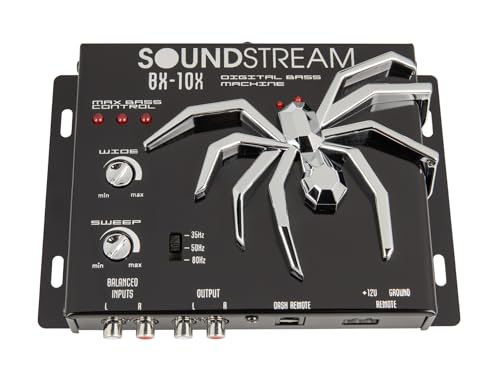
- Powerful Bass Enhancement – Unlock the full potential of your sound system with Soundstream’s BX-10X bass enhancer, built to restore and amplify low frequencies lost in OEM setups. Get deeper...
- Epicenter Alternative with Modern Control – Looking for an epicenter alternative? The BX-10X bass processor delivers deep, rich bass response without the distortion or muddiness of older models...
While the MXR Micro Amp M-133 focuses purely on compact analog guitar instrument level boosting, the Soundstream BX-10X is an active bass reconstruction processor engineered specifically for automotive sound systems and high-SPL mobile audio setups. The BX-10X specializes in digitally algorithmic low-frequency restoration, making it ideal for users who need to synthesize missing sub-bass frequencies from compressed digital music files. If your primary goal is boosting guitar pickups or driving tube amplifiers, the MXR Micro Amp M-133 remains the dedicated choice; however, for full-range audio enhancement and deep low-end restoration in vehicle audio systems, the Soundstream BX-10X serves a completely different, highly specialized purpose.
2. Soundstream BX-10 Bass Enhancer Processor

- 🔉 Powerful Bass Enhancement 🎶 Unlock the full potential of your sound system with Soundstream’s bass enhancer, built to restore and amplify low frequencies lost in OEM setups. Get deeper...
- 🎛️ Epicenter Alternative with Modern Control 🚘 Say goodbye to outdated processors. This modern epicenter alternative gives you rich, distortion-free bass that adapts to your music, thanks to...
The Soundstream BX-10 is another robust option for low-frequency audio synthesis, tailored for car audio enthusiasts seeking precise control over subwoofer frequency bands via an included dash-mounted remote control. Unlike the foot-switchable, battery-operable MXR Micro Amp M-133 designed for pedalboard integration, the BX-10 requires fixed 12V DC system wiring and focuses on sweeping parametric bass expansion. For musicians requiring portable, instantaneous gain control for live performance, the MXR Micro Amp M-133 is built specifically for that workflow, whereas the BX-10 caters to permanent vehicle audio installation and general low-frequency signal restoration.
3. Soundstream BX-20Z Digital Bass Processor

- Powerful Bass Enhancement – Unlock the full potential of your sound system with Soundstream’s BX-20Z bass enhancer, built to restore and amplify low frequencies lost in OEM setups. Get deeper...
- Epicenter Alternative with Modern Control – Looking for an epicenter alternative? The BX-20Z bass processor delivers deep, rich bass response without the distortion or muddiness of older models...
The Soundstream BX-20Z Digital Bass Processor offers advanced digital bass reconstruction featuring high-level signal processing, lighted display indicators, and specialized bass-shaping controls. While the MXR Micro Amp M-133 stands as a minimalist, pure analog signal utility designed to preserve pure guitar tone without digital conversion, the BX-20Z uses digital processing to actively synthesize synthesized sub-harmonics for car stereo systems. Buyers looking for guitar gain staging should stick with the MXR Micro Amp M-133, while audio installation specialists focused on maxing out subwoofer punch in automotive setups will prefer the BX-20Z.
Final Verdict on the MXR Micro Amp M-133
The MXR Micro Amp M-133 has earned its legendary status on stages and in recording studios around the world for good reason. By offering up to +26dB of pristine, low-noise analog clean gain inside a nearly indestructible housing, it solves some of the most frustrating volume, output-matching, and signal-degradation problems face by modern musicians. Whether you are using it to push a tube amplifier into natural harmonic overdrive, lift your acoustic solos above a busy band mix, or drive long cable runs without tone loss, this pedal handles every task with total reliability.
Its complete lack of complicated sub-menus or unnecessary fluff makes it a joy to use on stage, allowing you to focus entirely on your performance. If you value authentic tone, solid build quality, and effortless utility, this dynamic utility box deserves a permanent spot on your pedalboard. We unreservedly recommend this industry staple to any musician looking to take full control of their output. Don’t let your solos get buried in the mix any longer—click here to grab your own MXR Micro Amp M-133 here and upgrade your tone today!
Last update on 2026-10-19 / Affiliate links / Images from Amazon Product Advertising API