
beyerdynamic DT 990 Pro Studio Headphones Review: The Legendary Open-Back Benchmark for Precision Mixing
If you have ever spent hours meticulously tweaking a snare drum or agonizing over a vocal reverb tail only to find that your mix sounds like mud when played in your car, you know the frustration of “lying” headphones. For years, I struggled with consumer-grade gear that artificially boosted bass and smoothed over harsh frequencies, hiding the very flaws I needed to fix. In the professional world of audio production, “pleasant” is the enemy of “accurate.” You don’t need headphones that make your music sound good; you need headphones that tell you exactly where your music sounds bad. This is where the beyerdynamic DT 990 Pro Studio Headphones enter the conversation. Designed specifically for those who need to hear every microscopic detail within a wide, three-dimensional space, these headphones aim to solve the problem of sonic claustrophobia. Without a reliable reference point, you are essentially mixing in the dark, and that is a recipe for amateur-sounding results that fail to translate across different playback systems.
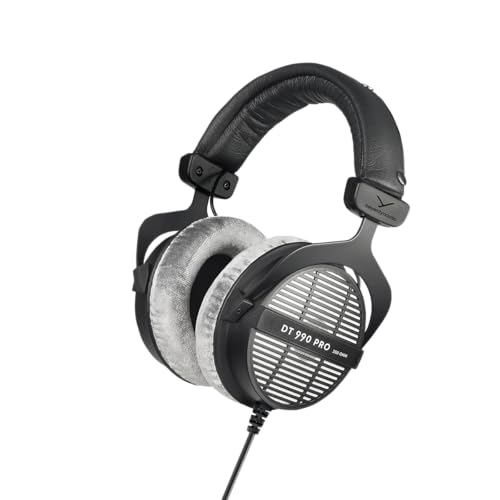
- 250-ohm studio impedance: designed for audio interfaces and headphone amps - it needs one for full volume; not ideal straight from a phone.
- The mixing reference: the open-back sound studios have trusted for decades, for honest mixes that translate everywhere.
What to Consider Before Investing in Professional Recording Headphones & In-Ear Audio Monitors
A Recording Headphone & In-Ear Audio Monitors setup is more than just an item; it’s a key solution for any creative professional or enthusiast who demands transparency over hype. In a studio environment, these tools serve as your primary lens into the frequency spectrum. Unlike consumer headphones designed for commuting or casual listening, studio monitors are engineered for a flat, or at least highly analytical, response. They allow you to identify phase issues, clipping, and frequency masking that would otherwise go unnoticed. When you choose a high-quality monitor, you are investing in the longevity of your hearing and the professional quality of your output, ensuring that your creative vision is preserved from the initial recording to the final master.
The ideal customer for this type of product is someone facing the challenges of critical listening—producers, mixing engineers, video editors, and even high-end gamers who require pinpoint spatial accuracy. These individuals need to wear gear for six to ten hours at a time, making comfort as important as sound. Conversely, this type of product might not be suitable for those who primarily listen to music in noisy environments like subways or airplanes. Because open-back designs like the beyerdynamic DT 990 Pro Studio Headphones leak sound and offer zero isolation, they are strictly tools for controlled environments. If you need something for recording vocals in front of a live microphone, a closed-back alternative would be a more appropriate choice to prevent “bleed” into the recording.
Before investing, consider these crucial points in detail:
- Dimensions & Space: In the world of audio, space refers to the soundstage. You want a design that offers a wide, natural “image” so you can place instruments accurately in a stereo field. Look for circumaural (over-ear) designs that don’t pinch your ears, especially if you wear glasses, as this ensures long-term comfort during marathon sessions.
- Capacity/Performance: This is defined by impedance and frequency response. A higher impedance, like 250 ohms, requires more “juice” to drive. You must ensure your audio interface or headphone amp is capable of powering them; otherwise, they will sound quiet and thin. A wide frequency range (like 5 Hz to 35,000 Hz) ensures you can hear sub-bass rumble and high-end air that cheaper units miss.
- Materials & Durability: Studio gear takes a beating. Look for spring steel headbands and high-quality plastics. More importantly, check if the parts are replaceable. Professional-grade monitors should have user-serviceable ear pads and headbands, as these are the first things to wear out after years of sweat and use.
- Ease of Use & Maintenance: Consider the cable type. A coiled cable is often preferred in studios to prevent tripping or getting caught in chair wheels, while a straight cable might be better for stationary listening. Maintenance is simple if the brand offers official replacement kits, which extends the life of your investment significantly.
Understanding these variables is the first step toward making an informed purchase that will serve your studio for a decade or more. Transitioning from “vibe” listening to “critical” listening is a rite of passage for every serious creator.
While the beyerdynamic DT 990 Pro Studio Headphones is an excellent choice, it’s always wise to see how it stacks up against the competition. For a broader look at all the top models, we highly recommend checking out our complete, in-depth guide:
- Good Sound Isolation: This sound isolation in ear monitors headphone could prevent outside noise from interfering with your listening experience and maintain the crisp detail in low volume listening

- 【Precision Hybrid 6-Driver Earphones】New BmasterX IEMs combines 1 dynamic driver (warm bass), 3 balanced armatures (rich mids), and 2 piezoelectric tweeters (ultra-detailed highs) delivers...

- Good Sound Isolation: This sound isolation in ear monitors headphone could prevent outside noise from interfering with your listening experience and maintain the crisp detail in low volume listening
First Impressions: The German Engineering of the beyerdynamic DT 990 Pro Studio Headphones
Unboxing the beyerdynamic DT 990 Pro Studio Headphones is a refreshingly “no-nonsense” experience. There are no flashy LEDs or aggressive “gamer” aesthetics here. Instead, you are met with the classic, utilitarian design that has remained virtually unchanged for decades—a testament to the “if it ain’t broke, don’t fix it” philosophy. The first thing I noticed was the weight, or lack thereof. At just 0.55 pounds (without the cable), they feel incredibly light in the hand. The gray velour ear pads are iconic and feel much more premium and breathable than the synthetic leather found on most competitors. To truly understand why these are a staple in professional settings, you should see its full feature set and user reviews for yourself.
When I first slid them on, the “Pro” headband pressure was noticeable but not distracting. It feels secure, as if it’s designed to stay put even if you’re nodding along to a beat. The open-back grilles on the earcups are striking, offering a glimpse into the drivers and hinting at the airy soundstage to come. Compared to the market leaders in the closed-back category, these feel much less “stuffy.” Before you commit to a purchase, I highly recommend you check the latest price and availability as they often represent the best value-to-performance ratio in the industry.
Key Benefits We Love
- Outstanding spatial imaging and a wide, “three-dimensional” soundstage.
- Legendary comfort with soft, replaceable velour ear pads that prevent sweating.
- Robust, handcrafted German build quality with fully serviceable parts.
- Precise, analytical high-end detail perfect for surgical EQ tasks.
Drawbacks to Consider
- The 250-ohm impedance requires a dedicated amplifier or interface for optimal volume.
- The coiled cable is non-detachable, which can be a point of failure for some users.
A Deep Dive into the Performance of the beyerdynamic DT 990 Pro Studio Headphones
The Open-Back Advantage: Spatial Imaging and Soundstage
The defining characteristic of the beyerdynamic DT 990 Pro Studio Headphones is their open-back architecture. Unlike closed-back headphones that trap sound waves inside the ear cup—often leading to standing waves and a “boxy” low-end—the DT 990 Pros allow air to move freely. In my testing, this resulted in an incredibly natural and expansive soundstage. When mixing a complex orchestral piece or a dense rock track, I could literally “point” to where the second violin or the rhythm guitar was panned in the stereo field. It doesn’t feel like the sound is happening inside your head; it feels like it’s happening in the room around you.
This transparency is a massive benefit for reverb and delay adjustment. In closed-back models, it’s easy to over-apply effects because the “room” feel is missing. With these, you can hear the subtle decay of a room mic or the tail of a plate reverb with startling clarity. We found that this level of detail is exactly why many professionals choose this model for critical listening and final mix checks. User feedback consistently confirms this, with many noting that moving from “gaming” headsets to these was like seeing the world in 4K for the first time.
The “V-Shaped” Frequency Response: Analytical but Punchy
While many studio monitors strive for a “dead flat” response, the beyerdynamic DT 990 Pro Studio Headphones are famous for their slight “V-shape.” This means the bass and the highs are slightly emphasized. However, don’t mistake this for consumer “bass boost.” The low end is tight, fast, and authoritative without being muddy. It allows you to hear the “thump” of a kick drum and the “growl” of a bass guitar with distinct separation. One feature that really sets it apart is the frequency range of 5 Hz to 35,000 Hz, which captures sub-harmonics and ultra-high-frequency air that standard headphones simply roll off.
The treble is where things get interesting. It is very “sparkly” and detailed. For some, this can be perceived as brightness or even sharpness. However, as an expert reviewer, I view this as a tool. This brightness highlights sibilance in vocals (those annoying “s” and “t” sounds) and harshness in cymbals. If you can make a mix sound smooth on the DT 990 Pros, it will sound buttery on almost any other system. We have found that while the “high-end zing” might be fatiguing for casual listening at high volumes, it is an invaluable diagnostic tool for the mixing engineer. As one user noted, using EQ software to slightly tame the 8kHz peak can turn these into the most balanced headphones you’ve ever heard.
Powering the Beast: The 250-Ohm Impedance Requirement
One of the most misunderstood aspects of the beyerdynamic DT 990 Pro Studio Headphones is the 250-ohm impedance. I tested these across multiple devices to see the real-world impact. When plugged directly into a standard laptop or a smartphone, the volume was underwhelming, and the sound lacked “body”—the bass felt thin and the dynamics were squashed. However, once connected to a proper audio interface (like a Focusrite Scarlett or a Universal Audio Apollo) or a dedicated headphone amp, the headphones truly came to life. The extra power allows the drivers to move with more precision, resulting in better transient response and a more “visceral” sound.
If you are planning to use these for professional work, you absolutely must factor in an amplifier. This isn’t a “nice-to-have”; it’s a requirement to get the performance you’re paying for. This high impedance is actually a benefit in a studio setting, as it allows for better power handling and lower distortion at high volumes. If you are a mobile creator, you might want to look into the lower-ohm variations, but for the serious studio dweller, the 250-ohm version is the undisputed king of the lineup.
Ergonomics and Long-Term Durability: Handcrafted Excellence
I have worn these for sessions lasting upwards of eight hours, and I can confidently say they are among the most comfortable headphones ever made. The velour ear pads are the “secret sauce” here. Unlike leather or pleather, they don’t get sweaty or sticky. They distribute the 250g weight evenly around the ears rather than on them. I also found that as a glasses wearer, the soft pads didn’t break the acoustic seal or cause the temples of my glasses to dig into my head—a rare feat in the headphone world.
From a build standpoint, the beyerdynamic DT 990 Pro Studio Headphones are built like a tank. The “spring steel” headband can be bent and twisted without snapping, and the overall construction feels rugged enough to survive being tossed in a gym bag or dropped in a booth. Perhaps the most impressive aspect is that every single part—from the pads to the headband to the drivers themselves—is replaceable. I’ve spoken to engineers who have used the same pair of DT 990s for over 15 years, only swapping out the pads every few years. In an era of disposable electronics, this level of sustainability is refreshing. You can invest in these with the confidence that they won’t end up in a landfill in two years.
What Other Users Are Saying
The general consensus among the audio community is overwhelmingly positive, though there are consistent “notes” that every buyer should be aware of. Most users praise the beyerdynamic DT 990 Pro Studio Headphones for their “pinpoint accuracy,” especially in gaming and music production. One user who has owned them for eight years mentioned that they are “still going strong” after multiple ear pad changes, highlighting the incredible longevity we discussed. Another reviewer noted that these were a “100% step up from overpriced gaming headsets,” emphasizing that the sound immersion exceeded their high expectations.
On the flip side, the “sharpness” of the treble is the most common critique. One user mentioned that the high end was so “sharp” out of the box that it caused ear fatigue, suggesting that an EQ adjustment is necessary for those sensitive to high frequencies. Another user pointed out the non-detachable cable as a downside, mentioning that they accidentally bent the jack and had to seek a repair, which would have been a simple cable swap on other models. However, even the critical reviewers admit that for the price range, the sound quality is nearly unbeatable. You can read more testimonials here to see how they fit into different workflows.
Comparing the beyerdynamic DT 990 Pro Studio Headphones to the Competition
Before making your final decision, it is essential to see how the DT 990 Pro stacks up against other specialized tools in the beyerdynamic and Alesis lineups. Each of these alternatives serves a slightly different niche within the audio world.
1. beyerdynamic DT 770 Pro Studio Headphones 80 Ohm

- THE STUDIO STANDARD: At 80 Ohms, these are the most versatile headphones for recording and professional monitoring. They provide a balanced frequency response that is perfect for mixing, mastering...
- CHOOSING YOUR IMPEDANCE: Pick 32 Ohm for mobile gear, 80 Ohm for universal studio use, or 250 Ohm for high-powered setups. Each model is tuned for specific power levels and includes specialized cable...
The DT 770 Pro is the “closed-back” brother to the DT 990 Pro. While the DT 990 is open and airy, the DT 770 is designed for isolation. If you are a singer who needs to hear the backing track without the mic picking up the “click,” or a drummer who needs to block out the sound of the kit, the DT 770 is the better choice. It has a slightly more “sub-bass” heavy sound because of the closed chambers, but it lacks the wide, natural soundstage of the 990. I recommend the 80-ohm version for those who want a bit more versatility to use with laptops without a dedicated amp.
2. Alesis DRP100 Monitoring Headphones for Drums

- Stay Focused on Your Performance - Over-ear design provides extreme audio isolation and comfort, perfect for studio, practice and stage use
- Superior Comfort - Sweat-proof silicone headband for fit flexibility and stability while performing, even during extended sessions

The Alesis DRP100 is a highly specialized tool compared to the all-rounder nature of the beyerdynamic units. These are specifically voiced for electronic drum monitoring. They offer extreme isolation to drown out the physical “clack” of the drum pads, ensuring you only hear the high-quality samples from your module. While they lack the refined, analytical high-end of the beyerdynamic DT 990 Pro Studio Headphones, they are significantly more affordable and rugged for a practice-room environment. If you are strictly a drummer looking for a practice tool, these are a solid budget alternative.
3. beyerdynamic DT 990 PRO 250 ohm Limited Edition
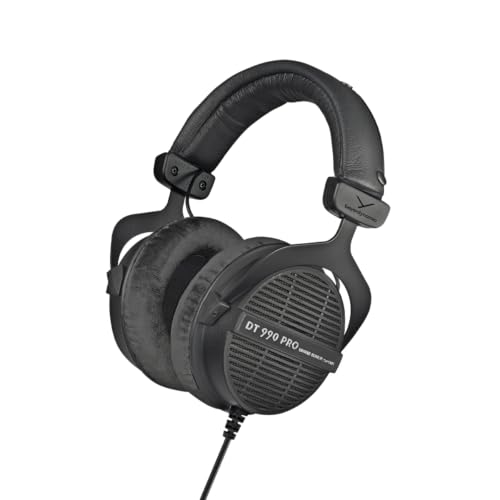
- Wide Open Sound: Open-back studio headphones for critical listening and professional editing deliver astoundingly precise audio clarity with a wide, natural soundstage.
- Ultimate comfort for extended sessions: Experience luxurious listening pleasure with these open-back studio headphones featuring soft, circumaural, and replaceable ear pads
The Limited Edition is essentially the same legendary headphone but with a few “quality of life” tweaks. The most notable difference is the move from a coiled cable to a straight cable and an all-black aesthetic. Some users find the coiled cable of the standard version to be too heavy or prone to tangling, so the straight cable version is a great alternative for those who sit further away from their interface. Internally, the drivers are identical, so you get the same world-class sound. If you prefer a modern, sleek look over the classic gray-and-black, this is the version to grab.
The Final Verdict: Are the beyerdynamic DT 990 Pro Studio Headphones Right for You?
The beyerdynamic DT 990 Pro Studio Headphones remain an industry standard for a reason. They offer a combination of spatial clarity, surgical detail, and long-session comfort that few headphones under $500 can match. While the 250-ohm impedance requires some extra equipment and the treble can be “energetic,” these are exactly the traits that make them a professional powerhouse. They don’t hide the truth of your audio; they put it under a microscope. Whether you are a producer looking to clean up a muddy mix, a gamer wanting to hear exactly where an opponent is stepping, or an audiophile who appreciates a wide soundstage, these headphones deliver.
In conclusion, if you have a decent audio interface and a quiet room to work in, there is no better investment for your ears in this price bracket. The build quality alone ensures these will be a part of your creative journey for years to come. Stop guessing what your audio sounds like and start hearing the truth. I highly recommend you grab a pair to elevate your studio workflow today and experience the “Beyerdynamic sound” for yourself.
Last update on 2026-10-16 / Affiliate links / Images from Amazon Product Advertising API