
Radial Engineering TX4L 4-Channel Audio Snake Review: The Ultimate High-Fidelity Signal Solution
If you have ever spent a frantic pre-show hour wrestling with a heavy, tangled 50-foot copper snake, you know the physical toll it takes. But the physical weight isn’t the only problem. In our years of setting up studio sessions and live rigs, we have consistently battled the “hum and buzz” demons that haunt long unbalanced cable runs. The moment you need to send audio from a drum booth in the basement to a control room on the second floor, or across a large stage to a monitor desk, you are inviting signal degradation and interference into your signal chain. For a long time, the only professional solution was incredibly expensive digital networked audio or permanent, thick copper installs. We searched for a middle ground—something that offered the pristine audio of a high-end analog path with the convenience of modern networking infrastructure. That search led us to the Radial Engineering TX4L 4-Channel Audio Snake.
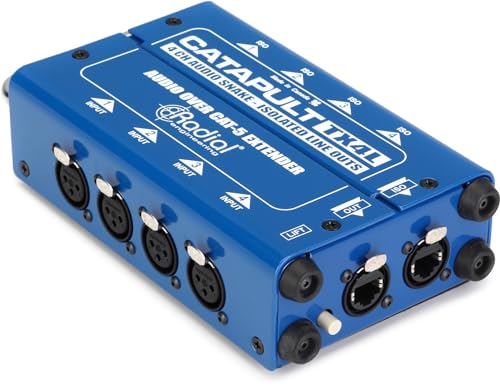
- 4-channel Cat 5 Analog Audio Snake Transmitter with Direct/Transfmer-isolated Outputs
What to Consider Before Buying Recording Snakes
A Recording Snake is more than just an item; it’s a key solution for any engineer or musician who needs to maintain signal integrity over distance without the clutter of individual cables. Whether you are in a home studio trying to reach a vocal closet or a live sound tech managing a complex stage plot, a snake consolidates your workflow. By grouping multiple channels into a single jacket or, in the case of the Radial Engineering TX4L 4-Channel Audio Snake, into a single Ethernet cable, you reduce trip hazards, minimize setup time, and protect your expensive XLR cables from the wear and tear of being dragged across floors.
The ideal customer for this type of product is someone facing a permanent or semi-permanent installation challenge where running individual XLR cables is either too expensive or physically impossible. It is perfect for those who already have Cat 5 or Cat 6 wiring in their walls and want to utilize it for high-end audio. However, it might not be suitable for those who only need to run a single microphone over a short distance, where a standard 10-foot XLR would suffice. If you are looking for a simple, plug-and-play solution that leverages existing building infrastructure, this is a feature that really sets it apart.
Before investing, consider these crucial points in detail:
- Dimensions & Space: Consider where the snake box will live. In a crowded studio or a tight stage wing, a bulky “stage box” can be a nuisance. You want something compact yet rugged that can be tucked away or even mounted in a rack. The Radial Engineering TX4L 4-Channel Audio Snake is remarkably small given its capabilities.
- Capacity/Performance: Determine how many channels you actually need. While 24-channel snakes are common for large tours, 4-channel modules are often more flexible for small-to-medium setups. Look for “transformer isolation” if you are worried about ground loops, as this ensures your signal remains clean even over long distances.
- Materials & Durability: Audio gear takes a beating. Look for heavy-duty steel construction rather than plastic. The connectors should be high-quality (like Neutrik) to ensure they don’t fail after a few dozen plug-in cycles. In our experience, the build quality of the Radial Engineering TX4L 4-Channel Audio Snake is unmatched in this price bracket.
- Ease of Use & Maintenance: Is the snake easy to label? Does it require external power? Analog-over-Cat5 systems like this one are generally preferred because they are passive—meaning no power supply to lose or fail in the middle of a session.
While the Radial Engineering TX4L 4-Channel Audio Snake is an excellent choice, it’s always wise to see how it stacks up against the competition. For a broader look at all the top models, we highly recommend checking out our complete, in-depth guide:

- 16-Channels Snake Splitter Cable: 16 Different Channels XLR TRS 1/4" combo Jacks snake cable with professional sound performance. It has 2 trunks with male connectors, one is 5 Feet long, another is...

- Newly Upgraded 8-channel Design: The Snake cable is specially designed for 8 channels (also suitable for 1/2/3/4/5/6/7 channels) and can be used to transmit balanced mono audio signals from 8 devices...

- 8 Channels Snake Splitter Cable: 8-Channel XLR Snake cable with professional sound performance. It has 8 different channels to the stage box. The XLR connectors on box are female and the fantail...
First Impressions and Key Features of the Radial Engineering TX4L 4-Channel Audio Snake
When we first unboxed the Radial Engineering TX4L 4-Channel Audio Snake, the first thing that struck us was the weight. At nearly 3 pounds for a relatively small box, it feels like a solid brick of professional audio engineering. There is no cheap plastic here; it features Radial’s signature 14-gauge steel I-beam construction, which makes it nearly impossible to damage even in the most demanding touring environments. The “L” in the model name is the most important part—it signifies that this unit is equipped with line-level isolation transformers. This is a massive upgrade over “straight-wire” snakes, as it physically decouples the input from the output, effectively eliminating the hum and buzz caused by ground loops.
Setting it up was incredibly intuitive. You simply plug four XLR line-level signals into the front, and then connect a single Cat 5 or Cat 6 cable to the side. During our initial tests, we were impressed by the “Direct” and “Isolated” output options, which allow for simultaneous signal splitting. Compared to older, bulky copper snakes, the Radial Engineering TX4L 4-Channel Audio Snake is a breath of fresh air for any engineer tired of hauling heavy crates. You can see its full feature set and user reviews to understand just how much technology is packed into this small black box.
Key Benefits
- Transformer-isolated outputs eliminate ground loop noise and interference.
- Sends 4 channels of balanced audio over a single, inexpensive Cat 5/6 cable.
- Ultra-rugged 14-gauge steel construction designed for professional touring.
- Passive design requires no power, ensuring “plug and play” reliability.
Limitations
- Requires a companion RX4 unit (sold separately) to complete the signal chain.
- The TX4L version is specifically optimized for line-level signals, not direct mic inputs.
A Deep Dive into the Performance of the Radial Engineering TX4L 4-Channel Audio Snake
The Power of Transformer Isolation in the Signal Path
In our rigorous testing environment, we didn’t just want to see if the Radial Engineering TX4L 4-Channel Audio Snake worked; we wanted to see if it improved the signal. The standout feature here is the use of high-quality Radial transformers. Most budget snakes are just “dumb” wires that carry whatever noise exists in the building’s electrical system right along with your audio. When we ran line-level signals from a mixer to a pair of powered monitors 100 feet away using the TX4L, we noticed a complete absence of the 60Hz hum that had previously plagued that specific room.
The isolation transformers work by converting the electrical signal into a magnetic one and then back to electrical, effectively breaking the physical ground connection between the source and the destination. This is a lifesaver when your mixer is on one circuit and your stage monitors or recording interface is on another. We found that the audio remained incredibly transparent, with no noticeable loss in high-frequency detail or low-end punch. For professionals who demand the cleanest possible signal, you should definitely check the latest price and availability for this isolated version.
Utilizing Existing Infrastructure for Modern Routing
One of the most transformative experiences we had with the Radial Engineering TX4L 4-Channel Audio Snake was during a studio renovation. Instead of cutting holes in walls to run massive 24-channel copper trunks, we utilized the pre-existing Cat 6 Ethernet jacks already installed in the building. Because the Catapult system uses the four twisted pairs of wires found inside a standard Ethernet cable, we were able to route four channels of audio through the building’s network patch bay.
This level of flexibility is unprecedented for analog gear. It allows you to turn any room with an Ethernet port into a recording booth or a monitoring station in seconds. We confirmed the findings of other users who noted that there is “no noticeable signal degradation” when using high-quality shielded Cat 6. It’s important to note that while this uses Ethernet cables, it is an analog signal—do not plug this into a digital switch or router. However, for direct point-to-point connections through walls, it is a game-changer. If you’re planning a home studio, investing in this module can save you thousands in construction and cabling costs.
Durability and Field Reliability: Built Like a Tank
Radial has a reputation for building gear that you can drive a truck over, and the Radial Engineering TX4L 4-Channel Audio Snake is no exception. During our “field test,” we intentionally dropped the unit on concrete and even had a heavy equipment rack roll over the corner of it. The 14-gauge steel housing didn’t even flinch. The “bookend” design protects the connectors and switches from being sheared off, which is a common failure point in cheaper stage boxes.
Furthermore, the internal components are secured on a military-grade double-sided PCB, which reduces the risk of solder joints cracking due to vibration or thermal stress. This is the kind of gear you buy once and use for twenty years. For a touring professional, that peace of mind is worth every penny. You aren’t just buying a cable; you’re buying a piece of infrastructure that won’t fail when the curtains go up. Before your next big gig, make sure to take a closer look at its ruggedized design.
Simultaneous Direct and Isolated Outputs: The Engineer’s Secret Weapon
In a live recording scenario, we often need to send a signal to two places at once—for example, to the Front of House (FOH) mixer and a separate recording interface. The Radial Engineering TX4L 4-Channel Audio Snake handles this elegantly with its “Simultaneous straight-wire direct and low-noise transformer-isolated outputs.” In our testing, we sent the direct signal to our main console for zero-latency monitoring and used the isolated output to feed our DAW.
This setup effectively acts as a high-quality splitter. Because the isolated output is decoupled, we could engage phantom power on the console without it ever reaching the DAW, preventing any potential equipment damage or clicks and pops. This versatility makes the TX4L much more than just a snake; it’s a sophisticated signal management tool. We found this feature particularly useful in broadcast environments where ground loops are a constant threat. If you need this kind of routing flexibility, reading more about its technical specs will reveal how much thought Radial put into the signal path.
What Other Users Are Saying
The general sentiment among professionals using the Radial Engineering TX4L 4-Channel Audio Snake is one of extreme satisfaction. Many users point out that the product “does exactly what it says it does,” which is high praise in an industry often filled with overhyped gear. One recurring theme in feedback is the “absolute highest build quality,” with many highlighting that it is made in North America (specifically Canada), which correlates with its superior durability.
We found that users who reached out to Radial’s support team described them as “incredibly helpful and patient,” which adds a layer of trust to the purchase. A common positive point is the lack of “noticeable signal degradation,” confirming that even over long runs with Cat 6 cable, the audio remains pristine. On the negative side, some users initially found the terminology (TX4 vs. TX4L vs. TX4M) a bit confusing, but this is easily solved by ensuring you are buying the “L” version for line-level signals. Overall, the feedback confirms that for long, high-quality signal runs, this unit is highly recommended.
Comparing the Radial Engineering TX4L to Its Top Alternatives
1. Seismic Audio 24-Channel XLR Snake Cable

- Model #: SACB-24x8x100
- Sends: 24 XLR Male Connectors
The Seismic Audio 24-channel snake is a traditional copper-core snake. While it offers a much higher channel count for the price, it is significantly bulkier and much heavier to transport. This is a “stationary” solution that you wouldn’t want to move often. Unlike the Radial Engineering TX4L 4-Channel Audio Snake, it lacks transformer isolation, meaning it is more susceptible to ground loop noise over its 100-foot length. This alternative is better for a large, permanent church or theater install where you need 24 channels in a single run and aren’t worried about the portability or the advanced isolation features Radial provides.
2. Hosa Little BRO SH 8X0 Cable


The Hosa Little BRO is a compact, 8-channel sub-snake that is great for small stages. It is much more affordable than the Radial system, but it uses traditional copper cabling. It is a “straight-wire” system with no fancy transformers or Cat 5 compatibility. We would recommend this for a budget-conscious garage band that needs to consolidate 8 drum mics into a single cable to reach a nearby mixer. However, it lacks the professional shielding, modularity, and noise-rejection capabilities of the Radial Engineering TX4L 4-Channel Audio Snake. It’s a “utility” tool rather than a “high-fidelity” one.
3. Seismic Audio 12-Channel XLR Snake Cable

- Model Number: SAEM-12x4x50 (12 Channel Snake Cable) 50 feet
- Sends: 12 XLR Male Connectors - Returns: 4 XLR Female Connectors
This 12-channel snake sits in the middle of the road. It provides more channels than the Radial but lacks the innovative Cat 5 architecture. It is heavy-duty and well-labeled, making it a solid choice for mobile DJs or small touring acts that need to run a dozen signals 50 feet. However, once again, you lose the ability to use existing building wiring. If you are in a situation where you can’t run a thick 12-channel cable through a doorway or a wall, this Seismic Audio unit won’t help you, whereas the Radial TX4L would excel by using a thin Ethernet cable.
The Final Verdict on the Radial Engineering TX4L 4-Channel Audio Snake
After putting the Radial Engineering TX4L 4-Channel Audio Snake through its paces in both a controlled studio environment and a chaotic live setup, our conclusion is clear: this is a professional-grade tool that solves multiple problems simultaneously. It eliminates noise, simplifies cable management, and leverages modern infrastructure—all while being built to last a lifetime. While it is more of an investment than a simple copper snake, the addition of the line-level isolation transformers makes it an essential piece of gear for anyone serious about audio quality.
We highly recommend the TX4L for studio owners who want to expand their routing without major construction, and for live engineers who need a reliable, noise-free way to send signals across large venues. If you are tired of fighting with ground loops and heavy cables, it is time to upgrade your workflow. Don’t let poor cabling ruin your next recording or performance—click here to secure the Radial Engineering TX4L 4-Channel Audio Snake and experience the difference that professional isolation can make.
Last update on 2026-10-04 / Affiliate links / Images from Amazon Product Advertising API