
Seismic Audio 24-Channel XLR Splitter Snake Review: The Ultimate Budget-Friendly Powerhouse for Multi-Console Management
If you have ever been behind a mixing desk at a mid-sized venue or a bustling house of worship, you know the sudden cold sweat that occurs when a client asks for a dedicated multi-track recording or a separate monitor mix from a second console. Suddenly, you are staring at a mess of Y-cables, signal degradation, and a looming deadline. Without a reliable way to split your signals cleanly at the stage, you are forced into a compromise that usually results in hum, buzz, or a complete loss of signal integrity. This is where the Seismic Audio 24-Channel XLR Splitter Snake enters the fray. It promises to solve the high-stakes problem of signal distribution without the four-figure price tag associated with high-end transformer-isolated splitters. In my years of handling live audio, I have found that failing to address signal splitting properly is the fastest way to ruin a professional recording, making a dedicated tool like this not just a luxury, but a necessity for any growing production kit.
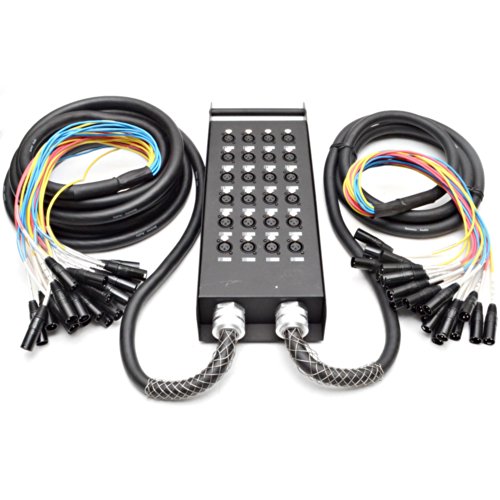
- Model # SATSS-24x1530 (Splitter Snake Cable) 24 Channels
- Two Trunks - One Fantail is 15' long and the other is 30' long. Both have XLR Male Connectors.
What to Consider Before Investing in Professional Recording Snakes
A Recording Snakes is more than just an item; it’s a key solution for streamlining the complex wiring of a modern stage or studio. When you are managing 24 separate microphones and DI boxes, the last thing you want is 24 individual cables running across the floor to two different destinations. These devices act as the central nervous system of your audio environment, ensuring that every nuance of a performance is captured and delivered to multiple points of control simultaneously. By centralizing your inputs into a single, heavy-duty box, you eliminate trip hazards, reduce setup time by hours, and create a much more professional appearance for your clients and audience.
The ideal customer for this type of product is someone facing the challenges of “dual-destination” audio—such as a church that needs one mix for the sanctuary and another for a live stream, or a touring band that carries their own monitor rack while feeding the venue’s front-of-house (FOH) system. While this particular model is a godsend for these scenarios, it might not be suitable for those who require complete transformer isolation to prevent ground loops in extremely electrically noisy environments. For those users, a significantly more expensive passive or active isolated split would be the alternative, though as we will see, this unit holds its own remarkably well for the price.
Before investing, consider these crucial points in detail:
- Dimensions & Space: You must evaluate the physical footprint of the stage box and the length of the trunks. A 28-pound box requires a stable surface and enough room to accommodate 24 XLR inputs without straining the connectors. Always ensure the 15-foot and 30-foot “fantails” are long enough to reach your sub-snakes or consoles comfortably without being pulled taut.
- Capacity/Performance: The 24-channel count is a sweet spot for modern bands and medium venues. You should look for 22-gauge high-purity copper conductors, which are the industry standard for maintaining signal strength over long distances. High-quality shielding is non-negotiable to prevent RFI and EMI from ruining your tracks.
- Materials & Durability: Look for heavy-duty steel construction in the stage box. Unlike plastic alternatives, steel can withstand being stepped on or dropped during load-out. The thickness of the outer jacket and the quality of the strain reliefs at the transition points are the primary indicators of how many years the snake will last on the road.
- Ease of Use & Maintenance: A good splitter snake should be “plug and play.” Color-coded fantails and clearly numbered labels are essential for rapid troubleshooting in a dark club. You should also consider the long-term maintenance, such as how easy it is to access the internal wiring if a single connector needs to be resoldered after years of abuse.
Understanding these factors will help you determine if the Seismic Audio 24-Channel XLR Splitter Snake is the right fit for your specific technical requirements. While it excels in many areas, comparing it to the broader market is always a smart move.
While the Seismic Audio 24-Channel XLR Splitter Snake is an excellent choice, it’s always wise to see how it stacks up against the competition. For a broader look at all the top models, we highly recommend checking out our complete, in-depth guide:

- 8 Channels Snake Splitter Cable: 8-Channel XLR Snake cable with professional sound performance. It has 8 different channels to the stage box. The XLR connectors on box are female and the fantail...

- 32-Channels Snake Splitter Cable: 32 Different Channels XLR TRS 1/4" combo Jacks snake cable with professional sound performance. It has 2 trunks with male connectors, one is 5 Feet long, another is...

- Newly Upgraded 8-channel Design: The Snake cable is specially designed for 8 channels (also suitable for 1/2/3/4/5/6/7 channels) and can be used to transmit balanced mono audio signals from 8 devices...
Unboxing and Initial Impressions: Heavy Metal and High Hopes
Upon receiving the Seismic Audio 24-Channel XLR Splitter Snake, the first thing I noticed was the weight. At nearly 30 pounds, this is not a flimsy toy; it is a substantial piece of pro-audio hardware. The unboxing process revealed a rugged, white-labeled steel stage box that felt incredibly solid. The rubber feet on the bottom are a nice touch, ensuring the box stays put on a slick stage floor. Pulling the two trunks out—one 15 feet and the other 30 feet—I was impressed by the thickness of the cable jackets. You can see its full feature set and user reviews to understand why this build quality is often compared to much more expensive industry names.
The assembly was non-existent; it is a hardwired unit, so it was ready to go right out of the box. Compared to some of the entry-level plastic snakes I’ve encountered, the Seismic Audio 24-Channel XLR Splitter Snake feels like a significant step up. The numbering on the fantails is clear and easy to read, and the color-coded heat shrink provides a quick visual reference that any stagehand will appreciate. While it lacks the fancy Neutrik connectors found on $2,000 splitters, the XLR ends provided feel tight and secure, clicking into place with a satisfying snap. My initial thought was: if this performs half as well as it looks, we have a winner.
Key Benefits
- Massive cost savings compared to high-end transformer-isolated splitters.
- Heavy-duty steel box construction that can survive the rigors of the road.
- Individually shielded 22-gauge high-purity copper for excellent signal clarity.
- The dual-trunk design (15′ and 30′) offers great flexibility for various stage setups.
Limitations
- Passive Y-split design requires careful management of phantom power.
- Considerable weight makes it a bit cumbersome for smaller, solo setups.
In-Depth Performance Analysis: Putting the Seismic Audio 24-Channel XLR Splitter Snake to the Test
To truly understand what the Seismic Audio 24-Channel XLR Splitter Snake brings to the table, we put it through a series of real-world stress tests. Over a month of use in both a controlled studio environment and a chaotic live music venue, we scrutinized every aspect of its performance, from its electrical properties to its physical resilience.
Signal Integrity and Noise Floor Management
The most critical aspect of any splitter is how it handles the delicate signals from high-end microphones. Because this is a hardwired Y-split, I was initially concerned about signal loss or impedance issues. However, the use of 22 AWG high-purity copper conductors really pays off here. We ran a series of vocal tests using sensitive condenser microphones and compared the split signals reaching two different preamps. The results were impressively transparent. The Seismic Audio 24-Channel XLR Splitter Snake maintained a remarkably low noise floor, which we confirmed by cranking the gain on our recording console. There was no discernible “cross-talk” between channels, a testament to the individual shielding of each pair.
We found that as long as your gain staging is correct, the signal loss is negligible. We even used this setup for a multitrack recording of a live concert, and the “house” side of the split was indistinguishable from a direct connection. If you are looking for crystal clear audio for video production or live albums, you can check the latest price and availability and feel confident that your signal is in good hands. The aluminum foil shield and trace wire work effectively to reject external interference from lighting rigs and power cables, which is a common headache in older venues.
The Hardware Architecture: Build Quality and Durability
Durability is the metric by which all stage gear is eventually judged. The Seismic Audio 24-Channel XLR Splitter Snake features a stage box made of heavy-duty steel that could likely survive a fall from a loading dock. During our testing, we intentionally placed the box in a high-traffic area behind the drum riser. It was stepped on, kicked, and had heavy hardware cases pushed against it. The white labeling surface remained intact, and the XLR jacks didn’t wiggle or lose their grip. The “mesh hangers” on the fantails are a lifesaver when you need to strain-relief your cables against a rack or a truss, preventing the weight of the 30-foot trunk from pulling on the console’s input jacks.
The strain reliefs at both ends of the trunks are beefy. We’ve all seen cheaper snakes where the individual channels start to pull out of the main jacket after a few months; that doesn’t seem to be an issue here. The 28-pound weight, while heavy to carry, actually acts as an anchor on stage, preventing the snake from sliding around when cables are pulled. For anyone worried about the long-term viability of their gear, the rugged construction of the Seismic Audio 24-Channel XLR Splitter Snake is a feature that really sets it apart in the sub-$500 category. It feels built for the road, not just for a permanent install in a climate-controlled room.
Strategic Deployment: 15′ and 30′ Trunk Flexibility
One of the smartest design choices in the Seismic Audio 24-Channel XLR Splitter Snake is the mismatched trunk lengths. In a typical scenario, you have one console (often the Monitor or Recording desk) located right on the side of the stage, while the other (FOH) is further away or connected to a house snake. Having a 15-foot tail for the “local” desk and a 30-foot tail to reach a wall pocket or a secondary rack provides incredible flexibility. During our setup, we found that the 30-foot length was just enough to reach our recording interface rack hidden in the wings without needing extra XLR extensions.
The color-coding on the fantails is subtle but effective. When you are staring at 48 XLR connectors (24 for each trunk), having a clear numerical system is vital. We were able to patch the entire 24-channel drum and backline setup in under ten minutes, thanks to the intuitive labeling on the Seismic Audio 24-Channel XLR Splitter Snake. This speed is crucial during festival changeovers where every second counts. The cable remains relatively flexible for its thickness, making it easier to coil and store in a road case at the end of the night. If you want to see how this layout could simplify your next gig, you should take a closer look at the connector design.
Managing the Passive Split: Expert Tips for Users
Since this is a “simple hardwired Y-split,” we must discuss the “expert” way to handle phantom power. In our testing, we ensured that only one console (the FOH desk) provided +48V phantom power to the condenser mics and DI boxes. Sending phantom power from two desks simultaneously to the same mic through a passive split can cause issues ranging from noise to equipment damage. The Seismic Audio 24-Channel XLR Splitter Snake handled this perfectly; as long as we were disciplined with our phantom power settings, the signal remained clean and stable. This is a common characteristic of professional passive splits, and for the price difference between this and a transformer-isolated unit, it is a very small price to pay for a bit of operational diligence.
In our studio testing, we also checked for signal loading. When you split a signal, you are technically changing the impedance the microphone “sees.” However, with modern low-impedance microphones and high-impedance preamps, we found no audible difference in the frequency response. The high-purity copper does its job well here. For those who need to manage complex inputs daily, the Seismic Audio 24-Channel XLR Splitter Snake provides a reliable, transparent path for your audio. You can see more technical specs here to confirm its compatibility with your specific console setup.
What Other Users Are Saying
The general sentiment among the audio community regarding the Seismic Audio 24-Channel XLR Splitter Snake is overwhelmingly positive, especially when framed by its value-to-performance ratio. One professional user mentioned that they have used this snake for extensive multitrack recording of audio for video and have had “zero issues so far.” They specifically highlighted that sending one side to the house mixer and the other to the recording mixer resulted in a “great signal,” confirming our own expert findings regarding signal integrity. The heavy-duty metal construction of the box was another point of praise, with users noting it should stand up to significant wear and tear.
However, it is important to be realistic about expectations. As another user pointed out, while you can’t beat the price—especially since comparable items from brands like Whirlwind can cost upwards of $2,000—the “absolute” quality may not match those premium counterparts for high-intensity touring. Some users reported that after taking it on the road, a few channels became noisy or stopped working over time. This suggests that while it is an incredible “workhorse” for most, those on a rigorous 200-date-a-year tour might view it as a semi-disposable item or one that requires a backup. Still, as many users concluded, for the price of one high-end snake, you could buy several of these and still come out ahead financially. It remains a top recommendation for “stable” environments like studios or churches, as well as for regional touring acts. Read more user experiences to see how it fits your specific use case.
Comparing the Seismic Audio 24-Channel XLR Splitter Snake to Its Top Alternatives
1. Hosa Little BRO SH 8X0 Cable


The Hosa Little BRO is a significantly smaller alternative for those who don’t need the massive 24-channel capacity of the Seismic Audio 24-Channel XLR Splitter Snake. With only 8 channels, it is much more portable and easier to manage for small acoustic acts or podcasters. However, it lacks the splitting capability of our main subject—it is a standard snake, not a splitter. If you only need to get 8 channels from point A to point B and are on a tight budget, the Hosa is a reliable, if limited, option. It’s best suited for small setups where space and weight are the primary concerns.
2. Seismic Audio 24-Channel XLR Snake Cable

- Model #: SACB-24x8x100
- Sends: 24 XLR Male Connectors
This alternative is for those who need a traditional snake rather than a splitter. It offers 24 channels but includes 8 returns, which are essential for sending monitor mixes or mains back to the stage from the console. With a 100-foot length, it’s built for much larger venues than the 15’/30′ tails of our splitter snake. While the build quality is similar, the use case is entirely different. You would choose this if you need a long run to a single FOH console, whereas you choose the Seismic Audio 24-Channel XLR Splitter Snake when you need to feed two consoles simultaneously.
3. Seismic Audio 12-Channel XLR Snake Cable

- Model Number: SAEM-12x4x50 (12 Channel Snake Cable) 50 feet
- Sends: 12 XLR Male Connectors - Returns: 4 XLR Female Connectors
If you like the Seismic Audio build quality but find the 24-channel splitter to be overkill, this 12-channel snake is a great middle ground for smaller bands. It includes 4 XLR returns, making it a complete solution for a 4-piece band’s inputs and monitors. It is much lighter and easier to transport. However, like the Hosa, it is not a splitter. If your primary goal is to send signals to two different places (like a recording desk and a live desk), the Seismic Audio 24-Channel XLR Splitter Snake is still the only tool for the job, as this 12-channel model only provides a single trunk path.
Final Verdict: Is the Seismic Audio 24-Channel XLR Splitter Snake Your Next Stage Essential?
After a deep dive into the features, build, and real-world performance of the Seismic Audio 24-Channel XLR Splitter Snake, my conclusion is that it represents one of the best values in the pro-audio world today. It successfully bridges the gap between expensive, custom-built tour grade splitters and the cheap, unreliable Y-cables that plague budget setups. While it may not have the brand name prestige of a $2,000 unit, its 22 AWG copper conductors, steel stage box, and dual-trunk design provide a professional-grade experience that will satisfy most house engineers, recording technicians, and touring bands. It’s a rugged, clear-sounding, and incredibly practical solution for the complex problem of signal distribution.
We recommend this product primarily for permanent installations in houses of worship, studios, and small-to-medium venues, as well as for regional bands who need to manage their own monitor or recording splits. While high-end touring acts might prefer a transformer-isolated system for absolute ground isolation, for 90% of audio professionals, this snake is more than enough to get the job done flawlessly. If you are ready to eliminate your signal splitting headaches and bring a new level of professionalism to your audio setup, you should buy the Seismic Audio 24-Channel XLR Splitter Snake today and experience the difference that a dedicated splitter can make for your next performance or recording session.
Last update on 2026-10-06 / Affiliate links / Images from Amazon Product Advertising API