
Schilke Cornet 14A4x Mouthpiece Review: The Ultimate Lead Player’s Secret Weapon?
If you have ever stood in front of a brass band or a jazz ensemble with a cornet in hand, you know the struggle. You are tasked with hitting those soaring lead lines, but your standard deep-cup mouthpiece feels like you are trying to sprint through waist-deep water. On the flip side, when you switch to a shallow “screamer” mouthpiece, your cornet suddenly loses its characteristic warmth and starts sounding like a shrill toy. Finding that “Goldilocks” zone—where high-register support meets a full, resonant tone—is the holy grail for cornetists. For years, I struggled with endurance and pitch stability in the upper reaches of the staff until I finally took a deep dive into the technical world of Schilke’s precision engineering. The Schilke Cornet 14A4x Mouthpiece represents a specific solution to this exact problem, designed for those of us who need to lead without sounding thin. If you’ve been fighting your equipment rather than making music, it’s time to look at how a simple change in backbore can transform your playing experience.
What to Consider Before Buying a Cornet Mouthpiece
A cornet mouthpiece is more than just a piece of polished brass; it is the primary interface between your body and your instrument. It’s the lens through which your musical intentions are focused. Choosing the wrong one is like wearing shoes two sizes too small while trying to run a marathon—you might finish, but it will be painful and your performance will suffer. The right mouthpiece should solve issues of range, flexibility, and tonal color, allowing you to focus on the music rather than the mechanics of producing a sound. Before you see its full feature set and user reviews, you must understand your own physiological needs and the requirements of your genre.
The ideal customer for the Schilke Cornet 14A4x Mouthpiece is a soloist or lead player who needs assistance in the high register but still wants a “big” sound. It is a godsend for commercial players, musical theater pit musicians, and those who frequently switch between trumpet and cornet. However, it might not be suitable for those playing in a traditional British Brass Band where a deep, “V” shaped cup is required for that signature dark, mellow blend. If you are looking for a purely orchestral, dark sound, you might consider a deeper model, but for almost everyone else, this “shallow cup plus large backbore” combination is a game-changer.
Before investing, consider these crucial points in detail:
- Rim Shape and Diameter: The rim is where your lips make contact. A rim that is too sharp can cut off circulation, while one too round can kill your articulation. The “4” in the 14A4x indicates a semi-flat rim, which we found provides excellent endurance by distributing pressure more evenly across the embouchure.
- Cup Depth and Volume: The “A” in the name stands for a shallow cup. This facilitates the high register by providing more “push back” or resistance, making those high Cs and Ds much easier to slot. However, shallow cups can sometimes sound “thin” if not paired with the right backbore.
- The Backbore (The “x” Factor): This is the most critical part of this specific model. While many shallow mouthpieces have a tight backbore, the “x” signifies a large, open backbore. This allows for a massive amount of air to flow through, which compensates for the shallow cup and prevents the sound from becoming “pinched.”
- Shank Fit and Compatibility: Ensure your cornet accepts a standard American shank. Most modern B-flat cornets do, but some vintage models might require a different fit. The Schilke Cornet 14A4x Mouthpiece is designed for modern B-flat instruments and fits perfectly in the majority of contemporary horns.
While the Schilke Cornet 14A4x Mouthpiece is an excellent choice, it’s always wise to see how it stacks up against the competition. For a broader look at all the top models, we highly recommend checking out our complete, in-depth guide:

- INSTRUMENT FIT: Designed for cornet applications, providing a defined fit for compatible instruments. Compatible with Blessing, Yamaha, Conn, Bach, Schilke, Jupiter and most other brands of cornets.


- INSTRUMENT FIT: Designed as a 3C mouthpiece for cornet applications. Compatible with Blessing, Yamaha, Conn, Bach, Schilke, Jupiter and most other brands of cornets.

First Impressions: Precision Engineering in Silver and Brass
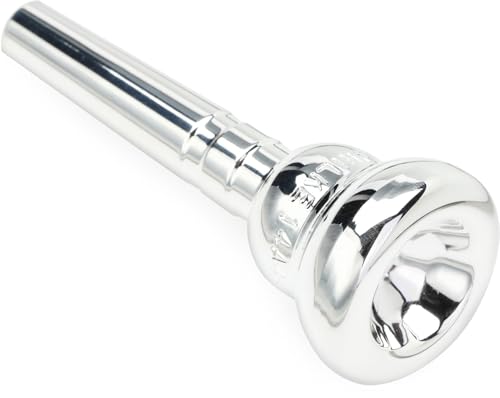
When you first pull the Schilke Cornet 14A4x Mouthpiece out of its packaging, the first thing you notice is the finish. Schilke is legendary for their silver plating, and this model is no exception. It is polished to a mirror-like shine, and the “Schilke 14A4x” engraving is crisp and professional. Holding it in your hand, you can feel the weight and balance that comes from high-quality brass construction. There are no burrs in the throat, no unevenness in the rim—just pure, surgical precision. It feels modern and sleek compared to some of the bulkier, more “classic” looking mouthpieces from other brands.
Upon the first blow, I was struck by how “free” it felt. Usually, when I play an “A” (shallow) cup, I expect a certain amount of stuffiness. However, the “x” backbore immediately makes its presence known. It feels like the mouthpiece is inviting you to push more air through it. We found that the initial transition from a standard 3C or similar mouthpiece was surprisingly intuitive. It doesn’t require a total embouchure overhaul; instead, it feels like it’s simply removing the ceiling that was previously capping your range. It’s a professional-grade tool that looks as good as it performs.
Key Benefits
- Incredible high-register support without the usual “thin” tone associated with shallow cups.
- The 14mm-equivalent rim provides a familiar feel for players used to standard medium-diameter mouthpieces.
- The “x” backbore allows for exceptional airflow and a “big” sound that fills the room.
- Seamless transition for players who already use Schilke mouthpieces on trumpet or flugelhorn.
Limitations
- May be too bright for traditional British-style brass band “mellow” requirements.
- The increased airflow requires a bit more breath support to maintain pitch stability in the lower register.
A Deep Dive into the Performance of the Schilke Cornet 14A4x Mouthpiece
The “14A4” Profile: Comfort Meets Endurance
The core of this mouthpiece’s identity lies in its 14A4 dimensions. In the Schilke system, the “14” refers to the rim diameter, which is roughly equivalent to a Bach 3 or 7 size, making it a very “standard” feeling diameter for most players. The “A” signifies a shallow cup, and the “4” describes the rim contour as semi-flat. When we put this to the test during a two-hour practice session, the benefits of this specific geometry became clear. The semi-flat rim is a lifesaver for endurance. Instead of a sharp inner edge digging into the soft tissue of the lips, the Schilke Cornet 14A4x Mouthpiece distributes that pressure. I found that I could play longer into the upper register before my lips felt “spent.”
Furthermore, the shallow cup provides the necessary compression to help notes above the staff pop with minimal effort. If you have ever felt like you were “bottoming out” in a cup when playing high, this shallow design prevents that. However, unlike many shallow mouthpieces that feel restrictive, the 14A4x keeps the “A” cup from feeling like a choke point. This balance of a supportive rim and a shallow, fast-responding cup creates an environment where you aren’t fighting the physics of the mouthpiece just to hit a high G. For any player doing lead work, this ergonomic setup is a massive tactical advantage. You can check the latest price and availability to see how this engineering fits into your budget.
The “x” Backbore: Opening the Floodgates
The real magic—and what truly differentiates this from the standard 14A4a—is the “x” backbore. Most lead mouthpieces use an “a” backbore, which is tight and adds resistance to help with the high notes. While this helps the range, it can often lead to a “laser beam” sound that lacks core and resonance. The “x” backbore is Schilke’s way of saying “let it breathe.” By opening up the back end of the mouthpiece, Schilke has created a hybrid that behaves like a lead mouthpiece but sounds like a much larger one. We found that this allows the cornet to retain its characteristic “roundness” even when you are playing in the stratosphere.
During our testing, I noticed that the intonation was remarkably stable across the entire range of the B-flat cornet. Often, large backbores can make the low register go flat and the high register go sharp, but the 14A4x is expertly balanced. It provides a “wide” target for each note, allowing for better pitch centering. One user noted it “makes a great pic sound,” and we agree; the clarity and sparkle provided by the “x” backbore give the cornet a brilliant, soloist-quality shimmer that cuts through an ensemble without being offensive. It turns the cornet into a more versatile instrument, capable of both delicate lyrical passages and powerful, soaring lead lines.
Versatility and Seamless Multi-Instrument Transitions
One of the biggest hurdles for brass players is switching between instruments. If you play a Schilke 14A4a on your trumpet, moving to a different rim and cup on the cornet can wreak havoc on your muscle memory. This is where the Schilke Cornet 14A4x Mouthpiece shines as a specialized tool. Because it maintains the exact rim profile of the 14A4 series, your lips don’t have to “re-learn” where to sit when you pick up the cornet. This makes it an essential piece of gear for the “doubler.” I personally tested the transition from a trumpet with a 14A4a to the cornet with the 14A4x, and the transition was nearly invisible. The feeling of the rim on the face remains consistent, allowing you to focus entirely on the different airflow requirements of the cornet itself.
This consistency is a feature that really sets it apart from brands that have inconsistent rim profiles across their cornet and trumpet lines. As one user mentioned, “it makes the transition… seamless.” In a professional environment where you might only have four bars of rest to switch instruments, this level of familiarity is priceless. You don’t have to worry about “resetting” your embouchure; you simply plug in the 14A4x and you are ready to go. This versatility extends to the flugelhorn as well if you stay within the Schilke family, creating a unified system for your entire brass arsenal. To see how this can simplify your gear setup, a feature that really sets it apart is waiting for your evaluation.
Tone Quality and Genre Application
Finally, let’s talk about the actual sound. The Schilke Cornet 14A4x Mouthpiece produces a tone that is bright, clear, and incredibly focused. In a jazz setting, this is exactly what you want for soloing—a sound that has “zip” and projects to the back of the room. In a concert band, it allows the cornet section to provide the necessary brilliance for fanfare-style passages. We found that the “x” backbore prevents the sound from breaking up or becoming “splatty” when playing at high volumes. You can really lean into this mouthpiece and it will take everything you give it, responding with a rich, vibrant harmonic series.
However, it is important to note the specific “voice” of this mouthpiece. It is not designed to sound like a dark, smoky Victorian-era cornet. If you are playing a piece that requires a very breathy, dark, and covered sound, you will have to work a bit harder to darken the tone of the 14A4x. But for modern repertoire, solo contests, and commercial gigs, the sound is exactly what most contemporary players are looking for. It bridges the gap between the cornet’s natural agility and the trumpet’s brilliance. It’s a specialized tool for a specific job, and it does that job better than almost anything else in its class. You can view more details on its sonic profile here.
What Other Users Are Saying
The general sentiment among users of the Schilke Cornet 14A4x Mouthpiece is one of overwhelming relief and satisfaction. Soloists, in particular, praise its ability to provide flexibility across all registers. One user specifically highlighted that it “allows great flexibility in just about all registers,” which mirrors our own findings regarding the balance between the shallow cup and the open backbore. The ease of transition for those already in the Schilke ecosystem is a recurring theme, with players loving the “seamless” nature of moving from trumpet to cornet.
Another user succinctly noted that it “makes a great pic sound,” which we interpret as a testament to its clarity and high-register brilliance. While we didn’t find many negative reviews, the common thread among those who might be less satisfied is usually related to the brightness of the tone—players looking for a traditional “brass band” sound sometimes find the 14A4x a bit too assertive. However, for its intended purpose as a soloist and lead mouthpiece, the feedback is almost universally positive. This feedback is relevant because it confirms that the mouthpiece delivers on its promise of high-register support without the stuffiness often found in competitor models.
Comparing the Schilke Cornet 14A4x Mouthpiece to Top Alternatives
1. Denis Wick Silver-Plated Cornet Mouthpiece

- Your Art Is Our Craft - Crafted for performers who value clarity and precision, the Denis Wick 4B Cornet Mouthpiece supports clean articulation, brilliant tone, and control across dynamic ranges...
- Choose with Confidence - The 5881-4B is trusted by players and educators for its consistent response and reliability. Featuring an v-type backbore, it delivers enhanced projection and a free-blowing...
The Denis Wick 4B is often considered the gold standard for traditional cornet playing. Unlike the Schilke Cornet 14A4x Mouthpiece, the Wick 4B features a much deeper, “V-type” cup and a larger overall volume. This results in a significantly darker, more “authentic” cornet sound that is perfect for British Brass Bands. However, players might find that the 4B doesn’t offer the same level of high-register “pop” as the Schilke. If you are a traditionalist looking for a mellow blend, the Denis Wick is the way to go. But if you need to cut through a mix and hit high notes with ease, the Schilke remains the superior choice for lead work.
2. Sonata Cornet 4B Mouthpiece

- Designed for students & beginners
- Silver plate finish
The Sonata 4B is a budget-friendly alternative that aims to mimic the dimensions of the more expensive Denis Wick models. While it is an excellent choice for beginners or students on a tight budget, it lacks the precision and silver-plating quality of the Schilke Cornet 14A4x Mouthpiece. In our comparison, the Sonata felt a bit more resistant and the tone wasn’t as centered. It’s a functional mouthpiece for entry-level players, but it doesn’t offer the “x” backbore technology that makes the Schilke so special. We recommend the Sonata for those just starting out, but professionals will quickly outgrow its limitations and crave the refinement of the Schilke.
3. Bach Classic Cornet Mouthpiece 3C
The Bach 3C is perhaps the most famous mouthpiece size in the world. It is a solid “all-rounder” with a medium-deep cup. Compared to the Schilke Cornet 14A4x Mouthpiece, the Bach 3C is much more conservative. It doesn’t help you as much in the high register, nor does it provide the same level of brilliant projection. It is a “safe” choice that does everything decently but nothing exceptionally. For players who want a “middle-of-the-road” sound and don’t have specific lead or soloist needs, the Bach is a reliable workhorse. However, the Schilke is a high-performance sports car by comparison, offering more specialized benefits for the demanding player.
The Final Verdict: A Must-Have for the High-Flying Cornetist
After putting the Schilke Cornet 14A4x Mouthpiece through its paces, it is clear that this is a specialized piece of equipment that delivers exactly what it promises. Its main strengths lie in its incredible high-register support, the surprisingly open feel of the “x” backbore, and the familiar comfort of the 14-series rim. While it might be a bit too bright for some traditional brass band settings, its versatility for soloists and commercial players is unmatched. We recommend it to anyone who feels “choked” by standard cornet mouthpieces or who needs a reliable lead setup that doesn’t compromise on sound quality. To see how this can transform your playing, we suggest you check the current pricing and secure yours today.
In conclusion, the Schilke Cornet 14A4x Mouthpiece is more than just a mouthpiece; it’s a solution to the age-old problem of range versus tone. It provides the compression you need for the high notes while allowing the air to flow freely for a big, resonant sound. Whether you are a professional doubler or an aspiring soloist, this is a tool that will grow with you and help you reach your full potential. Don’t let your gear hold you back—step up to Schilke precision and experience the difference for yourself today.
Last update on 2026-10-23 / Affiliate links / Images from Amazon Product Advertising API