
PreSonus Revelator io44 USB-C Audio Interface with Mixer & Effects Review: The Ultimate Pocket-Sized Powerhouse for Streamers and Musicians
I remember the days when setting up a professional-sounding live stream or a high-quality vocal recording meant an expensive, sprawling desk cluttered with mixers, outboard compressors, and a tangled web of XLR cables. For many of us, the dream is to produce “pro-level” content without needing a degree in sound engineering or a dedicated room for gear. We’ve all been there: you’re trying to balance game audio, your voice, and maybe some background music, only to find your computer lagging or your audio levels clipping into a distorted mess. This frustration is exactly why the market for compact interfaces has exploded. If you don’t solve these audio routing and processing issues, your content suffers, your audience leaves, and your creativity gets buried under technical hurdles. That is where the PreSonus Revelator io44 USB-C Audio Interface with Mixer & Effects enters the frame, promising to condense a full studio rack into a device that fits in the palm of your hand.

- Ultra-compact: Versatile USB-C audio interface for recording, music production, and streaming with professional sound quality
- Professional sound made easy: Professionally crafted Presets make you sound like a pro with a single click. You can also create your own custom presets to share, save, or produce on the go.

What to Consider Before Buying a Computer Recording Audio Interface
A Computer Recording Audio Interface is more than just an item; it’s a key solution for bridging the gap between your physical performance and the digital world. Whether you are a guitarist tracking a new riff or a streamer engaging with a live audience, the interface acts as the “brain” of your audio chain. It converts analog signals to digital data that your computer can understand, and just as importantly, it handles the monitoring so you can hear yourself without distracting delays. Without a dedicated interface, you are stuck with the noisy, low-quality sound cards built into most laptops, which simply can’t handle professional-grade microphones or high-impedance instruments.
The ideal customer for this type of product is someone facing the limitations of basic “plug-and-play” USB microphones or entry-level interfaces that lack internal processing. It is perfect for the mobile musician, the bedroom podcaster, or the professional streamer who needs loopback capabilities. However, it might not be suitable for those who need to record a full drum kit or a live band simultaneously, as the channel count is purposefully kept lean for portability. For those users, a larger rack-mounted unit would be a better alternative.
Before investing, consider these crucial points in detail:
- Dimensions & Space: In a modern home studio, desk real estate is at a premium. You want a device that offers a small footprint without sacrificing stability. A compact interface is great for travel, but it must be heavy enough—or have enough grip—that the weight of your cables doesn’t pull it off the desk.
- Capacity & Performance: Look for the maximum sample rate and bit depth. While 44.1 kHz is standard, having the headroom for 96 kHz ensures your recordings are future-proof. Additionally, check the gain range of the preamps; you need enough “clean” gain to power hungry dynamic microphones like the Shure SM7B without introducing hiss.
- Materials & Durability: Since interfaces are often the centerpiece of a setup, they need to withstand daily use. Metal chassis are preferred over plastic for both durability and shielding against electromagnetic interference. The quality of the knobs (potentiometers) is also vital for precise level setting.
- Ease of Use & Maintenance: Software integration is often where interfaces succeed or fail. A good interface should have stable drivers and an intuitive control panel. Consider whether the device requires external power or can run off bus power, which is essential for recording on the go with a laptop or tablet.
While the PreSonus Revelator io44 USB-C Audio Interface with Mixer & Effects is an excellent choice, it’s always wise to see how it stacks up against the competition. For a broader look at all the top models, we highly recommend checking out our complete, in-depth guide:

- Pro performance with great pre-amps - Achieve a brighter recording thanks to the high performing mic pre-amps of the Scarlett 3rd Gen. A switchable Air mode will add extra clarity to your acoustic...

- The new generation of the songwriter's interface: Plug in your mic and guitar and let Scarlett Solo 4th Gen bring big studio sound to wherever you make music

- The new generation of the artist's interface: Connect your mic to Scarlett's 4th Gen mic pres. Plug in your guitar. Fire up the included software. Start making your first big hit
First Impressions: The PreSonus Revelator io44 USB-C Audio Interface with Mixer & Effects Under the Microscope
When I first pulled the PreSonus Revelator io44 USB-C Audio Interface with Mixer & Effects out of its packaging, I was genuinely surprised by its stature. It is incredibly small—small enough to slide into a coat pocket—yet it feels surprisingly dense and well-constructed. The metal chassis gives it a professional heft that belies its size. Setting it up was a breeze; I simply connected it via the included USB-C cable, and my Mac recognized it instantly. However, the real magic happens once you install the Universal Control software, which unlocks the onboard DSP (Digital Signal Processing).
Compared to other entry-level units I’ve tested, the inclusion of a high-resolution onboard display is a total game-changer. It provides immediate visual feedback for your input and output levels, which means you spend less time squinting at your computer screen and more time focused on your performance. You can see its full feature set and user reviews to understand why this compact design is disrupting the market. It feels like a premium piece of kit that has been shrunk down, rather than a “budget” version of a larger interface.
Key Benefits
- Powerful onboard DSP allows for “Fat Channel” processing (EQ, Compression, Limiter) without taxing your computer’s CPU.
- Built-in 7-channel mixer with loopback audio makes it incredibly easy to blend game audio, Discord, and music for streaming.
- Professional XMAX-L mic preamp provides 50 dB of clean gain and supports +48V phantom power for condenser mics.
- Highly portable, bus-powered design that works seamlessly with macOS, Windows, iOS, and Android.
Limitations
- The software control panel (Universal Control) has a slight learning curve for absolute beginners.
- Physical knobs and buttons are plastic, which some users might find less premium than the metal chassis.
A Deep Dive into the Performance of the PreSonus Revelator io44 USB-C Audio Interface with Mixer & Effects
Studio-Quality Processing Without the Latency
One of the most significant advantages we found when testing the PreSonus Revelator io44 USB-C Audio Interface with Mixer & Effects is the integrated “Fat Channel” processing. If you have ever tried to run a bunch of VST plugins (like reverb or EQ) while recording, you know the pain of “latency”—that distracting delay between when you speak and when you hear yourself in your headphones. Because this interface has its own internal processor, you can apply professional-grade compression, EQ, and even fun voice effects (like robots or aliens) directly on the hardware. This means the sound is processed before it even hits your computer, resulting in zero-latency monitoring.
During my vocal tests, I was able to dial in a broadcast-ready tone using the built-in presets. I found that the compressor was particularly transparent, helping to level out my voice during excited moments in a stream without sounding “squashed.” We confirmed this through various user experiences as well; many have noted that they were able to ditch their complicated software chains in favor of the io44’s internal presets. To get the most out of your vocal takes, you should definitely check the latest price and availability for this unit, as the value of the included software and DSP alone is worth the entry fee.
The Streamer’s Secret Weapon: The Loopback Mixer
In the world of streaming, “loopback” is a term that essentially means taking the audio coming out of your computer and routing it back into your stream as an input. Most standard interfaces require complex third-party software like Voicemeeter to do this. However, we were impressed by how the PreSonus Revelator io44 USB-C Audio Interface with Mixer & Effects handles this natively. It provides two dedicated stereo loopback channels. This allowed me to have my game audio on one channel and my Spotify or Discord audio on another, mixing them all independently within the PreSonus Universal Control app.
This level of control is typically reserved for much larger, more expensive mixers like the GoXLR. The fact that you can achieve a professional “broadcast” mix on a device this size is revolutionary. We found that the ability to create custom mixes for your headphones that are different from what your audience hears is a feature that really sets it apart from competitors like the Focusrite Scarlett Solo. Whether you are a musician performing live on TikTok or a gamer on Twitch, this routing flexibility is the interface’s standout “killer feature.”
Input Versatility and the XMAX-L Preamp
Despite its small size, the PreSonus Revelator io44 USB-C Audio Interface with Mixer & Effects does not skimp on connectivity. It features a combo XLR/TRS input for your main microphone or instrument, a 3.5mm line input for things like a DJ mixer or a smartphone, and even a 3.5mm headset jack (perfect for those who prefer using gaming headsets with built-in mics). We tested the XMAX-L preamp with a variety of microphones, and the results were consistently clean. With 50 dB of gain, it had enough juice to power most of our dynamic mics without the need for an external lifter, though very quiet mics might still benefit from one.
The addition of the 3.5mm stereo line in is a stroke of genius for mobile creators. I used it to plug in a synthesizer and record directly into my iPad Pro, and the signal was crystal clear. The interface is “Class Compliant,” meaning I didn’t need to install any drivers to get it working with my mobile devices. For anyone looking for a rugged, reliable mobile recording rig, we recommend you explore the full connectivity options. The balanced main outputs also allowed me to connect my studio monitors directly, making this a fully functional hub for a home studio.
Software Integration and the Studio One Bundle
A hardware review of a PreSonus product would be incomplete without mentioning the software ecosystem. The PreSonus Revelator io44 USB-C Audio Interface with Mixer & Effects comes bundled with Studio One Artist and the Studio Magic software suite. This isn’t just “filler” software; Studio One is one of the most powerful DAWs (Digital Audio Workstations) on the market today. I found the integration between the interface and the DAW to be seamless, with the interface’s internal mixer showing up directly within my recording environment.
While some users have mentioned a learning curve with the “Universal Control” application, I found that once you understand the signal flow—visualizing how the audio moves from the physical inputs through the DSP and into the loopback channels—it becomes second nature. The ability to save your favorite vocal presets directly to the hardware is a massive time-saver. You can see how other pros are utilizing this software bundle to jumpstart their production. It’s a comprehensive package that takes you from “unboxing” to “finished master” without needing to buy extra plugins.
What Other Users Are Saying
The general sentiment surrounding the PreSonus Revelator io44 USB-C Audio Interface with Mixer & Effects is overwhelmingly positive, especially among the streaming community. Many users have described it as a “fantastic upgrade” for those moving on from basic entry-level interfaces. One user mentioned that the unit is “frankly perfect” for their setup, noting its versatility compared to more expensive streaming-specific hardware. Another satisfied customer highlighted the professional quality of the preamps, stating that the audio quality was a significant step up from their previous budget interfaces.
However, no product is without its critiques. A few users pointed out that the physical knobs and buttons feel a bit “plastic-y,” which contrasts with the solid metal feel of the main chassis. We also saw some feedback regarding the software registration process, with one user expressing frustration over the initial setup on the official website. Additionally, one reviewer mentioned that while the interface is powerful, the learning curve for the loopback and routing software might be intimidating for those who are not technically inclined. Despite these minor gripes, the consensus is that the value-to-performance ratio is “disarming” and hard to beat in this price bracket.
How the PreSonus Revelator io44 USB-C Audio Interface with Mixer & Effects Compares to the Competition
When choosing an interface, it’s vital to see how it stands against other industry leaders. Here is how the io44 compares to three popular alternatives.
1. Audient iD4 MKII Audio Interface

- The new successor: Due to the great success of the Audient iD4, the audio experts had the project to bring the successor iD4 MKII to the next outstanding sonic level.
- Harmonious overall package: Thanks to new transducer technology and Class-A microphone preamplifier from Audient's high-end ASP8024 HE console, home recording is taken to the next level.
The Audient iD4 MKII is often cited as the gold standard for pure audio fidelity in a small format. It features a Class A console mic preamp that many find slightly warmer and more “musical” than the XMAX-L in the PreSonus. If your primary goal is recording acoustic instruments or high-end vocals in a traditional studio setting, you might prefer the Audient. However, it lacks the sophisticated loopback mixer and onboard DSP effects that make the PreSonus Revelator io44 USB-C Audio Interface with Mixer & Effects so superior for streamers and content creators who need “ready-to-go” sound without post-processing.
2. M-AUDIO AIR 192×14 USB-C Audio Interface 8×4
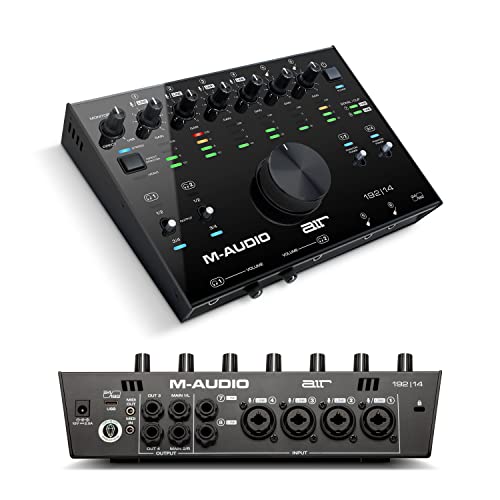
- Capture every detail - premium component selection and 24-bit/192kHz resolution for professional recording and monitoring to your Mac/ PC;
- Low latency - Hi-Speed USB/ USB-C circuitry gives you the fastest connection, with a class-leading round trip latency of only 2. 59Ms; USB and USB-C connection cables included
The M-AUDIO AIR 192×14 is a different beast entirely. It offers a much higher channel count (8 inputs and 4 outputs), making it the better choice for those who need to record multiple sources at once, such as a small band or a multi-mic podcast. It also features MIDI connectivity, which the io44 lacks. However, it is significantly larger and requires an external power supply, making it far less portable. If you don’t need the extra physical inputs, the io44 provides a much more streamlined and “smart” experience thanks to its virtual mixer and compact form factor.
3. M-AUDIO AIR 192×4 USB-C Audio Interface for Recording

- Capture Every Detail - Audio Interface with premium component selection and 24-bit/192kHz resolution for professional recording and monitoring to your Mac to PC
- Low Latency Audio Interface - Hi-Speed USB / USB-C circuitry gives you the fastest connection, with a class-leading round trip latency of only 2.59ms; USB and USB-C connection cables included
The M-AUDIO AIR 192×4 is a direct competitor in terms of price and portability. It is a solid, straightforward interface that does the basics very well. It’s great for someone who just wants to plug in a mic and a guitar and start recording into a DAW. However, it feels a bit “bare bones” when compared to the PreSonus. It doesn’t offer the onboard display, the integrated DSP effects, or the advanced loopback routing. For just a small jump in price, the PreSonus Revelator io44 USB-C Audio Interface with Mixer & Effects offers a massive increase in functionality that will save you time and effort in the long run.
Final Verdict: Is the PreSonus Revelator io44 the Right Interface for You?
After putting the PreSonus Revelator io44 USB-C Audio Interface with Mixer & Effects through its paces, I can confidently say it is one of the most innovative interfaces on the market. It successfully bridges the gap between professional studio recording and modern content creation. Its strengths lie in its incredible portability, the surprisingly powerful “Fat Channel” DSP, and a virtual mixer that makes complex routing a breeze. While the plastic knobs and the software learning curve are small hurdles, they are far outweighed by the convenience of having a broadcast-ready studio that fits in your pocket.
We highly recommend this interface to streamers, podcasters, and mobile musicians who want to elevate their audio quality without being tied down by bulky equipment. It offers a level of control and “smart” features that few other interfaces in this price range can match. If you’re ready to stop fighting with your audio and start creating with confidence, we suggest you click here to secure yours today and experience the difference for yourself. It is a small investment that will pay dividends in the professional polish it brings to your creative projects.
Last update on 2026-10-16 / Affiliate links / Images from Amazon Product Advertising API