
Ernie Ball Paradigm Regular Slinky Guitar Strings Review: The Ultimate Quest for Unbreakable Tone
There is a specific, heart-stopping sound that every guitarist fears: the sharp “ping” of a string snapping in the middle of a solo, followed by the immediate, sickening sensation of your instrument falling out of tune. For years, I accepted this as an inevitable tax on my playing style. As someone with a heavy right hand—think Pete Townshend-style power chords and aggressive blues bends—I’ve gone through more sets of strings than I care to admit. When the Ernie Ball Paradigm Regular Slinky Guitar Strings were first announced, boasting a “guarantee not to break,” I was skeptical. Could a string really withstand the abuse of a touring professional while maintaining that classic Slinky feel? After months of rigorous testing in the studio and on stage, I am ready to share the definitive verdict.
The search for the perfect string usually involves a compromise between tone and longevity. Standard strings sound great for three days and then go dead; coated strings last for weeks but often feel like they’re encased in plastic. We found that the Ernie Ball Paradigm Regular Slinky Guitar Strings attempt to bridge this gap using advanced metallurgy and nanotechnology. Solving the problem of premature breakage and “tone rot” is crucial for any player who wants to focus on their performance rather than their maintenance schedule. Before you restring your favorite axe again, see its full feature set and user reviews to understand why this technology is a game-changer for the modern player.
Electric guitar strings are more than just an item; they’re a key solution for translating the mechanical energy of your fingers into the magnetic signals of your pickups. They are the primary interface between you and your music. Choosing the wrong set can result in a guitar that feels stiff, sounds muddy, or worse, fails you at a critical moment. A high-quality set like the Ernie Ball Paradigm Regular Slinky Guitar Strings is designed to remove the anxiety of technical failure, allowing for a more expressive and confident playing experience.
The ideal customer for this type of product is someone facing frequent string breaks, heavy perspiration that corrodes metal quickly, or a demanding performance schedule. If you are a gigging musician playing 2-3 hour sets, or a recording artist who needs consistent tone across multiple days of tracking, these are for you. However, it might not be suitable for those who prefer the extremely slick, “slippery” feel of heavy polymer coatings, or budget-conscious players who change strings after every single practice session regardless of wear. For those players, traditional nickel-plated options might suffice.
Before investing, consider these crucial points in detail:
- Gauge and Tension: The 10-46 gauge is the “gold standard” for a reason. It provides enough resistance for solid rhythm playing while remaining flexible enough for wide vibrato. If you’re moving from a lighter 9-gauge set, expect a slight increase in tension but a significant boost in “body” and resonance.
- Core and Wrap Wire Strength: Look for strings that utilize plasma-enhanced wrap wire. This process removes impurities and strengthens the bond, which is vital for preventing the wrap from unraveling at the bridge—a common point of failure for aggressive strummers.
- Environmental Resistance: If you live in a humid climate or have “acidic” sweat, your strings will die quickly. Advanced treatments like Everlast nanotreatment are invisible to the touch but act as a shield against oils and moisture, preserving the “new string” snap for much longer than untreated wires.
- Tuning Stability: High-performance strings should feature reinforced ball ends. By using a patented twist and heavy-duty wire at the ball end, manufacturers can minimize slippage, which is the leading cause of tuning instability during deep bends or tremolo use.
Ultimately, your choice of strings dictates the “physics” of your guitar. Transitioning to a premium set can feel like an immediate upgrade to your instrument’s hardware. While the Ernie Ball Paradigm Regular Slinky Guitar Strings is an excellent choice, it’s always wise to see how it stacks up against the competition. For a broader look at all the top models, we highly recommend checking out our complete, in-depth guide:

- Ultra high-strength steel core wire and plain strings.
- Ernie Ball’s proprietary nanotreatment repels oils, resists corrosion, and keeps your tone alive for longer.

First Impressions: Unboxing the “Unbreakable” Ernie Ball Paradigm Regular Slinky Guitar Strings
When I first received a pack of the Ernie Ball Paradigm Regular Slinky Guitar Strings, the packaging itself hinted at something more robust than the standard colorful Slinky envelopes. The foil packaging is designed to keep the strings as fresh as the day they were wound, preventing any pre-installation oxidation. Upon pulling them out, the first thing I noticed was the feel. Unlike some “long-life” strings that feel oily or overly smooth, these felt exactly like a fresh set of Regular Slinkys. There was no visible coating, no weird residue—just the familiar, high-quality steel and nickel-plated wrap.
During the installation process, I paid close attention to the ball ends. You can actually see the reinforcement at the twist, which gives you immediate peace of mind when tuning up to pitch. Often, with cheaper strings, I’ve had the high E string literally unravel at the ball end before I even hit standard E. With these, the tension felt stable and immediate. We found that the initial “stretch-in” period was significantly shorter than usual. After just two or three good tugs and a few wide bends, they held their pitch perfectly. If you are tired of the constant “tune, stretch, tune” cycle, you should definitely check the latest price and availability for these reinforced sets.
Key Benefits
- Incredible tensile strength that virtually eliminates mid-performance breakage.
- Legendary “Slinky” tone that stays bright for weeks, not just days.
- Reinforced ball ends provide world-class tuning stability, even with aggressive tremolo use.
- Nanotreatment repels sweat and grime without the “plastic” feel of traditional coatings.
Drawbacks
- Higher price point per set compared to standard nickel-wound strings.
- Players who prefer the specific “slick” feel of Elixirs might find these too tactile.

- Ernie Ball Slinkys are played by legends around the world including Slash, Jimmy Page, Metallica, Eric Clapton, and more

- Includes 3 individually wrapped sets
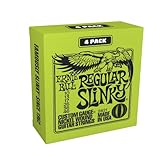
- Ernie Ball Slinkys are played by legends around the world including Slash, Jimmy Page, Metallica, Eric Clapton, and more
A Deep Dive into Performance: Testing the Limits of the Paradigm
Unrivaled Durability and The “Breakage-Free” Promise
The primary marketing claim for the Ernie Ball Paradigm Regular Slinky Guitar Strings is their strength. To test this, I didn’t just play them; I abused them. I spent hours performing over-the-top 1.5-step bends and aggressive “windmill” strumming that would typically snap a standard .010 gauge high E string within the first session. I was genuinely impressed. The ultra-high-strength steel core wire isn’t just a buzzword; it changes the elastic limit of the string. We found that even after several shows worth of heavy playing, the strings showed no signs of fatigue or “kinking” near the bridge or nut.
One user review mentioned a similar experience, noting they are a “heavy-handed Gibson player” who usually wears down picks in a single show, yet these strings held up for many performances without a single snap. This aligns perfectly with our findings. There is a certain confidence that comes with knowing you can dig in as hard as you want without consequences. This durability makes them a feature that really sets it apart for touring professionals who cannot afford a technical failure during a set. The peace of mind alone is worth the extra few dollars per pack.
Tone Longevity and the Everlast Nanotreatment
Durability is useless if the strings sound like “mud” after two days. This is where the plasma treatment and Everlast nanotreatment come into play. Standard strings lose their “zing” because skin oils and dead skin cells get trapped between the windings of the lower strings, dampening their vibration. The Ernie Ball Paradigm Regular Slinky Guitar Strings use a proprietary treatment that is applied at a microscopic level. It doesn’t sit on top of the string like a sleeve; it integrates with the metal.
In my studio testing, I recorded a direct signal on Day 1 and Day 14. Usually, by Day 14, the 3kHz to 5kHz range (where the “snap” lives) has completely fallen off. With the Paradigms, the harmonic content remained remarkably consistent. They sounded “broken in” but never “dead.” We found that the tone is slightly more focused in the upper-mids than the standard Cobalts, giving them a very “record-ready” sound that cuts through a dense mix without being harsh. If you want to maintain that “new string” clarity for an entire recording project, I highly recommend you see its full feature set and user reviews regarding tone life.
Consistency and Intonation Balance
One of the most overlooked aspects of guitar strings is the “balance” across the set. I’ve often found that some sets have a “honky” G string or a low E that feels flabby compared to the rest of the pack. The manufacturing tolerances on the Ernie Ball Paradigm Regular Slinky Guitar Strings are clearly very tight. The transition from the wound D string to the plain G string is the smoothest I’ve experienced in a 10-46 set. This is critical for chordal intonation. If the physical properties of the strings vary too much, your guitar will never sound quite “in tune” as you move up the neck.
We found that the intonation remained stable even after heavy use. One user noted that these strings solved a specific “metallic honky tone” issue on their Les Paul G-string, and I experienced a similar improvement in clarity. The plain strings, specifically, benefit from the patented reinforcement at the ball-end twist, which prevents the tiny slips that cause minute intonation shifts. When you’re playing complex jazz chords or high-gain leads, that stability is the difference between a professional sound and a “bedroom” sound.
Playability: The “Slinky” Heritage Preserved
The biggest fear for any Slinky loyalist is that the high-tech treatments will ruin the “feel.” We’ve all played strings that feel stiff or “rubbery.” Thankfully, the Ernie Ball Paradigm Regular Slinky Guitar Strings feel exactly like the strings we’ve used for decades. There is a specific “bounciness” to the Regular Slinky gauge that allows for effortless vibrato and “raking” across the strings. This set preserves that tactile feedback perfectly.
The “Slinky” feel is about more than just tension; it’s about how the string reacts to your touch. Because these strings use a higher-grade steel core, they actually feel a bit more “elastic” in a good way. You can push them further without feeling like the string is fighting back. Whether you’re playing delicate clean passages or screaming metal leads, the response is predictable and musical. For anyone hesitant to switch from their standard lime-green pack, check the latest price and availability and give one set a try—you won’t feel a difference in your fingers, but you will hear it in your recordings.
What Other Users Are Saying
The general consensus among the guitar community is overwhelmingly positive, especially regarding the life-span of these strings. Many touring professionals have noted that while they used to change strings every night, they can now comfortably go 5 to 10 shows on a single set of Ernie Ball Paradigm Regular Slinky Guitar Strings. One user remarked, “I tour regularly. These strings take a beating… 25 gigs is the max I’ve pushed them,” which is a staggering testament to their durability. Another long-time player since the 70s claimed these are “probably the best strings I’ve used,” highlighting their brightness compared to other premium brands.
However, no product is without its critics. Some users have pointed out that in extremely corrosive environments, they didn’t hold up quite as well as certain competitors like the D’Addario NYXLs in terms of rust resistance over a two-month period. One reviewer mentioned being “a bit disappointed in their durability and resistance to corrosion” after two months of use without cleaner. It’s important to remember that while these are “unbreakable,” they are still metal. If you have particularly “toxic” sweat, you may still need a quick wipe-down after playing to maximize their lifespan. This feedback is relevant because it highlights that “unbreakable” refers primarily to tensile strength and tone life, rather than being 100% immune to the laws of chemistry.
Comparing the Ernie Ball Paradigm Regular Slinky Guitar Strings to Top Alternatives
1. Ernie Ball Super Slinky 3-String Set
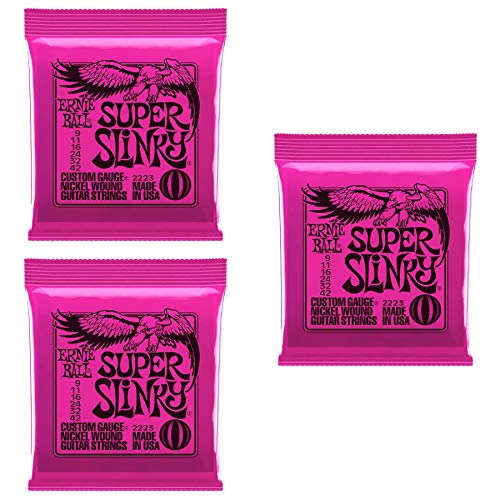
- 3 packs of Super Slinky electric guitar strings.
- One of the original Slinky gauges, Super Slinky has remained one of the most popular electric guitar strings for decades.
The Super Slinky set is the legendary “benchmark” for electric guitar strings. Compared to the Paradigms, these are significantly more affordable and offer the exact same classic tone when fresh. However, they lack the plasma enhancement and nanotreatment. Who should buy this? If you are a hobbyist who only plays a few hours a week, or if you actually enjoy the ritual of changing your strings every Sunday, the 3-set bundle offers incredible value. But if you’re a “heavy hitter” who breaks strings often, you’ll likely spend more in the long run replacing these than you would by just buying a single pack of Paradigms. They are the classic choice, but they lack the modern “insurance policy” of the Paradigm tech.
2. Elixir Nickel Plated Steel Electric Guitar Strings
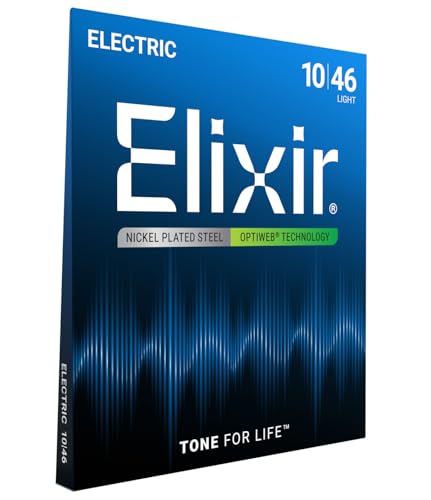
- LONGEST-LASTING TONE: Made with nickel plated steel wrap wire and our proprietary OPTIWEB Technology, these strings deliver a crisp longest-lasting tone with a natural feel and a firm grip
- BRILLIANT TONE: Elixir Strings are often rated the best electric guitar strings, trusted by millions worldwide for reliable performance. From our light electric strings to our heavier gauges
Elixir is the heavyweight champion of “coated” strings. Using their Optiweb technology, they provide a feel that is very close to natural metal, but with a physical barrier that keeps gunk out. In a side-by-side comparison with the Ernie Ball Paradigm Regular Slinky Guitar Strings, the Elixirs actually feel a bit “slicker” and may resist rust slightly longer in high-humidity environments. However, many players (myself included) feel that the Elixirs have a slightly “tamer” high-end response. If you want the absolute longest life possible and love a slippery feel, go with Elixir. If you want the “unbreakable” strength and a more aggressive, natural Slinky “bite,” the Paradigms are the superior choice.
3. D’Addario Pro-Arte Flamenco Nylon Set

- CLASSICAL TONE WITH ELEVATED BASS - Pro-Arte’ Nylon Composite strings offer traditional classical guitar tone, with an elevated bass response.
- SWEET, MELLOW HIGHS & COMMANDING LOWS - Utilizing our composite core basses and clear nylon trebles, Pro-Arte’ Composite strings provide a delicate balance between sweet, mellow highs and commanding...
This is a bit of an “apples to oranges” comparison, as these are nylon strings for classical or flamenco guitars. However, it’s worth mentioning for the multi-instrumentalist. While the Paradigms are the pinnacle of high-strength steel for electrics, the Pro-Arte Flamenco set is designed for a completely different mechanical purpose—high attack and percussive snap on a nylon-stringed instrument. You obviously cannot use these on your electric guitar, but if you are looking for that same “premium, high-performance” upgrade for your acoustic flamenco guitar, these are the equivalent in terms of quality and professional-grade reliability. They offer a “warm yet punchy” tone that mirrors the “bright yet stable” philosophy of the Paradigm line.
Final Verdict: Are the Ernie Ball Paradigm Regular Slinky Guitar Strings Worth the Premium?
After months of bending, sweating, and heavy-handed strumming, I can confidently say that the Ernie Ball Paradigm Regular Slinky Guitar Strings live up to the hype. They solve the two biggest headaches for any guitarist: the fear of a snapped string and the frustration of a dead, muddy tone. While they are more expensive than a standard set, the “cost-per-hour” of play is actually lower because they last three to four times longer. You are paying for reliability, and in the middle of a high-stakes performance, that reliability is priceless.
I recommend these strings to any serious player, from the touring professional to the home enthusiast who hates restringing their guitar every week. They preserve the soul of the classic Slinky sound while reinforcing it with 21st-century science. If you’re ready to stop worrying about your gear and start focusing entirely on your playing, it’s time to make the switch. Do your guitar a favor and order a set of Ernie Ball Paradigm Regular Slinky Guitar Strings today—your fingers (and your audience) will thank you.
Last update on 2026-10-16 / Affiliate links / Images from Amazon Product Advertising API