
KRK 12sHO Powered Studio Subwoofer Review: The Ultimate High-Output Solution for Professional Low-End Accuracy
If you have ever spent hours meticulously EQing a kick drum only to find it sounds like a wet cardboard box when played in a car or a club, you are familiar with the “low-end lie.” Most standard studio monitors, even high-end 8-inch models, struggle to accurately reproduce frequencies below 40Hz. Without a dedicated subwoofer, you are essentially mixing in the dark, guessing where the sub-harmonics sit. This leads to muddy transitions, phase issues, and a lack of impact that separates amateur home recordings from professional-grade productions. Solving this requires more than just “more bass”; it requires high-output, precision-engineered low-end extension. This is exactly why we turned our attention to the heavy-duty solution provided by KRK.
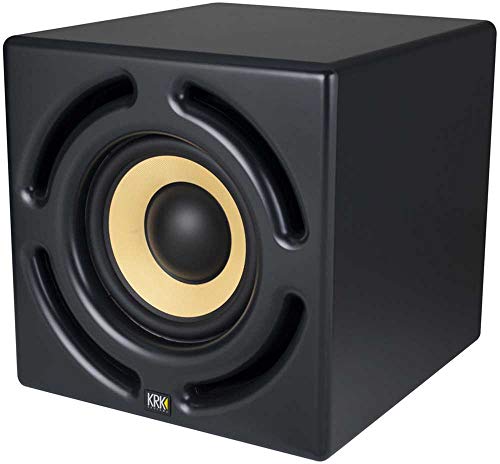
- Curved Baffle Curved front plate design virtually eliminates diffraction distortion
- Front-firing port provides low frequency extension while reducing boundary coupling and the unique shape is optimized to avoid port turbulence
What to Consider Before Investing in a Professional Studio Subwoofer
A Studio Subwoofer is more than just an item; it’s a key solution for uncovering the sonic “truth” hidden at the bottom of your frequency spectrum. In a professional setting, a subwoofer isn’t there to make the room shake for the sake of it; it’s there to provide a linear extension of your existing monitoring system. By offloading the strenuous low-frequency reproduction to a dedicated 400W amplifier and a 12-inch driver, your primary monitors can focus on the mid-range and high-frequency transients with much greater clarity. This reduces overall system distortion and provides a much wider “sweet spot” for critical listening.
The ideal customer for this type of product is someone facing high-stakes mixing environments, such as film scoring, EDM production, or professional mastering, where knowing exactly what is happening at 29Hz is a requirement, not a luxury. Conversely, it might not be suitable for those who work in tiny, untreated bedrooms where a 12-inch high-output driver would cause more standing wave issues than it solves. For smaller spaces, a more compact 8-inch or 10-inch unit might be the better path forward to avoid overwhelming the room’s natural acoustics.
Before investing, consider these crucial points in detail:
- Dimensions & Space: The physical footprint of a high-output subwoofer is significant. You need to ensure you have enough floor space—ideally away from corners to prevent “bass buildup”—and that your floor can support a unit that weighs as much as a small piece of furniture. Before purchasing, the sheer technical specifications and professional feedback can help you determine if your room can handle this level of power.
- Capacity & Performance: Look at the wattage and the driver material. A 400W Class A-B amplifier provides the headroom necessary to reproduce transients without clipping. Kevlar drivers are preferred in professional circles because they maintain their shape under high excursion, preventing the “woofiness” associated with paper or plastic cones.
- Materials & Durability: Studio gear is an investment. A subwoofer built with reinforced MDF and a curved baffle design helps minimize internal resonance and external diffraction. This ensures that the only thing you hear is the air moving from the port and the driver, not the cabinet itself vibrating or “singing” along with the music.
- Ease of Use & Maintenance: Professional integration is key. Does the unit include a bypass footswitch? Can you adjust the crossover frequency to match your specific monitors? These features allow you to maintain a seamless workflow, allowing you to check how your mix sounds on “consumer” systems by simply clicking a button to disable the sub.
While the KRK 12sHO Powered Studio Subwoofer is an excellent choice, it’s always wise to see how it stacks up against the competition. For a broader look at all the top models, we highly recommend checking out our complete, in-depth guide:

- 8inch bass-reflex powered subwoofer


- HONEST. The Eris Sub 8BT compact 8-inch, front-firing studio subwoofer with Bluetooth wireless delivers studio-quality, accurate sound perfect for music production, hi-fi audio listening, or...

- 10" glass aramid composite woofer
First Impressions: Unboxing the “Beast”
When the KRK 12sHO Powered Studio Subwoofer arrived at our studio, the first thing we noticed was the sheer mass of the unit. Weighing in at roughly 50 pounds and standing over two feet tall, this is not a piece of equipment you casually slide under a desk. The unboxing process requires a bit of patience and, ideally, a second set of hands. The aesthetic is classic KRK—the iconic yellow Kevlar cone is front and center, protected by a sturdy grille. The cabinet feels incredibly dense, finished in a professional black that looks the part in any high-end control room.
What immediately stands out is the curved baffle design. Unlike many boxy, square subwoofers, the KRK 12sHO Powered Studio Subwoofer features a rounded front that is engineered to virtually eliminate diffraction distortion. This means the sound waves don’t “catch” on the edges of the cabinet, leading to a cleaner, more accurate stereo image when integrated with your mains. Before even plugging it in, we suggest seeing its latest price and detailed user ratings to understand why this unit is considered a “heavyweight” in more ways than one.
What We Like
- Massive 400W of power provides incredible headroom for distortion-free bass.
- The included bypass footswitch is an absolute game-changer for mix translation checks.
- High-excursion Kevlar driver delivers exceptionally tight and “fast” low-end response.
- Front-firing port allows for easier placement near walls without excessive boundary coupling.
What We Didn’t Like
- Extremely heavy and bulky; difficult to move or reposition once set up.
- The sheer power can be “too much” for smaller, untreated studio environments.
Deep Dive: The KRK 12sHO Powered Studio Subwoofer Performance Analysis
The Power of Kevlar and 400 Watts of Headroom
When we pushed the KRK 12sHO Powered Studio Subwoofer during our testing phase, the first thing that struck us was the composure of the low end. Many subwoofers start to “chuff” or become “loose” when you ask them to reproduce a sustained 30Hz synth note at high volumes. This is usually due to a weak amplifier or a driver cone that is flexing under pressure. The 12-inch high-excursion woven Kevlar driver in this unit is remarkably stiff. Because it retains its shape even at the limits of its excursion, the bass remains articulate. You don’t just hear a “thump”; you hear the texture of the bass guitar string or the specific resonance of a 808 kick drum.
The 400W of power is perhaps the most critical spec here. In the world of audio, power isn’t just about loudness; it’s about “headroom.” When a sudden transient—like a massive orchestral timpani hit—demands a huge burst of energy, the KRK 12sHO Powered Studio Subwoofer has the electrical reserves to deliver that energy instantly without clipping. This results in a “punch” that you can feel in your chest, but it’s a clean, clinical punch, not the muddy boom you find in consumer-grade theater subs. We recommend the robust Kevlar driver and internal amplifier for anyone who needs to feel the music as much as they hear it.
Acoustic Engineering: The Front-Firing Port Advantage
Placement is the single biggest challenge when adding a subwoofer to a studio. Most subwoofers are rear-ported, which means if you place them too close to a wall, the bass reflects off the wall and creates “boundary coupling,” which artificially inflates the low end and creates a smeary, inaccurate sound. We found that the front-firing port of the KRK 12sHO Powered Studio Subwoofer is a massive practical benefit. It allows the low-frequency energy to move directly toward the listening position, reducing the turbulence and “port noise” that can plague other designs.
Furthermore, the curved baffle design mentioned earlier plays a huge role in the “disappearing act” a good sub should perform. When properly calibrated, you shouldn’t be able to point to the floor and say “the bass is coming from there.” Instead, it should sound like your main monitors have simply grown in size. The reduction in diffraction distortion provided by this curved surface ensures that the high-pressure sound waves exit the cabinet cleanly. You can spend more time analyzing how the curved baffle affects sound diffraction to see why this design choice is so popular among professional studio engineers.
Seamless Integration with the Bypass Footswitch
One of the most impressive “pro” features we evaluated was the dedicated bypass footswitch control. In a professional mixing workflow, you constantly need to check how your song will sound on “normal” speakers that don’t have subwoofers—like a laptop, a small Bluetooth speaker, or a standard car system. In many setups, this requires menu-diving or reaching behind the sub to flip a switch. With the KRK 12sHO Powered Studio Subwoofer, you simply tap the included footswitch. This mutes the sub and sends the full-range signal directly to your studio monitors.
This allows for instantaneous A/B testing. We found this feature indispensable when trying to balance the relationship between the kick drum and the bass guitar. By clicking the sub out, you can hear if the “meat” of the instruments is still present in the mid-bass; by clicking it back in, you can ensure they aren’t clashing in the sub-harmonics. This level of control is what makes this a true “Studio” tool rather than just a “Loud” speaker. It’s well worth viewing the full input/output configuration to see how this integrates with your current audio interface and monitors.
Build Quality and Thermal Protection: Built for the Long Haul
A 12-inch driver moving air at 400W generates a significant amount of heat and vibration. During our long 8-hour mixing sessions, we were pleased to find that the KRK 12sHO Powered Studio Subwoofer remained relatively cool to the touch on the back panel. This is thanks to the high-quality internal thermal and overload/clip protection. For a professional, there is nothing worse than gear failing in the middle of a client session. Knowing that the KRK has internal circuitry to prevent damage from power surges or over-driving provides a layer of security that “budget” subs simply don’t offer.
The cabinet itself is built like a tank. We noticed that even at high volumes, the enclosure doesn’t vibrate excessively. This is vital because cabinet vibrations can introduce “boxiness” into the sound. The high-resolution gain range on the input sensitivity also allows you to precisely match the sub’s output to the output of your monitors, regardless of whether you are using a professional +4dBu console or a -10dBV home interface. This versatility makes it a future-proof investment for any growing studio.
What Other Users Are Saying
The general consensus among those who have integrated the KRK 12sHO Powered Studio Subwoofer into their workflow is one of absolute awe at its power. One user noted that after having the sub for a month, “words fail when describing it,” comparing the experience at high volumes to being at a rock concert—only clearer and more controlled than a typical venue setup. This echoes our findings: it’s not just about loudness; it’s about the scale and clarity of the soundstage.
However, users also consistently warn about the physical size of the unit. As one reviewer put it, “She’s HEAVY and requires two people to move around.” One particularly dedicated user mentioned they managed to place foam under it solo only because they “lift,” but strongly advised against doing it without help. This is a relevant warning—this is a serious piece of equipment that demands a permanent home in your studio. The feedback regarding the footswitch is universally positive, with users calling it a “must-have” for checking mixes on the fly.
Comparing the KRK 12sHO Powered Studio Subwoofer to the Competition
While the KRK is a dominant force, it is important to see how it compares to other popular choices in the market to ensure it fits your specific needs.
1. JBL LSR310S Studio Monitor Subwoofer
- This patented JBL port design works in concert with the LSR310S low frequency driver for deep, dynamic bass response at all playback levels. The double-flared shape of the port is precisely calculated...
- A JBL first, the XLF setting activates a specially-engineered tuning that emulates the ample bass tuning used in today's dance clubs. When producing a dance track, the XLF setting will inspire you and...
The JBL LSR310S is a very popular choice for home and mid-tier studios. It features a 10-inch down-firing driver and a 200W amplifier. Compared to the KRK, the JBL is much more manageable in terms of size and weight. It also features a unique “XLF” (Extended Low Frequency) setting which mimics the bass response found in dance clubs. However, for a professional engineer, the JBL lacks the raw power and the footswitch bypass capability of the KRK 12sHO. If you are in a smaller room and don’t need to reach concert-level volumes, the JBL is a fantastic, more affordable alternative, but it won’t match the KRK’s surgical precision at high SPL.
2. PreSonus Eris Sub 8 Compact Studio Sub

- 8-inch, front-firing, paper-composite transducer with high-elasticity rubber surround delivers smooth low-frequency transients.Waterproof : No
- 100W Class AB amplifier (50W RMS) gives robust output with minimal distortion.
The PreSonus Eris Sub 8 is designed for “compact” environments. If you are working out of a bedroom or a small van, the KRK 12sHO would simply be impossible to fit or calibrate. The Eris Sub 8 provides a much-needed low-end boost to smaller 4-inch or 5-inch monitors. While it is excellent for its size, it belongs to a completely different class of equipment. It offers only 100W of peak power compared to the KRK’s 400W. We would recommend the PreSonus for casual creators or those with severe space constraints, but it cannot compete with the KRK for professional-grade mixing or mastering applications.
3. Mackie CR-X Series 8-Inch Multimedia Subwoofer
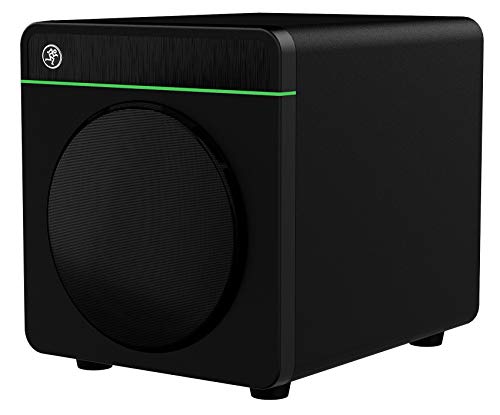
- Professional studio-quality sound
- Adds Bluetooth streaming to any studio monitors
The Mackie CR-X series is aimed more toward the “prosumer” and gaming market. It features Bluetooth connectivity and a desktop volume control, which are great for convenience but are rarely used in a critical mixing environment. At 200W, it has decent power for its 8-inch driver, but it lacks the Kevlar construction and the specialized curved baffle of the KRK. The Mackie is a great choice for someone who wants an all-in-one solution for gaming, movie watching, and hobbyist music production. However, for a dedicated studio looking for “no-compromise” accuracy, the KRK 12sHO remains the superior technical choice.
Final Verdict: Is the KRK 12sHO the Right Choice for You?
The KRK 12sHO Powered Studio Subwoofer is not just a speaker; it is a precision instrument designed for those who refuse to compromise on their low-end accuracy. Its 400W amplifier, high-excursion Kevlar driver, and innovative curved baffle design combine to create a monitoring experience that is both physically visceral and technically flawless. While its massive weight and size make it a commitment, the clarity it brings to the bottom three octaves of your mix is invaluable. We highly recommend this for professional producers, film composers, and electronic musicians who need to hear the “truth” of their sub-frequencies.
If you are tired of guessing how your bass will translate and are ready to take your studio’s monitoring to the next level, this is the tool to get you there. It provides the headroom, the durability, and the professional features—like the footswitch bypass—that make daily mixing a breeze. We suggest bringing this studio beast into your own workspace and finally hearing what you have been missing in your low-end.
Last update on 2026-10-16 / Affiliate links / Images from Amazon Product Advertising API