
MusicNomad Guitar Fretboard Gauge Tool Set Review: Achieving the Perfect Setup with Professional Precision
Every guitar player has been there: you’ve spent hours adjusting your bridge saddles, tweaking your truss rod, and fiddling with your action, only to find that your high E-string is still buzzing or your bends are “choking out” on the upper frets. For years, I relied on the “eyeball” method, assuming that if the strings looked relatively level, the guitar would play fine. But the reality is that the human eye is notoriously bad at detecting the subtle curves of a 9.5-inch versus a 12-inch radius. Without the right tools, you are essentially flying blind, and the result is a guitar that feels stiff, uneven, and ultimately uninspiring to play.
Failing to match your string radius to your fretboard radius is one of the most common mistakes in home maintenance. It leads to inconsistent string tension and a disjointed playing experience. To solve this once and for all, I integrated the MusicNomad Guitar Fretboard Gauge Tool Set into my permanent workbench setup. This isn’t just about making things look professional; it’s about the mathematical precision required to make a guitar “play like butter.” In this review, I’ll dive deep into why this two-piece set has become an essential part of my toolkit and how it can transform your instrument’s playability.
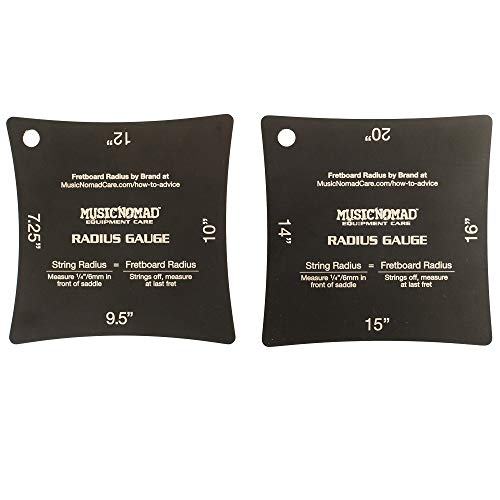
- Precision Radius Gauge Set with 7.25”, 9.5”, 10”, 12”, 14”, 15”, 16”, 20” Accurate Measurements
- Measures Your Fretboard Radius & String Radius on Electric, Acoustic & Bass Guitars
What to Consider Before Investing in Professional Guitar Tools
A set of high-quality guitar tools is more than just a luxury for the gear-obsessed; it’s a key solution for ensuring the longevity and optimal performance of your instruments. When you take a guitar to a professional luthier, a significant portion of what you are paying for is their access to precision measuring equipment. By investing in these tools yourself, you are not only saving money on setups in the long run but also developing a deeper “mechanical” relationship with your instrument. Understanding how your fretboard radius interacts with your bridge height is fundamental to mastering the instrument itself.
The ideal customer for this type of product is the dedicated hobbyist, the gigging musician who needs to perform their own emergency repairs, or the aspiring tech who wants to follow a standardized setup procedure. It is perfect for those who own multiple guitars with varying specifications, such as a vintage-spec Telecaster and a modern shred-machine. However, it might not be suitable for the casual player who only owns one guitar and prefers to have it serviced once a year by a pro. If you aren’t comfortable making adjustments to your bridge or saddles, a simple measurement tool might feel like overkill, and you might consider a more general maintenance kit instead.
Before investing, consider these crucial points in detail:
- Accuracy and Measurement Standards: When dealing with guitar setups, we are often talking about fractions of a millimeter. You need tools that are laser-cut and guaranteed to be accurate to the advertised radius. If a gauge is even slightly off, your entire bridge setup will be skewed, leading to localized buzzing.
- Legibility and Visibility: Many workshop environments are dimly lit. If you can’t clearly see the markings on your gauge or distinguish where the string meets the tool, the tool is effectively useless. Look for high-contrast finishes and clear, etched numbering that won’t rub off over time.
- Material Composition: Guitars are made of relatively soft materials like wood and nickel-silver. The tools you use should be made of durable stainless steel to prevent warping, but they must also be finished with polished, smooth edges. Rough or burred edges on a metal gauge can easily scratch a finished fretboard or a delicate bridge.
- Comprehensive Utility: Most guitars don’t share the same radius. A good tool set should cover the entire spectrum from vintage 7.25” curves to modern 20” flat boards. Having a “4-in-1” or “multiple-radius” design reduces the clutter on your workbench and makes the transition between different guitars much smoother.
While the MusicNomad Guitar Fretboard Gauge Tool Set is an excellent choice for those looking to refine their setup process, it’s always wise to see how it stacks up against the competition. For a broader look at all the top models and how to build a complete repair station, we highly recommend checking out our complete, in-depth guide:
How to Choose the Best Guitar Neck Rests and Support Tools for Professional Home Repairs

- Comprehensive Tool Set: This guitar tool kit comes with Hex Wrenches, Files, Screwdriver, Steel Ruler, String Action Ruler, Guitar String Winder Cutter Pin Puller, Nut Bridge Saddle Grooves Sanding...
- ALL-IN-ONE GUITAR STRING WINDER TOOL - The ergonomic and high-quality design of the D'Addario Accessories Pro-Winder makes string changes quicker and easier than ever before with its built-in...


- RELIABLE TUNING, NO MATTER WHERE YOU PLAY: By sensing vibrations directly from the instrument, tuning stays accurate in loud venues, quiet practice rooms, and everything in between, so you can focus...
First Impressions: Unboxing the MusicNomad Guitar Fretboard Gauge Tool Set
When I first unboxed the MusicNomad Guitar Fretboard Gauge Tool Set, I was immediately struck by the industrial quality of the build. Unlike the thin, stamped-tin gauges you often find in “all-in-one” budget kits, these gauges have a reassuring heft to them. Weighing in at 1.69 ounces, they feel substantial in the hand, which is vital when you’re trying to hold a tool steady against a string. The black finish isn’t just for aesthetics; it provides a high-contrast background that makes the white laser-etched numbers pop, even in a “man cave” with suboptimal lighting.
The set consists of two precision gauges that cover eight different radii: 7.25”, 9.5”, 10”, 12”, 14”, 15”, 16”, and 20”. This covers virtually every major guitar brand, from vintage Fenders to modern Jacksons and Gibsons. I particularly appreciated the polished edges—I ran my finger along the measuring surfaces and found zero burrs or sharp points. This gave me the confidence to place them directly onto the fretboard of my prized 1960s reissue without fear of marring the rosewood. Before you even start the setup, you can see its full feature set and user reviews to understand the level of detail MusicNomad has put into this KISS (Keep It Simple, Setup) methodology.
Key Benefits We Found
- Exceptional build quality using heavy-duty, rust-resistant stainless steel.
- Brilliant high-contrast black finish makes reading string gaps much easier than shiny silver tools.
- Wide range of 8 common radii accommodates almost any electric or acoustic guitar and bass.
- Smooth, polished edges ensure no accidental scratches on your guitar’s finish or fretboard.
Drawbacks to Consider
- While great for the bridge, they are not “notched” for measuring the wood underneath the strings.
- Visibility can still be tricky on the string side without a dedicated backlighting source.
Deep Dive: Putting the MusicNomad Guitar Fretboard Gauge Tool Set to the Test
To truly understand the value of this tool, I used it to perform a complete setup on three different instruments: a vintage-spec Stratocaster with a 7.25″ radius, a modern PRS with a 10″ radius, and a 5-string bass with a 16″ radius. The performance of the MusicNomad Guitar Fretboard Gauge Tool Set across these varied tasks revealed exactly why this tool is a cut above the rest.
Precision Engineering and Legibility Under Pressure
The most impressive aspect of these gauges is the combination of their thickness and their finish. In the past, I’ve used cheap silver gauges that were so thin they would flex if I pressed too hard against the fretboard. The MusicNomad Guitar Fretboard Gauge Tool Set is significantly sturdier. This rigidity is crucial because if a gauge bends, your measurement is no longer accurate. I found that I could rest the gauge across the frets with total confidence that it was providing a true flat reference for the radius.
The black finish is a game-changer. When you are checking the string radius at the bridge, you are essentially looking for tiny slivers of light between the bottom of the string and the top of the gauge. On a standard polished steel gauge, the reflections from your overhead lights can make it nearly impossible to tell if the string is actually touching the metal or just floating a hair above it. Because these gauges are matte black, the silver or nickel string stands out in sharp relief. I found that I could dial in my saddle heights much faster than usual because I wasn’t constantly squinting to fight glare. As one user noted, it helped them set bridge saddles perfectly so the guitar “plays like butter,” and I have to agree—the speed and accuracy gained from the high-contrast design cannot be overstated.
Versatility Across the “KISS” Method
MusicNomad markets this as part of their “Keep It Simple, Setup” (KISS) method, and the integration is seamless. I used the gauges not just for the bridge, but also to verify the fretboard radius before beginning a fret leveling job. Having four radii on a single tool (two on each side) meant I wasn’t constantly digging through a drawer for different gauges. When switching from my 7.25″ Strat to the 16″ bass, the transition was as simple as flipping the tool over.
I also discovered a clever “pro tip” mentioned by other users: using a small light behind the gauge. While the black finish is excellent, placing a light source behind the strings while the gauge is in place creates a “silhouette” effect. This allowed me to see exactly where the radius was off by as little as a few thousandths of an inch. The tool’s dimensions (4.3 x 5 inches) make it large enough to cover the width of a 6-string guitar comfortably but compact enough to maneuver around the bridge of a bass without hitting the body of the instrument. To get the most out of your workshop, you should check the latest price and availability for this essential kit.
Durability and Long-Term Workshop Value
We’ve all had tools where the printed markings eventually wear off after being tossed in a toolbox. MusicNomad opted for laser etching for the numbers and text on this set. During my testing, I intentionally rubbed the markings with a bit of fretboard oil and a cloth to see if they would fade; they remained perfectly crisp. The stainless steel construction also means these are essentially “forever tools.” They won’t rust, and they won’t lose their shape.
One minor gripe some might have is that these are “over-string” gauges. This means if you want to measure the fretboard radius, you generally have to remove the strings or slide the gauge underneath them. Some luthiers prefer “notched” gauges that can sit over the strings. However, for setting the *bridge* radius—which is where most playability issues occur—these are superior. The ability to verify the string curve at the bridge is a feature that really sets it apart from more basic straight-edge tools. It ensures that the curve of your strings perfectly mirrors the curve of your frets, which is the secret to low action without buzzing.
Real-World Performance on Bass and Specialty Instruments
One of the highlights of our testing was using the set on a high-end 5-string bass. Bass guitars often have flatter radii (like 16″ or 20″) and much thicker strings that exert significant pressure. The MusicNomad Guitar Fretboard Gauge Tool Set handled the 16″ and 20″ measurements with the same precision as the smaller guitar measurements. Because the gauges are thick, they didn’t “dip” under the weight of the heavy B and E bass strings. This level of consistency is what separates a professional tool from a generic one. If you’re a multi-instrumentalist, having one set that handles everything from a ukulele to a 5-string bass is a massive convenience. I highly recommend you view the technical specifications to see how the dimensions fit your specific instrument needs.
Voices from the Workbench: What Other Users Are Saying
The general sentiment among users who have integrated the MusicNomad Guitar Fretboard Gauge Tool Set into their workflow is overwhelmingly positive, with many emphasizing the jump in quality over cheaper alternatives. We found that the most common praise centers on the legibility and the “burr-free” finish. One user mentioned that these gauges are “thicker and sturdier than the thin stamped metal versions,” which echoes our findings regarding the tool’s rigidity. Another user highlighted how it helped them identify the exact curve of their fretboard in a “dimly lit man cave,” specifically praising the black metal and white etching.
However, no tool is perfect for everyone. Some users noted that they “had a difficult time seeing when strings were correctly aligned” without a secondary light source. This is a fair point—while the black finish is a massive improvement over silver, it doesn’t eliminate the need for good workshop lighting. Another user expressed a wish for a “notched version” to measure the wood without moving the strings. While these are valid critiques based on specific preferences, the consensus is that for bridge and saddle setup, these are among the most accurate and easy-to-use tools on the market. One reviewer even mentioned they use a black paper “spacer” to help visualize light gaps, showing just how much these tools encourage a high level of precision and “best practices” in the community.
Comparing the MusicNomad Guitar Fretboard Gauge Tool Set to the Competition
While the MusicNomad set is our top pick for radius measurement, different workshop needs might lead you toward other types of tools. Here is how it compares to three common alternatives found in the market.
1. iLuiz Guitar Neck Notched Straight Edge Tool
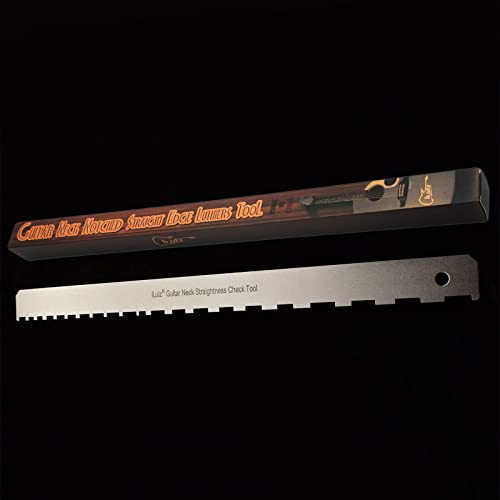
- Synthesized 25.5” and 24.75” scale guitar, and precisely adjusted the distance of the notched, let it not just fit fender and gibson, also for others. Fit more guitars than other neck straight...
- Use side of notched for fingerboard straightness check, and side of complete for fret wires levelness check.
The iLuiz Notched Straight Edge serves a different primary purpose than the MusicNomad radius gauges. While the MusicNomad set is designed to measure the *curve* of the frets and strings, the iLuiz tool is designed to check the *straightness* of the neck itself. It features notches that allow it to sit flat against the wood of the fretboard, bypassing the frets entirely. If your primary concern is adjusting your truss rod to achieve a perfectly flat neck, the iLuiz is a better choice. However, it cannot help you set your string radius at the bridge. Most serious techs will actually want both: the iLuiz for neck relief and the MusicNomad for the final radius setup.
2. Micling Guitar Tool Kit
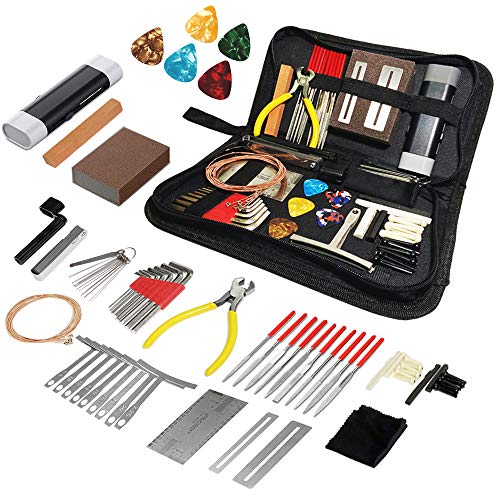
- 【Great Value! Comprehensive Basic Tools】Micling 72Pcs guitar repairing tool kit are the most complete kit on the market for daily use, including bridge pins, fret crowning luthier files, guitar...
- 【Multifunctional Use】Available for changing strings, setting intonation, adjusting action or checking string height, perfect for stringed instrument cleaning, maintenance and repair.Dedicated to...
If you are a complete beginner with zero tools, the Micling 72-piece kit might seem tempting because of the sheer volume of items included. It features strings, picks, and basic gauges. However, in our experience, the quality of the gauges in these massive “budget” kits is significantly lower than the MusicNomad Guitar Fretboard Gauge Tool Set. The metal is usually thinner, the edges are often sharp, and the measurements can be slightly inaccurate. While the Micling kit is a fun gift for a new player, those looking to perform high-precision setups will quickly outgrow its basic components. It’s a quantity-over-quality play, whereas MusicNomad is pure quality.
3. Noisy Clan Music Theory Wheel
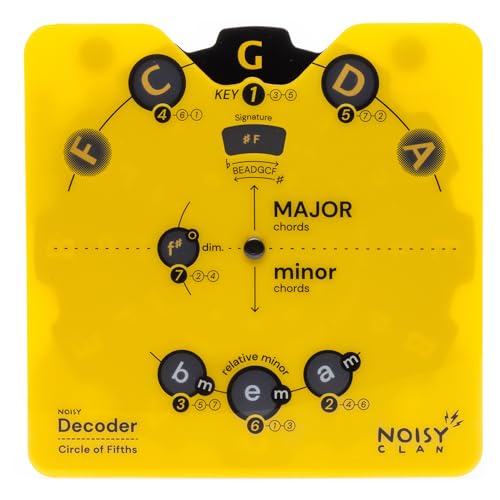
- CIRCLE OF FIFTHS WHEEL FOR MUSIC THEORY - A practical music theory tool that helps players understand chords, scales, keys and progressions visually, making complex theory easier to apply during...
- CHORD & KEY DECODER TOOL - Quickly identify major and minor chords, key relationships, scale patterns and common chord progressions so you can move from theory to real playing with more confidence.
The Noisy Clan Circle of Fifths Wheel is an entirely different category of “tool.” While the MusicNomad set is a mechanical tool for physical maintenance, the Noisy Clan wheel is a mental tool for songwriting and theory. It’s an excellent companion for the desk, helping you decode scales and progressions. We include it here to highlight that a “guitar tool” can mean many things. If you find yourself struggling with *what* to play rather than *how* your guitar plays, this theory wheel is a fantastic investment. However, it won’t help you fix a buzzing G-string!
The Final Verdict: Is the MusicNomad Guitar Fretboard Gauge Tool Set Worth It?
After putting the MusicNomad Guitar Fretboard Gauge Tool Set through its paces, the answer is a resounding yes. In a market flooded with cheap, unreliable measuring tools, MusicNomad has delivered a professional-grade solution that is accessible to the average player. The standout features—the high-contrast black finish, the laser-etched precision, and the smooth, polished edges—solve the most common frustrations associated with home setups. Whether you are a professional tech or a weekend warrior, the ability to accurately match your string radius to your fretboard is the single biggest factor in making a guitar feel “right.”
If you are tired of “eyeballing” your bridge adjustments and want a tool that will last a lifetime, this set is a mandatory addition to your workbench. It eliminates the guesswork, prevents accidental scratches, and ensures that every guitar you own is playing at its absolute peak performance. Don’t let a poorly matched radius hold back your playing—take control of your setup today. I highly encourage you to click here to secure your set and start achieving professional-level setups at home.
Last update on 2026-10-16 / Affiliate links / Images from Amazon Product Advertising API