
tech21 Q-Strip EQ Pedal Review: The Studio-Grade Secret Weapon for Your Pedalboard
As guitarists and bassists, we’ve all been there. You spend thousands on a high-end instrument, hundreds on a boutique amplifier, and yet, when you plug in, something is… missing. Your tone feels “thin,” or perhaps there’s a muddy frequency in the low-mids that makes your chords sound like a cluttered mess. You try to fix it with the three knobs on your amp, but they are too broad. You buy a standard graphic EQ, but the fixed frequencies never seem to hit the exact spot you need. This frustration is what leads many of us to search for professional-grade solutions like the tech21 Q-Strip EQ Pedal. Without the ability to surgically remove “mud” or add “air” to your signal, you are essentially fighting your gear rather than making music. Solving this tonal bottleneck is crucial because a great performance can be completely overshadowed by a poor sonic profile. If you’ve ever felt that your passive bass lacked “punch” or your guitar solos didn’t “cut” through the mix, you’re exactly the person who needs a higher level of equalization.
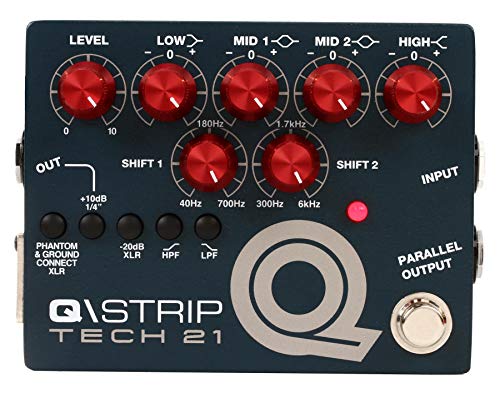
- 1/4" Output with 10dB Boost
- XLR Output with 10dB Pad
What to Consider Before Buying Electric Guitar Equalization Effects
An Electric Guitar Equalization Effects unit is more than just an item; it’s a key solution for unlocking the full potential of your signal chain. At its core, an EQ pedal allows you to reshape the harmonic balance of your instrument, compensating for room acoustics, subpar speakers, or the inherent limitations of your pickups. For many, it acts as a “corrective” tool to fix problems, but for the creative artist, it’s an “additive” tool used to craft a signature sound that stands out in a crowded mix. By mastering your frequencies, you ensure that you occupy your own space in the frequency spectrum without clashing with the kick drum or the vocals.
The ideal customer for this type of product is someone facing inconsistent live sound environments or someone who plays multiple instruments—such as moving from a passive bass to an acoustic guitar—and needs a way to balance those levels instantly. It is perfect for the “minimalist” performer who wants to go direct-to-PA without hauling a heavy amplifier. However, it might not be suitable for those who prefer “plug-and-play” simplicity with zero learning curve, or those looking for heavy distortion and overdrive built-in, as this is a clean preamp/EQ. Those individuals might consider a dedicated drive pedal or a multi-effects unit instead.
Before investing, consider these crucial points in detail:
- Dimensions & Space: On a crowded pedalboard, every inch matters. You need to look for a unit that offers professional features—like XLR outputs and multiple knobs—without taking up the space of three standard pedals. A compact design ensures it fits into your existing workflow without requiring a board redesign.
- Capacity/Performance: Look beyond just the number of bands. Consider whether the EQ is graphic (fixed frequencies) or parametric (sweepable frequencies). Parametric controls offer far more precision, allowing you to “seek and destroy” specific problem frequencies rather than just boosting a whole range.
- Materials & Durability: Since this is a piece of gear that will be stepped on and hauled to gigs, a metal chassis is non-negotiable. Look for high-quality knobs that won’t snap off and jacks that feel secure. The internal circuitry should be analog if you are looking for that vintage, warm harmonic response.
- Ease of Use & Maintenance: Consider how the unit is powered. While 9V batteries or adapters are standard, the ability to run on 48V phantom power from a mixing console is a massive “quality of life” feature for gigging musicians. Long-term maintenance is usually minimal for analog pedals, provided they are kept in a dry environment.
While the tech21 Q-Strip EQ Pedal is an excellent choice, it’s always wise to see how it stacks up against the competition. For a broader look at all the top models, we highly recommend checking out our complete, in-depth guide:
- PRECISE ±18dB TONE SCULPTING – 6 GUITAR-OPTIMIZED BANDS: Shape your sound with surgical precision across six carefully selected frequencies (100Hz, 200Hz, 400Hz, 800Hz, 1.6kHz, 3.2kHz). Each slider...

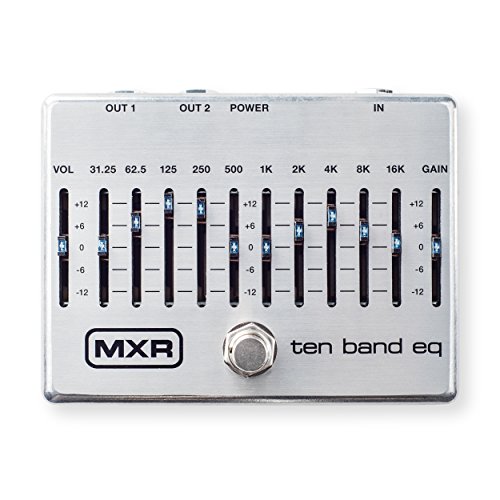
- Cut or boost 10 different frequencies up to ±12dB

- ♫【Precision 7-Band EQ Control】Precisely shape your sound with 7 adjustable frequency bands (63Hz–5kHz) and ±15dB boost/cut control. Eliminate muddy lows, enhance sparkling highs, or dial in...
First Impressions and Key Features of the tech21 Q-Strip EQ Pedal
When I first pulled the tech21 Q-Strip EQ Pedal out of the box, I was struck by its weight and finish. It feels “expensive”—not in a fragile way, but in a robust, studio-grade manner. It’s significantly more compact than I expected for a device that claims to emulate a vintage Neve-style channel strip. Unlike many digital EQ pedals that feel like small computers, the tech21 Q-Strip EQ Pedal is unapologetically analog. The knobs have a satisfying resistance, and the brushed metal aesthetics scream “professional outboard gear.” Before you even plug it in, you can see its full feature set and user reviews, which confirm its reputation as a “must-have” for serious tone chasers.
Comparing it to market leaders like the Boss GE-7 or the MXR 10-band, the Q-Strip feels more like a piece of recording equipment than a “stompbox.” While the others use sliders, the Q-Strip uses high-quality potentiometers and offers features rarely seen on pedalboards, such as a dedicated High Pass Filter (HPF) and Low Pass Filter (LPF). This is a tool designed for the discerning ear—those who want the “sparkle” and “warmth” of a high-end console under their feet.
Key Benefits
- Studio-grade analog circuitry based on classic MOSFET technology for natural warmth.
- Dual sweepable (parametric) mid-bands for surgical tonal control.
- Highly versatile connectivity including XLR out with a 10dB pad and 1/4″ out with a 10dB boost.
- Multiple power options, including the extremely convenient 48V phantom power.
Limitations
- The price point is higher than entry-level graphic EQ pedals.
- Requires a basic understanding of frequency ranges to get the most out of the parametric knobs.
A Deep Dive into the tech21 Q-Strip EQ Pedal’s Performance
Mastering the Mid-Range: The Power of Dual Parametric Control
In our testing, the standout feature of the tech21 Q-Strip EQ Pedal is undoubtedly its two sweepable mid-bands. Most guitarists are used to a single “Mid” knob that boosts or cuts a pre-determined frequency. However, the Q-Strip gives you two separate controls: one for the low-mids and one for the high-mids. This is a game-changer. We found that being able to sweep through the frequencies allows you to identify exactly where the “boxiness” of a guitar lives or where the “clank” of a bass string resides. It’s like having a flashlight in a dark room; you can pinpoint the exact frequency and then use the cut/boost knob to deal with it.
One user mentioned that the tech21 Q-Strip EQ Pedal acts like “ultra-fine finishing sandpaper,” and we couldn’t agree more. When we ran a passive Precision Bass through it, we were able to boost the low-mids for that classic “thump” while simultaneously cutting a narrow band of high-mids that was causing some unwanted finger noise. This level of precision is simply not possible on a standard amp EQ. It transforms a “good” sound into a “finished” sound—the kind of tone you usually only hear after a professional engineer has processed your tracks in a studio. To get this level of control on your board, you should check the latest price and availability and see why pros are swapping their graphic EQs for this unit.
The Ultimate Swiss Army Knife: DI Box, Preamp, and FX Loop Tool
The versatility of the tech21 Q-Strip EQ Pedal cannot be overstated. During our evaluation, we tested it in three distinct scenarios, and it excelled in all of them. First, as a standalone DI box for bass. By using the XLR output, we went straight into our recording interface. The MOSFET circuitry added a subtle harmonic richness that made the DI signal feel “alive” and “tube-like.” It’s a clean sound, but it has a weight to it that cheaper DI boxes lack. For the bassist who wants “pure and punchy” without the grit of a SansAmp, this is the Holy Grail.
Second, we placed it in the FX Loop of a high-gain guitar amplifier. This is where the tech21 Q-Strip EQ Pedal really showed its teeth. High-gain amps often suffer from “mud” in the low end and “fizz” in the high end. By engaging the High Pass Filter (HPF) and Low Pass Filter (LPF), we were able to tighten up the low end and smooth out the harsh highs instantly. It made a standard tube amp sound like it had been professionally mixed for a CD. Finally, for acoustic players, this pedal is a lifesaver. It tames the “piezo quack” common in acoustic pickups, making your acoustic guitar sound natural and resonant through a loud PA system. It is truly a feature that really sets it apart from simpler pedals.
Analog Warmth and High-Pass Precision: The MOSFET Difference
One of the reasons the tech21 Q-Strip EQ Pedal sounds so much better than digital alternatives is the use of MOSFET (Metal-Oxide-Semiconductor Field-Effect Transistor) technology. We found that even when the EQ was set flat, just running the signal through the pedal added a pleasant “sheen.” It’s not a distortion, but a thickening of the tone that feels very “Neve-esque.” This is particularly noticeable when using the unit as a preamp for “lap steel” or other clean instruments. It provides that vintage console warmth that makes the listener feel like the music is “right in front of them.”
The addition of dedicated HPF and LPF buttons is a studio trick brought to the pedalboard. The HPF (High Pass Filter) is essential for removing stage rumble and “boominess” that can cause your amp to work harder than it needs to. The LPF (Low Pass Filter) is the secret to getting a “cab sim” feel when going direct. By cutting off the extreme high frequencies that guitar speakers don’t reproduce anyway, the tech21 Q-Strip EQ Pedal makes a direct signal sound natural and “miked-up.” As one user noted, you can go straight into a PA with “decent results,” but we found the results to be better than decent—they were stage-ready. You can see more technical details and user success stories to understand just how powerful these filters are.
Powering Your Performance: Phantom Power and Road-Ready Reliability
In the world of live music, reliability is everything. The tech21 Q-Strip EQ Pedal is built like a tank, but its most underrated feature is the ability to be powered by 48V phantom power via the XLR cable. We tested this by unplugging our power supply and running only the XLR to our mixer. The pedal performed flawlessly. This means one less cable on your board and one less point of failure during a gig. For the traveling musician who fits their entire rig in a messenger bag, this is a massive advantage. No more worrying about dead batteries or finding an outlet near the front of the stage.
The 15.52-ounce weight makes it feel substantial enough to stay put on a pedalboard, yet light enough not to be a burden. The 10dB boost on the 1/4″ output also allows it to act as a clean boost for solos, pushing your amp into a natural breakup if desired. Every design choice on this pedal feels intentional, aimed at the working professional who needs a tool that works every single time. It’s an investment in your long-term sound quality, and you can check its current pricing to see how it fits into your gear budget.
What Other Users Are Saying
The general sentiment among users is one of “tonal enlightenment.” Many players, like us, report that they didn’t realize how much they needed a parametric EQ until they tried the tech21 Q-Strip EQ Pedal. One bassist noted that he is “not looking for the next secret pedal anymore” because the Q-Strip helped him finally “dial in a sound and keep it strong.” This echoes our finding that the pedal provides a sense of finality to your tone-seeking journey. Another user mentioned using it in the FX loop of a Peavey Invective to “clean out the mud,” highlighting its effectiveness in high-gain scenarios.
On the more critical side, some users pointed out the price, noting that for the same cost, you could buy a small amplifier head. While this is a fair comparison in terms of dollars, we believe it misses the point of the Q-Strip’s specialized studio-grade circuitry. Another user mentioned the sheer number of variables can be overwhelming at first, stating they had “only skimmed the tip of the iceberg.” This reinforces our view that while there is a learning curve, the rewards for mastering this pedal are immense. To get a better sense of these diverse experiences, read the latest user feedback for yourself.
Comparing the tech21 Q-Strip EQ Pedal to the Competition
1. MXR Ten Band EQ Guitar Effects Pedal
- Cut or boost 10 different frequencies up to ±12dB
- LEDs provide high visibility, even in direct sunlight
The MXR Ten Band EQ is a classic graphic equalizer that offers ten fixed frequency sliders. While it provides more “bands” than the tech21, it lacks the surgical precision of sweepable parametric mids. The MXR is great for those who want a visual representation of their EQ curve and need a lot of gain (up to 12dB of boost/cut per band). However, it lacks the XLR output, the MOSFET “warmth,” and the HPF/LPF filters found on the tech21 Q-Strip EQ Pedal. If you are looking for a standard EQ pedal for a rock board, the MXR is excellent, but if you need a studio-grade preamp/DI, the Q-Strip wins easily.
2. Behringer Eq700 7-Band Graphic Equalizer

- Shape your sound and eliminate feedback with 7 bands of equalization
- Wide frequency range from 100 Hz to 6.4 kHz with a powerful 15dB boost/cut per band
The Behringer EQ700 is the budget-friendly alternative for those who are just starting to experiment with equalization. It offers seven bands of fixed EQ in a plastic housing. While it is incredibly affordable and gets the job done for basic tone shaping, it simply doesn’t compete with the tech21 Q-Strip EQ Pedal in terms of build quality, signal-to-noise ratio, or professional features. The Behringer is for the hobbyist on a strict budget, whereas the tech21 is for the professional who needs a reliable, high-fidelity tool for the stage and studio.
3. Caline CP-24 10-Band EQ Guitar Effects Pedal

- Sturdy aluminum alloy case;True bypass design minimizes tone loss
- True Bypass
The Caline CP-24 is another 10-band graphic EQ that offers a lot of control for a very low price. Like the MXR, it uses sliders to adjust fixed frequencies. It’s a solid, metal-housed pedal that provides a lot of value, but it lacks the sophisticated analog circuitry and the specialized DI features of the tech21 Q-Strip EQ Pedal. If you are looking to fill a spot on your board for basic EQ duties without breaking the bank, the Caline is a strong contender. However, it won’t provide the “Neve-style” harmonic richness or the phantom power capabilities that make the tech21 so unique.
The Final Verdict: Is the tech21 Q-Strip EQ Pedal Worth It?
After extensive testing and comparison, our verdict is a resounding yes. The tech21 Q-Strip EQ Pedal is not just another EQ pedal; it is a professional-grade channel strip in a stompbox format. Its ability to solve complex tonal problems with its sweepable mids, clean up a signal with its HPF/LPF filters, and act as a high-end DI box makes it an invaluable asset for any serious musician. While it may seem “boring” to those looking for wild effects, it is the one pedal that makes every other pedal on your board—and your instrument itself—sound significantly better. We recommend it to bassists who want a pure direct tone, acoustic players who need to tame their pickups, and electric guitarists who want studio-quality control over their amp’s frequency response. Stop settling for “good enough” and give your tone the professional finish it deserves. Invest in your tone today and experience the MOSFET difference.
Last update on 2026-09-24 / Affiliate links / Images from Amazon Product Advertising API