
Horse 10-Band EQ Pedal Review: Precision Tone Sculpting for Every Rig
We’ve all been there. You’ve spent thousands on a high-end guitar and a reputable amplifier, yet when you plug in, the sound feels… underwhelming. Maybe it’s a “honky” midrange that makes your solos feel boxy, or perhaps your low-end is so muddy it swallows the bassist’s frequency space. Standard three-band EQ knobs—Bass, Middle, and Treble—are often too blunt for the surgical precision needed to fix these issues. They are wide-sweeping filters that affect large chunks of your frequency spectrum simultaneously. When you try to boost the “sparkle,” you accidentally increase the harshness; when you try to cut the mud, you lose the body of your tone. This frustration often leads guitarists down a rabbit hole of buying and selling pedals, when the real solution is often just a better way to shape the frequencies you already have. In our testing of various signal chains, we found that without a dedicated equalizer, you are essentially fighting your gear rather than making it work for you. This is exactly where the Horse 10-Band EQ Pedal enters the conversation as a potential game-changer for your pedalboard.

- This Band Controller, this 10 band EQ pedal is suitable for both Bass and Guitar, the frequency band ranges from 31.25Hz to 16kHz, including 4-string, 5-string Bass, and 6-string, 7-string Guitar.
- On the pedal's right side, there is an independent "Volume" Control Knob, and the related LED light on each knob flickers accordingly.
What to Consider Before Buying an Electric Guitar Equalization Pedal
An electric guitar equalization effect is more than just an item; it’s a key solution for unlocking the hidden potential of your existing gear. Whether you are trying to match a single-coil guitar to a humbucker-voiced amp or trying to remove a specific frequency that causes feedback on stage, an EQ pedal provides a level of control that most amplifiers simply cannot match. Before you see its full feature set and user reviews, it is vital to understand that an EQ pedal can function as a clean boost, a frequency shaper, or even a “fixed wah” effect depending on how you set the sliders.
The ideal customer for this type of product is someone facing tonal limitations in their current rig, such as a “flat” sounding solid-state amp or a guitar that lacks character in the mix. It is also perfect for multi-instrumentalists who switch between bass and guitar and need a way to instantly recalibrate their signal. However, it might not be suitable for those who prefer a “plug and play” minimalist setup or those who find the visual complexity of ten sliders overwhelming. For those users, a simple 3-band boost or a tilt-EQ might be a better, albeit less powerful, alternative.
Before investing, consider these crucial points in detail:
- Dimensions & Space: Your pedalboard real estate is precious. While 10-band EQs are traditionally bulky, the Horse 10-Band EQ Pedal measures approximately 108mm in length, which is quite compact for a 10-slider unit. Always measure your available “wasted real estate” to ensure the pedal and its top-mounted or side-mounted jacks will fit without crowding your other effects.
- Capacity/Performance: Look at the frequency range. A guitar-only EQ might stop at 5kHz, but for modern high-gain or bass applications, you want a wider range. This pedal covers from 31.25Hz to 16kHz, which is massive. This ensures you can handle the sub-bass of a 5-string bass and the “air” frequencies of an acoustic or electric guitar.
- Materials & Durability: Since you will be stomping on this device, the housing must be rugged. Metal chassis are the standard, and you should look for sliders that have a firm resistance so they don’t move if you accidentally brush them with your foot. High-quality internal chips are also necessary to ensure the pedal doesn’t introduce unwanted hiss into your signal.
- Ease of Use & Maintenance: While EQs are generally low-maintenance, the power requirements are key. This unit requires a standard 9V DC supply. Ensure the pedal features “true bypass” switching, which ensures that when the pedal is off, your signal remains pure and unaffected by the internal circuitry, preserving your natural tone.
With these factors in mind, it becomes clear that an EQ pedal is a tool of utility. While it might not be as “exciting” as a shimmering delay or a screaming fuzz, it is often the most important pedal on a professional’s board. While the Horse 10-Band EQ Pedal is an excellent choice, it’s always wise to see how it stacks up against the competition. For a broader look at all the top models, we highly recommend checking out our complete, in-depth guide:
Discover the best graphic equalizer pedals to perfectly contour your instrument’s voice
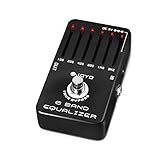
- PRECISE ±18dB TONE SCULPTING – 6 GUITAR-OPTIMIZED BANDS: Shape your sound with surgical precision across six carefully selected frequencies (100Hz, 200Hz, 400Hz, 800Hz, 1.6kHz, 3.2kHz). Each slider...

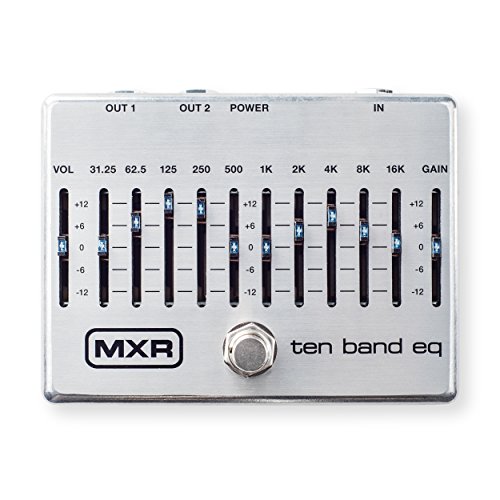
- Cut or boost 10 different frequencies up to ±12dB

- ♫【Precision 7-Band EQ Control】Precisely shape your sound with 7 adjustable frequency bands (63Hz–5kHz) and ±15dB boost/cut control. Eliminate muddy lows, enhance sparkling highs, or dial in...
First Impressions and Key Features of the Horse 10-Band EQ Pedal
When we first got our hands on the Horse 10-Band EQ Pedal, the first thing that struck us was the striking turquoise finish. It’s a refreshing change from the industrial greys and blacks typically found in the EQ world. The build feels surprisingly dense for its size, weighing in at 285g, which gives it a sense of durability that belies its affordable price point. Out of the box, the sliders felt smooth with just the right amount of tension, allowing for precise adjustments without the sliders feeling “floppy.”
Compared to market leaders like the MXR or BOSS equivalents, the Horse model offers a very similar frequency layout but at a fraction of the footprint and cost. We were particularly impressed by the inclusion of an independent volume control knob. Many EQ pedals only offer gain sliders on the individual bands, but having a master volume allows you to use the pedal as a dedicated clean boost for solos—simply set your EQ curve and then use the volume knob to jump above the band mix. We also noted the true bypass switching, which we confirmed in our studio environment to be effectively transparent. You can check the latest price and availability to see how it compares to your budget, but initial impressions suggest a very high “bang for your buck” ratio.
Key Benefits
- Extremely wide frequency range (31.25Hz to 16kHz) suitable for guitar and bass.
- ±12dB of gain/attenuation on each band for surgical tone shaping.
- Compact footprint for a 10-band unit, saving pedalboard space.
- Independent volume control allows for use as a clean boost.
Limitations
- Stomp switch can feel slightly “budget” compared to premium boutique pedals.
- Does not include a power supply or patch cables in the box.
A Deep Dive into the Performance of the Horse 10-Band EQ Pedal
Taming the Frequencies: Surgical Precision for Guitar and Bass
The primary reason anyone looks for a 10-band equalizer is the sheer granularity of control. In our evaluation, we tested the Horse 10-Band EQ Pedal with both a standard 6-string electric guitar and a 5-string active bass. The results were enlightening. On the guitar, we were able to pinpoint a specific “honky” frequency around 1kHz that was making our overdrive pedal sound nasal. By dipping that slider just 4dB, the distortion instantly became smoother and more professional. Conversely, boosting the 16kHz band added a “shimmer” and “air” to our clean tones that our amp’s treble knob simply couldn’t reach.
For bass players, this pedal is a secret weapon. The 31.25Hz and 62.5Hz sliders allow you to tighten up the sub-lows without affecting the “punch” in the 125Hz-250Hz range. We found that we could dial out the boominess of a small practice room while keeping the fundamental notes of a low B-string clear and articulate. This level of control is a feature that really sets it apart from 6-band or 7-band alternatives, which often group these critical low frequencies into a single slider. We also confirmed user feedback that this pedal adds a “tube-like warmth” to solid-state amps; this isn’t magic, but rather the result of boosting the low-mids while slightly rolling off the harsh highs, a curve that mimics the natural compression of a tube circuit.
Signal Integrity and Noise Floor Management
A common fear with affordable EQ pedals is that they will introduce a “hiss” or “hum” into the signal chain, especially when sliders are boosted. We put the Horse 10-Band EQ Pedal through a high-gain test, placing it after a heavy distortion pedal. While any EQ will amplify existing noise if you boost the high frequencies significantly, the internal chip in the Horse pedal operates remarkably quietly. Even with several bands boosted by 6dB, the noise floor remained well within acceptable limits for both live performance and studio recording.
The “True Bypass” claim also held up under scrutiny. When the pedal is disengaged, we noticed zero coloration of the signal or loss of high-end, which is essential for players who spent a lot of money on their cables and guitars. This transparency makes it an excellent “always-on” pedal. As one user noted, they used it to contour their sound perfectly on their rig and found it to be high quality for the price. We agree; the internal circuitry feels robust enough to handle the rigors of a signal chain without becoming the “weak link” that introduces interference. If you’ve been hesitant about budget EQs due to noise concerns, our findings suggest this model is a safe bet.
Versatility in the Effects Loop vs. Front of Amp
Where you place an EQ pedal in your signal chain changes its function entirely. During our review process, we tested the Horse 10-Band EQ Pedal in two distinct positions. When placed “in front” of the amp (between the guitar and the amp input), it acts as a character shaper. It changes how your guitar drives the preamp. By boosting the mids, we could make a Stratocaster sound thick and humbucker-like. By cutting the lows, we could make a muddy Les Paul sound crisp and biting.
However, the real magic happened when we placed it in the “Effects Loop” (between the preamp and power amp). In this position, the pedal acts as a global master EQ for your entire sound. This is where we found we could truly “fix” an amp’s inherent flaws. We used it to rescue a Crate Flexwave amp that lacked a midrange control, using the Horse sliders to create a variable notch filter. This transformed the amp from a “one-trick pony” into a versatile tool. Because the Horse 10-Band EQ Pedal features a 1/4″ (6.35mm) connectivity and handles standard signal levels, it integrated seamlessly into the loop without any clipping or headroom issues. This versatility makes it an indispensable tool for any guitarist who plays through backline gear at different venues.
The Value Proposition: Price vs. Performance
We need to address the elephant in the room: the price. Throughout our time with the Horse 10-Band EQ Pedal, we kept returning to the fact that it performs like a pedal costing twice as much. While one user mentioned that the price has fluctuated over time, even at its current point, it represents an incredible value. For the cost of a few packs of premium strings, you are getting a 10-band processor that can fundamentally change the way your gear sounds. You can check the current price here to see where it stands today.
The build quality, despite the occasional report of a stiff or intermittent switch, feels solid for home and moderate gigging use. We noticed that the sliders have a tactile “click” or center-detent (though subtle) which helps in returning to a flat EQ setting. The turquoise color makes it easy to spot on a dark stage, and the independent volume control provides that extra “kick” when you need to cut through a loud drummer. For musicians who are on a budget but refuse to compromise on their tone, this pedal bridges the gap between “entry-level” and “professional tool” with surprising grace.
What Other Users Are Saying
The general consensus among the community is overwhelmingly positive, with most users highlighting the pedal’s ability to “breathe life” into stagnant gear. One guitarist mentioned using it with an Orange Crush 35RT, noting that it added “tube-like warmth” and allowed them to dial down the gain on their dirt pedals, making everything sound better. Another user, an electronics engineer, praised its thoroughness, using it specifically to add a midrange control to an amp that lacked one. This sentiment—that the pedal solves specific, engineering-level problems—is a recurring theme.
On the flip side, some users have pointed out areas for improvement. One reviewer noted that their stomp switch worked only intermittently, suggesting some variability in quality control for the mechanical components. Another user mentioned that they didn’t notice much of a difference, though this may be a result of the pedal being used in a setup where the frequencies weren’t being pushed to their limits or the user was looking for a more “dramatic” modulation effect rather than frequency shaping. Overall, the feedback confirms our own findings: it is a high-performing utility pedal that offers exceptional value, provided you receive a unit with a solid switch.
Comparing the Horse 10-Band EQ Pedal to the Competition
To help you make the most informed decision, we’ve compared the Horse 10-Band EQ Pedal against three of its most popular rivals. Each offers a different take on the equalization problem.
1. MXR Ten Band EQ Guitar Effects Pedal
- Cut or boost 10 different frequencies up to ±12dB
- LEDs provide high visibility, even in direct sunlight
The MXR Ten Band EQ is widely considered the industry standard. It features a rugged build, bright LEDs on every slider, and dual outputs. However, it requires an 18V power supply to achieve its massive headroom, which can be a hassle for those with standard 9V power bricks. While the MXR offers a slightly lower noise floor and a more road-proven switch, it is significantly more expensive and larger than the Horse 10-Band EQ Pedal. Professional touring musicians may prefer the MXR for its tank-like build, but for the average player, the Horse offers 90% of the performance at a fraction of the cost.
2. Behringer Eq700 7-Band Graphic Equalizer

- Shape your sound and eliminate feedback with 7 bands of equalization
- Wide frequency range from 100 Hz to 6.4 kHz with a powerful 15dB boost/cut per band
The Behringer EQ700 is the budget king. It is incredibly affordable but comes in a plastic housing. It only offers 7 bands of equalization, which means you lose the surgical control over the extreme lows and highs that the Horse 10-Band EQ Pedal provides. We find the Behringer is a good “first EQ” for beginners, but the plastic construction and fewer bands make it less desirable for anyone looking to build a serious, long-term pedalboard. The Horse model is a significant step up in both build quality (metal vs. plastic) and tonal flexibility.
3. Caline CP-24 10-Band EQ Guitar Effects Pedal

- Sturdy aluminum alloy case;True bypass design minimizes tone loss
- True Bypass
The Caline CP-24 is perhaps the closest direct competitor to the Horse. It offers 10 bands and a very similar form factor. In our experience, the internal components are quite comparable, and both pedals likely share a similar design lineage. The main difference comes down to aesthetics and availability. Some players prefer the Caline’s look, while others find the Horse’s turquoise finish more distinctive. If you can’t find the Horse model in stock, the Caline is a virtually identical alternative, though we’ve found the Horse 10-Band EQ Pedal often has a slightly more “solid” feel to its sliders.
Final Verdict: Is the Horse 10-Band EQ Pedal Right for You?
After extensive testing and comparison, we can confidently say that the Horse 10-Band EQ Pedal is one of the best value-for-money upgrades you can give your guitar or bass rig. Its main strengths lie in its massive frequency range, its compact metal housing, and the inclusion of a master volume knob that allows it to pull double duty as a boost pedal. While the stomp switch might not feel as “boutique” as a $200 pedal, its performance in shaping tone is undeniable. We recommend this pedal to anyone who feels their current amp is “missing something” or any player who needs a versatile tool to handle different rooms and instruments on the fly.
Ultimately, a good EQ is about control. It’s about taking the sound you have and turning it into the sound you want. Whether you are cutting the mud from a bass guitar or adding “air” to an electric guitar solo, this pedal gives you the sliders to make it happen. If you are ready to stop fighting your gear and start sculpting your signature sound, we highly suggest you head over and grab the Horse 10-Band EQ Pedal today—your tone will thank you.
Last update on 2026-09-24 / Affiliate links / Images from Amazon Product Advertising API