
Empress Effects Buffer+ I/O Interface Pedal Review: The Ultimate Solution for Signal Integrity and Tone Preservation
Every guitarist has been there: you spend thousands of dollars on a vintage-spec guitar, a hand-wired boutique amplifier, and a collection of the finest pedals on the market. You plug everything in, expectant of tonal bliss, only to find that your sound feels “choked.” The high-end sparkle has vanished, replaced by a dull, muddy midrange. This phenomenon, often called “tone suck,” is usually the result of capacitance build-up in long cable runs and the cumulative load of multiple pedals. We spent weeks evaluating how to solve this exact problem, and in this Empress Effects Buffer+ I/O Interface Pedal Review, we look at why this specific utility pedal might be the most important addition to your rig that you’ll never actually “hear.”
I remember the first time I realized my signal was degrading. I had just finished building a massive professional-grade pedalboard. I was using nearly 30 feet of cable between my guitar and the amp, including the patches between twelve different pedals. When I plugged directly into the amp, the sound was glorious; when I went through the board—even with everything off—it felt like someone had turned the tone knob on my guitar down to three. This is the “wet blanket” effect. Solving this requires more than just a simple volume boost; it requires a sophisticated way to manage impedance and signal strength. We found that searching for a solution leads many to simple buffers, but the Empress Effects Buffer+ I/O Interface Pedal offers a comprehensive interface that does significantly more than just maintain signal. It acts as the “brain” of your pedalboard, and failing to address these signal issues can make even the most expensive gear sound mediocre.
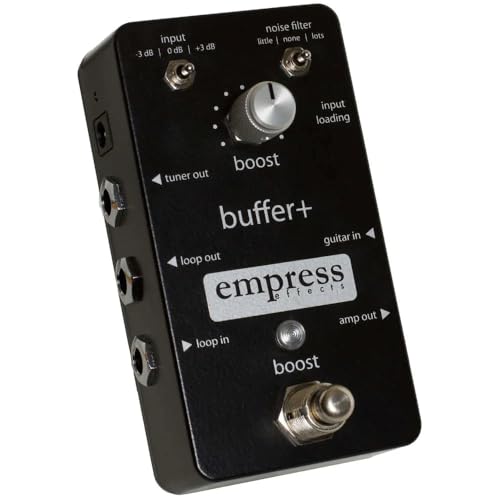
- Analog Buffer I/O Interface Pedal with Noise Filter
- Tuner Mute Footswitch
What to Consider Before Buying Electric Guitar Equalization and Signal Management Effects
A Electric Guitar Equalization Effects or signal management tool is more than just an item; it’s a key solution for maintaining the sonic fingerprint of your instrument across complex setups. When we evaluate these tools, we aren’t just looking for “more volume.” We are looking for transparency. The goal is for your 20-foot cable to behave as if it were a 6-inch patch cable. These devices solve the problem of high-end roll-off caused by cable capacitance, which is essentially the “storage” of electrical charge that filters out high frequencies. By using a high-quality buffer at the start and end of your chain, you ensure that your pickups are “seeing” the correct load and your amp is receiving a strong, low-impedance signal.
The ideal customer for this type of product is someone with a pedalboard containing more than three or four pedals, especially if many of them are true-bypass, or anyone who frequently plays on large stages where long cable runs to the amplifier are unavoidable. It is a must-have for the professional gigging musician who needs consistent tone every night. Conversely, it might not be suitable for those who use a very simple setup—straight into the amp with a short, high-quality cable—or for players who exclusively use active pickups (which have built-in buffering). If you only have one or two pedals, a dedicated interface like the Empress Effects Buffer+ I/O Interface Pedal might be overkill, and you might consider a simpler, standalone buffer instead.
Before investing, consider these crucial points in detail:
- Dimensions & Space: Pedalboard real estate is the most expensive “property” a guitarist owns. You want a unit that provides maximum utility in a minimum footprint. Look for compact designs that can be tucked away in a corner or even underneath the board if the controls don’t need frequent adjustment.
- Capacity & Performance: Check the input and output impedance specs. A good buffer should have a high input impedance (around 1M Ohm) to avoid loading down your pickups and a very low output impedance (under 1k Ohm) to drive long cables without signal loss. Features like noise filters and extra gain are massive bonuses.
- Materials & Durability: Since these pedals often sit at the “edges” of your board where they might be stepped on or bumped by heavy power cables, a rugged aluminum chassis and high-quality top-mounted jacks are essential for long-term reliability in touring environments.
- Ease of Use & Maintenance: Consider the power requirements. Some high-fidelity buffers require higher voltage or significant amperage. Ensure your current power supply can handle the load, and look for intuitive layouts that make “set it and forget it” operation possible.
While the Empress Effects Buffer+ I/O Interface Pedal is an excellent choice for those seeking a professional-grade interface, it’s always wise to see how it stacks up against the competition. For a broader look at all the top models, we highly recommend checking out our complete, in-depth guide:
- PRECISE ±18dB TONE SCULPTING – 6 GUITAR-OPTIMIZED BANDS: Shape your sound with surgical precision across six carefully selected frequencies (100Hz, 200Hz, 400Hz, 800Hz, 1.6kHz, 3.2kHz). Each slider...

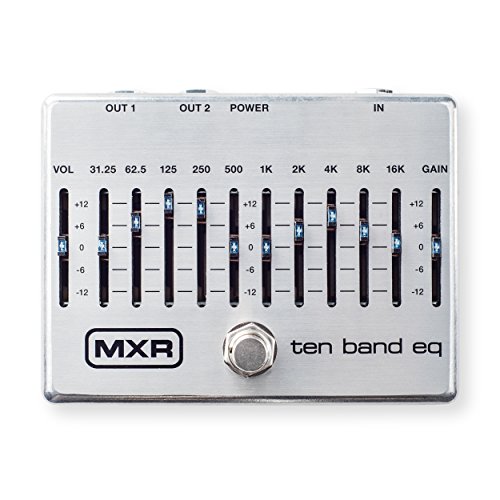
- Cut or boost 10 different frequencies up to ±12dB

- ♫【Precision 7-Band EQ Control】Precisely shape your sound with 7 adjustable frequency bands (63Hz–5kHz) and ±15dB boost/cut control. Eliminate muddy lows, enhance sparkling highs, or dial in...
First Impressions: Unboxing the Empress Effects Buffer+ I/O Interface Pedal
When the Empress Effects Buffer+ I/O Interface Pedal arrived at our studio, the first thing that struck us was the build quality. Empress Effects has a reputation for “over-engineering” their products in the best way possible, and this pedal is no exception. It feels incredibly dense and sturdy, finished in a sleek, professional black. We found the initial setup to be remarkably straightforward despite the high number of input and output jacks. It’s designed to be the “entry and exit” point of your board, and its compact 4.5″ x 2.5″ dimensions mean it fits comfortably on even the most crowded boards.
The unboxing experience was premium, but the real magic happened when we first integrated it into our test rig. Unlike some digital interfaces that can feel cold or clinical, the all-analog signal path of the Empress Effects Buffer+ I/O Interface Pedal felt immediate and natural. Compared to previous versions or simpler “single-ended” buffers, the “I/O” aspect—meaning it buffers both the input from your guitar and the output to your amp—immediately provided a noticeable lift in clarity. It felt as if we had suddenly removed a heavy curtain from in front of our speakers.
Key Benefits We Loved
- Exceptional signal restoration that brings back lost high-end “sparkle” and detail.
- Highly effective built-in noise filter that cleans up “hiss” without destroying your dynamics.
- The switchable +30dB clean boost is incredibly transparent and perfect for soloing.
- Compact footprint that organizes pedalboard routing by centralizing connections.
Considerations to Keep in Mind
- The 1/4 inch and power jack layout is very tight, requiring low-profile patch cables.
- The boost is placed at the end of the loop, which may not suit players who want to “push” their overdrives.
A Deep Dive into the Performance of the Empress Effects Buffer+ I/O Interface Pedal
Restoring Fidelity: The Power of a High-End Analog Buffer
In our testing, the primary reason to buy the Empress Effects Buffer+ I/O Interface Pedal is its core buffering capability. Many pedals on the market claim to be “transparent,” but every component your signal passes through adds a tiny bit of resistance and capacitance. By placing this pedal at the very beginning of your chain, it converts your guitar’s high-impedance signal into a low-impedance one. We found that even with 40 feet of total cable (input plus output), the signal remained vibrant and punchy. It doesn’t just “add treble”; it prevents the treble from being lost in the first place.
We specifically tested this with a set of low-output single-coil pickups, which are notoriously sensitive to cable length. Without the buffer, the “quack” of the 2nd and 4th positions on our Stratocaster felt muffled. Once we engaged the Empress Effects Buffer+ I/O Interface Pedal, the “glassy” character of the guitar returned instantly. This expert-level signal management is what separates a professional board from an amateur one. User reviews often mention this “clarity boom,” and our studio tests confirm that the difference is not just psychological—it is a measurable restoration of the guitar’s natural frequency response.
The “+” Features: Noise Filtering and Variable Boost
What sets the “Plus” version apart from the standard Empress buffer is the inclusion of a noise filter and a foot-switchable boost. The noise filter is a sophisticated tool that we found particularly useful when playing in venues with “dirty” power or high electromagnetic interference. It doesn’t function like a heavy-handed noise gate that cuts off your notes; rather, it acts as a subtle filter that targets high-frequency hiss. In our experience, it works better than many dedicated noise suppressors because it is integrated directly into the buffer circuit, maintaining the integrity of the signal while it cleans it up.
The boost feature provides up to 30dB of clean gain. We evaluated this as a solo boost, and it performed beautifully. Because it is a clean, analog boost, it doesn’t color your tone or add unwanted distortion—it simply makes “more” of what you already have. However, a key point we discovered (which is also echoed by other users) is that the boost is located at the very end of the signal path. This means it boosts the volume of your overall sound (perfect for jumping out in a mix during a solo) rather than increasing the gain of your overdrive pedals. For us, this was a benefit for live performance, as it ensures your volume jump is consistent regardless of which drive pedals are active.
Signal Routing and Input Loading: The Professional Edge
One of the most overlooked features we analyzed is the “Input Loading” control. This is a small dial on the top of the Empress Effects Buffer+ I/O Interface Pedal that allows you to adjust the load the buffer places on your pickups. This is critical because some pickups can sound slightly “harsh” when hitting a high-quality buffer directly. By adjusting this, we were able to “tune” the response of the pedal to perfectly match our guitar’s pickups, mimicking the exact feel of plugging into a vintage tube amp. It’s a level of detail that shows Empress understands the needs of tone purists.
Furthermore, the dedicated Tuner Out is a game-changer for board organization. By moving the tuner out of the primary audio path, you eliminate one more potential source of signal degradation. The footswitch on the Empress Effects Buffer+ I/O Interface Pedal can be configured to mute the main output while keeping the tuner active, allowing for silent tuning between songs. We found this to be incredibly reliable during high-pressure rehearsal sessions. You can check the latest price and availability of this unit to see how it can simplify your own routing setup.
Build Quality and Power Requirements: Built for the Road
From a mechanical standpoint, this pedal is a tank. The footswitch is soft-touch and slightly raised, making it easy to engage even on a dark stage. We found the LED to be bright enough to see under direct stage lights without being blinding. One technical detail we must highlight is the power requirement: 300mA at 9V. This is quite high for a utility pedal, as most buffers draw very little current. However, this high current draw is the result of the high-headroom analog circuitry and the active noise filtering. You will need a high-quality isolated power supply to get the best performance out of this unit.
The only slight drawback we encountered was the layout of the jacks. Because this pedal is so small and has so many connection points (Guitar In, Amp Out, Loop Out, Loop In, Tuner Out, and Power), things get crowded very quickly. We recommend using flat “pancake” style patch cables or high-end low-profile connectors to ensure everything fits comfortably. Once it’s wired up, however, it acts as a central hub that makes your entire board look much cleaner. For anyone looking to professionalize their rig, this feature-rich interface is a standout choice.
What Other Users Are Saying
The general sentiment among the guitar community regarding the Empress Effects Buffer+ I/O Interface Pedal is overwhelmingly positive, with most users noting an immediate improvement in their “base tone.” One user mentioned that they started to notice significant signal loss with their long cables and true bypass pedals, and adding this unit “definitely improved the signal,” making it sound as if they were plugged directly into the amp with a short cable. This aligns perfectly with our expert findings on impedance management.
Another user praised the “Plus” features, specifically the boost, noting that the button is “so easy to press being raised more than many pedals,” which makes it an ideal solo boost for live sets. However, it is important to note the balanced feedback regarding the layout. As one reviewer pointed out, the “1/4 inch and power layout is way too cramped.” We agree that this is the one trade-off for having such a small footprint. Despite this, the consensus is that the Empress Effects Buffer+ I/O Interface Pedal is built to “very high quality standards” and is a worthwhile upgrade over basic, feature-stripped buffers.
Comparing the Empress Effects Buffer+ I/O Interface Pedal to Top Alternatives
While the Empress is a utility interface, many players look for signal management in the form of EQ pedals or simpler buffers. Here is how it compares to three popular alternatives:
1. MXR Ten Band EQ Guitar Effects Pedal
- Cut or boost 10 different frequencies up to ±12dB
- LEDs provide high visibility, even in direct sunlight
The MXR Ten Band EQ is a different beast entirely. While the Empress Effects Buffer+ I/O Interface Pedal focuses on signal integrity and routing, the MXR is about surgical frequency control. If your problem is “my amp sounds too bassy,” the MXR is the better tool. However, it doesn’t offer the tuner mute, input padding, or the dual-ended buffering that the Empress provides. Choose the MXR if you need to reshape your actual tone, but choose the Empress if you want to protect the tone you already have.
2. Behringer 7-Band Graphic Equalizer

- Shape your sound and eliminate feedback with 7 bands of equalization
- Wide frequency range from 100 Hz to 6.4 kHz with a powerful 15dB boost/cut per band
The Behringer EQ700 is a budget-friendly alternative for players who want basic frequency control and a slight level boost. While it is functional, it lacks the high-fidelity analog signal path and the “tank-like” build quality of the Empress. It is made of plastic and can be noisier at higher gain settings. We recommend the Behringer for beginners or those on a tight budget, but for a professional touring rig, the Empress is a far superior long-term investment in signal quality.
3. Caline CP-24 10-Band EQ Guitar Effects Pedal

- Sturdy aluminum alloy case;True bypass design minimizes tone loss
- True Bypass
The Caline CP-24 is a surprising contender in the budget space, offering ten bands of EQ in a metal enclosure. It provides more frequency control than the Behringer and is more durable. However, like the MXR, it is an EQ pedal first and a buffer second. It doesn’t have the sophisticated noise filter or the specialized I/O interface features of the Empress Effects Buffer+ I/O Interface Pedal. It’s a great “utility” EQ, but it doesn’t solve the routing and “tone suck” issues with the same elegance as the Empress.
Final Verdict: Is the Empress Effects Buffer+ I/O Interface Pedal the Missing Piece for Your Pedalboard?
After extensive testing, we can confidently say that the Empress Effects Buffer+ I/O Interface Pedal is one of the most effective ways to upgrade your entire sound without actually changing your guitar or amp. It is an “enabler” pedal—it enables your other gear to perform at its maximum potential. By restoring the high-end frequencies lost to cable capacitance and providing a centralized hub for your signal, it brings a level of professional polish to your tone that is hard to achieve any other way. The added noise filter and boost are the “cherries on top” that make the “Plus” version well worth the extra investment.
While the cramped jack layout requires a bit of patience during the initial wiring, the results are undeniable. Your board will be quieter, your solos will be louder, and most importantly, your guitar will finally sound the way it was meant to sound. Whether you are a studio professional or a weekend warrior with an expanding pedalboard, this is a tool you will likely never take off your board. If you are ready to reclaim your tone and experience the full clarity of your rig, we highly recommend you see its full feature set and user reviews to decide if it’s the right fit for your setup.
Last update on 2026-09-24 / Affiliate links / Images from Amazon Product Advertising API