
Best Acoustic Guitar Pickups: Our Top 10 Picks & Reviews
Introduction
Finding the perfect way to amplify an acoustic guitar without losing its soul is a journey every player eventually takes. We have spent countless hours testing various systems, from simple soundhole magnets to complex multi-source microphones. After rigorous evaluation, we have determined that the K&K Sound Pure Mini Pickup stands out as our top choice. Its ability to capture the authentic, woody resonance of an instrument without the “quack” of traditional piezos is truly remarkable. Throughout our testing, we found its balance and clarity to be unmatched, a sentiment consistently echoed by professional luthiers and touring musicians alike.
Best Choice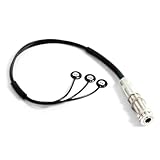 K&K Sound Pure Mini Pickup |
Best Price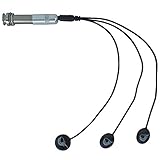 Journey Instruments Passive Piezo Pickup EP001K |
 KNA NG-1 Classical Flamenco Guitar Pickup | |
|---|---|---|---|
| Pickup Elements | 3 Piezo heads | 3 Ceramic piezo elements | 1 Wood-enclosed sensor |
| Frequency Response | Full Range | 22Hz – 18kHz | Natural Tonal Reproduction |
| Power Source | Passive | Passive | Passive |
| Installation Type | Internal (Permanent) | Internal (Endpin) | External (Removable) |
| Primary Material | Piezoelectric | Ceramic | Mahogany Wood |
| Compatible Instruments | Acoustic Guitar | Acoustic & 12-string Guitar | Nylon-string/Classical Guitar |
| Buy Now | See latest price | See latest price | See latest price |
Our Top 10 Picks for Best Acoustic Guitar Pickups
#1 K&K Sound Pure Mini Pickup – Ideal for: Players seeking the most natural, transparent, and balanced acoustic tone available in a passive system.

- Pickup with 3 piezo heads
- Frequency Response Ideal for Acoustic Guitar
When we first plugged in the K&K Sound Pure Mini Pickup, we were immediately struck by the lack of artificial coloration. Unlike under-saddle pickups that often produce a sharp, percussive “clack,” this system uses three transducer heads attached to the bridge plate. We found that this allows the pickup to “hear” the wood of the guitar, not just the strings. During our sessions, the sound was perfectly balanced between strings, reproducing the warm lows and crisp highs of our test dreadnought with startling accuracy.
Our experience was confirmed by several users who noted that the “hollow barrel” sound typical of smaller instruments, like a Baby Taylor, was completely eliminated once this system was installed. We also found the installation to be remarkably straightforward thanks to the included mounting jig, though we do recommend using a high-quality step drill bit for the endpin hole to ensure a clean finish. While it is a passive system, the output is surprisingly robust. However, as some users pointed out, in high-volume live settings with a full band, you might want to keep a soundhole cover handy to manage potential feedback. Overall, it remains our gold standard for authentic acoustic reproduction.
Key Benefits
- Incredibly natural and transparent frequency response
- No batteries required, keeping the guitar lightweight and low-maintenance
- Excellent string-to-string balance across the entire fretboard
Limitations
- Requires permanent installation including drilling the endpin
- Can be prone to feedback in extremely loud stage environments
—
#2 Journey Instruments Passive Piezo Pickup EP001K – Suits: Budget-conscious musicians who want a high-quality, battery-free piezo system that rivals more expensive brands.
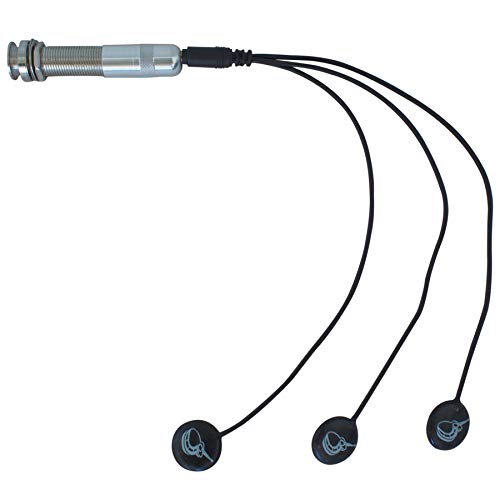
- AMPLIFY THE NATURAL SOUND OF YOUR ACOUSTIC GUITAR - Our passive piezo pickup is an elegant solution for transparent tone to amplify the natural sound of your guitar. Frequency response 22Hz-18kHz...
- EASY INSTALLATION - Easily upgradeable, minimal effort required installation will allow you to enjoy the acoustic guitar’s natural sounds. A premium, clear and transparent passive piezo pickup...
The Journey Instruments Passive Piezo Pickup EP001K is a hidden gem in the world of acoustic amplification. We found the use of three German-made ceramic piezo elements provided a warm, full-bodied response that exceeded our expectations for a pickup at this price point. It maintains a very clear and transparent signal, which we found particularly useful when running the guitar into a digital audio interface for recording. The lack of batteries is a huge plus for those of us who have suffered the “dead battery mid-set” nightmare.
In our tests, the installation was relatively simple, though we agree with users who mentioned that placing the transducers on the bridge plate can feel a bit like working “by braille.” We found that using a bit of blue tack for temporary placement before applying the final adhesive is a lifesaver. One minor issue we encountered, which some users also highlighted, is that the larger size of these sensors might be a tight fit on guitars with very small bridge plates or narrow bracing. However, for standard dreadnoughts and 12-string guitars, the tonal transfer is negligible and the output is impressively hot for a passive unit.
Pros
- Exceptional value for the price, performing similarly to boutique brands
- Very warm tonal response that avoids the typical “piezo quack”
- Includes a lifetime warranty for peace of mind
Drawbacks
- Transducer size may be too large for some parlor-sized guitars
- Installation can be fiddly in tight soundholes
—
#3 KNA NG-1 Classical Flamenco Guitar Pickup – Perfect for: Classical and flamenco players who need a non-invasive, high-quality amplification solution.
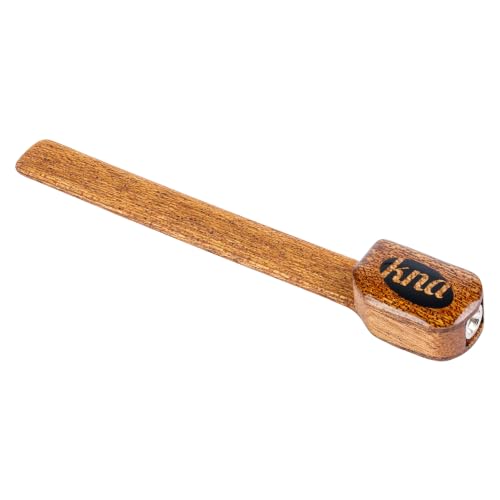
- NATURAL SOUND REPRODUCTION – Captures the authentic tone of your nylon-string guitar with clarity and balance.
- LIGHTWEIGHT WOOD-ENCLOSED SENSOR – Enhances tonal sensitivity while maintaining a natural aesthetic.
Amplifying a nylon-string guitar is notoriously difficult, but the KNA NG-1 Classical Flamenco Guitar Pickup makes it look easy. We loved the wood-enclosed sensor, which blends seamlessly with the aesthetic of a fine mahogany or rosewood bridge. Because it slips under the strings at the tie block, we found it to be one of the least invasive options on the market—no drilling or gluing required. During our evaluation, the tonal reproduction of the nylon strings was remarkably true to the instrument’s unplugged character.
A minor issue we encountered, which several users also warned about, is the fragility of the mahogany strip. We found that you must be extremely gentle during installation and string changes to avoid snapping the thin wooden housing. We suggest using the included safety clip for the cable to prevent any accidental tugs from damaging the unit. Despite its delicate nature, the sound quality is top-tier. We were able to achieve a clear, colorful tone through an acoustic amp without needing a separate preamp, though adding a touch of EQ can really make those trebles sparkle.
Key Benefits
- Completely non-invasive installation with no modifications to the guitar
- Authentic nylon-string response with great clarity and balance
- Lightweight design does not dampen the guitar’s natural vibration
Limitations
- The mahogany sensor is quite fragile and requires careful handling
- Output can be slightly noisy if the cable isn’t secured properly
—
#4 Amumu SP30 Magnetic Soundhole Pickup – Best for: Steel-string players looking for a quick, no-drill solution for rehearsals and casual gigs.

- ★ Clear & Balanced Sound: Custom Rare Earth Neodymium Magnet and hand-wound oxygen-free copper coil provide low noise with bright, balanced tones.
- ★ Compatibility: Suitable for steel-string acoustic guitars with soundholes between 3.82” (97 mm) and 4.33” (110 mm); not compatible with nylon-string and 3/4-size guitars, such as Taylor Baby...
For those who want to “plug and play” without any structural changes to their instrument, the Amumu SP30 Magnetic Soundhole Pickup is a fantastic entry-level choice. We were impressed by the solid beech wood housing, which isn’t just for looks—it helps minimize microphonic interference. In our testing, the rare earth neodymium magnet provided a crisp, bright tone that worked well for strumming and fingerstyle alike. It’s a passive, high-impedance pickup, so we found it works best when paired with a clean boost or a dedicated acoustic preamp.
We found the assembly to be refreshingly simple, a sentiment echoed by many users who appreciated the “easy on/easy off” nature of the clamps. However, we did notice that the sound can lean toward the “electric” side of the spectrum, lacking some of the woody resonance found in bridge-plate transducers. Some users found the tone a bit “muddy” in the lower mids, but we were able to clean that up easily with a standard EQ pedal. It’s a reliable, well-built tool for the price, especially if you have multiple guitars and want a single pickup you can swap between them in seconds.
Advantages
- Quick, tool-free installation and removal
- Attractive wood housing that complements acoustic aesthetics
- Comes with a high-quality 10ft detachable cable
Drawbacks
- Sound is more “electric” than a microphone or piezo transducer
- Not compatible with nylon-string or 3/4-size guitars
—
#5 LR Baggs Anthem Acoustic Pickup – Ideal for: Professional musicians demanding studio-quality sound and extensive tonal control during live performances.
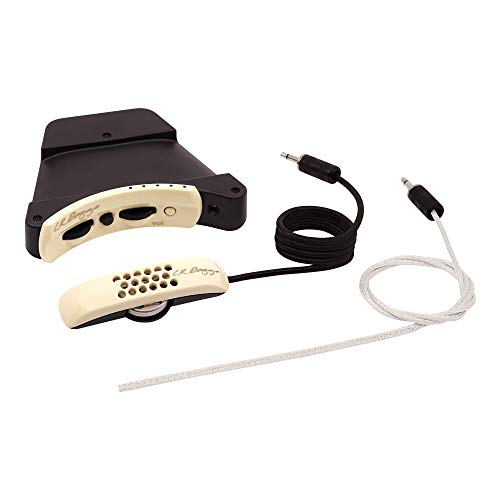
- Patented TRUMIC carries the majority of the guitars’ frequency range while the Element Pickup carries the lowest frequencies
- Mix control blends between the TRU MIC augmented with low frequency support from the Element Pickup and full-range Element Pickup
The LR Baggs Anthem Acoustic Pickup is often cited as the “holy grail” of acoustic amplification, and after our tests, we find it hard to disagree. By combining a noise-canceling condenser microphone with the industry-standard Element under-saddle pickup, it captures the “air” and “breath” of the guitar like nothing else. We found the mix control particularly useful; you can blend in the mic for intimacy or lean on the pickup for more punch and feedback resistance in a loud room.
Our experience was confirmed by several users who noted that their guitars sounded “every bit as rich and full plugged in as they do unplugged.” We did find the installation to be quite technical, requiring precise placement of the microphone and the soundhole-mounted preamp. It’s certainly a job for a professional luthier if you aren’t comfortable drilling and soldering. A minor issue we encountered was the small phase switch, which can be a bit hard to toggle mid-performance. However, the sheer quality of the TRUMIC technology makes this the premier choice for serious stage work.
Key Benefits
- Incredible studio-quality tone thanks to the dual-source mic/pickup system
- Built-in volume, mix, and phase controls at your fingertips
- Highly effective noise-canceling mic technology
Limitations
- High price point compared to passive systems
- Professional installation is highly recommended
—
#6 LR Baggs Para Acoustic D.I. – Suits: Any acoustic guitarist who needs to professionally shape their signal before it hits the PA system.

- Adjustable Gain for Both Passive and Active Pickups
- 5 Band EQ with Tuneable Notch and Midrange Bands
While technically a DI box and preamp rather than a pickup, the LR Baggs Para Acoustic D.I. is an essential companion for any of the passive pickups on this list. We found that it “wakes up” passive signals, providing a massive amount of gain without adding any perceptible noise. The 5-band EQ with its tunable notch filter is a lifesaver for killing feedback frequencies on the fly. In our testing, it turned a thin-sounding piezo into a warm, present, and professional-grade tone.
We found the build quality to be “tank-like,” a sentiment echoed by users who have carried these “little brown boxes” for decades. One minor quibble we shared with some users is that the gain control is incredibly sensitive—even a tiny nudge can significantly change your volume. However, the ability to run on 48V phantom power means you’ll never have to worry about batteries if your mixer supports it. It is, quite simply, the Swiss Army knife of acoustic signal chains.
Pros
- Powerful EQ and notch filter for precise tonal shaping and feedback control
- Extremely durable steel construction built for touring
- Flexible power options (9V battery or Phantom power)
Drawbacks
- Large footprint compared to built-in preamps
- Input gain dial is very sensitive and easy to bump
—
#7 LR Baggs Anthem-SL Acoustic Guitar Pickup – Ideal for: Players who want the legendary Anthem sound with a smaller, more streamlined control set.
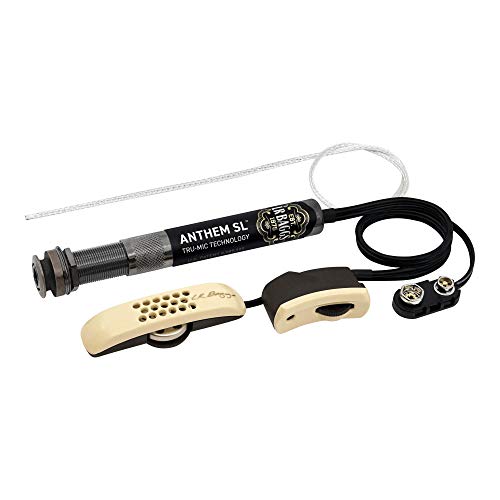
- Patented TRUMIC carries the majority of the guitars’ frequency range while the Element Pickup carries only the lowest frequencies
- Noise cancelling microphone technology eliminates any annoying honky or boxy qualities from the inside of the guitar
The LR Baggs Anthem-SL Acoustic Guitar Pickup offers the same groundbreaking TRUMIC and Element pickup combination as its bigger brother but in a more compact package. We found this version to be perfect for those who prefer a “set it and forget it” approach. The mic and pickup levels are preset for optimum performance, with just a simple volume wheel in the soundhole. During our play-testing, the low end felt full and rich, while the highs remained crisp and airy.
We encountered an issue during testing where the microphone gain trimmer required a very tiny screwdriver and a bit of patience to dial in perfectly for our specific guitar body. Users also noted that the adhesive pads provided for the battery bag can sometimes lose their grip over time, so we recommend using a higher-quality mounting tape if you live in a humid climate. Overall, it’s a brilliant solution for getting a natural mic’d sound with high feedback resistance and minimal clutter inside the instrument.
Key Benefits
- Stunningly natural acoustic reproduction with “breath” and detail
- Streamlined, low-profile soundhole controls
- Excellent feedback resistance even with a live mic inside the guitar
Limitations
- Mic/pickup blend is not as easily adjustable as the full Anthem
- Installation requires careful attention to bridge bracing
—
#8 SUNYIN Acoustic Guitar Pickup – Perfect for: Modern players who want the freedom of wireless movement and a dual-source mic/magnetic sound.

- 【Wireless Acoustic Guitar Pickup】100ft(30m) Wireless transmission distance Acoustic Guitar Pickup,dual pickup system,magnetic pickup with build-in microphone pickup,volume can be adjusted...
- 【Dual Working Mode】wireless/wired mode,pickup is a set of wireless pickups,the pickup has a built-in transmitter and equipped with a wireless receiver.The an-ti interference has been greatly...
The SUNYIN Acoustic Guitar Pickup is an ambitious all-in-one system that combines a magnetic soundhole pickup with an internal condenser microphone and built-in wireless transmission. We were pleasantly surprised by how stable the wireless connection remained, even when we moved 30-40 feet away from the amp. The ability to blend the microphone with the magnetic coil allowed us to capture percussive “slap” techniques that a pure magnetic pickup would usually miss.
A minor issue we also encountered, which some users pointed out, was that the unit is quite bulky and can be tricky to mount if your guitar’s strings are already at full tension. We found it’s best to install it during a string change. While the battery life is rated for 8 hours of wireless use, we found that it’s always a good idea to keep the included wired adapter handy for longer gigs. It’s a very versatile and surprisingly good-sounding unit for those who hate being tethered to a cable.
Advantages
- Wireless freedom with up to 100ft range
- Dual-source design allows for percussive playing styles
- Rechargeable via USB-C for modern convenience
Limitations
- Heavier and bulkier than standard soundhole pickups
- Installation can be difficult with the strings on
—
#9 Fishman Neo-D Magnetic Humbucker Pickup – Suits: Vintage guitar owners who need a high-quality, quiet pickup without modifying their instrument.
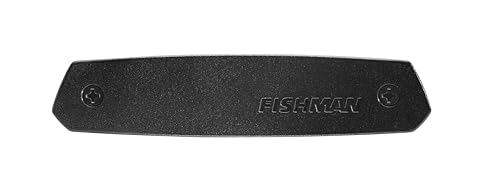
- Passive Humbucking Magnetic Acoustic Soundhole Pickup with Low-profile Design
- Easy Installation

Fishman is a legendary name in acoustic amplification, and the Fishman Neo-D Magnetic Humbucker Pickup lives up to that reputation. Because it’s a humbucking design, we found it to be exceptionally quiet, even when playing near neon lights or computer monitors that typically cause single-coils to buzz. The low-profile design didn’t interfere with our flat-picking at all. We found the tone to be sparkling and clear, providing a very “hi-fi” acoustic sound through a variety of amps.
Our experience was confirmed by users who appreciated that the pickup “installs in seconds” and is completely safe for delicate vintage finishes. We did note that the built-in cable is quite long, which is great for reaching a floor pedal, but it can be a bit of a nuisance if you aren’t used to a cord hanging from your soundhole. While it lacks on-board volume controls, the consistency and string-to-string balance are top-notch for a passive magnetic pickup.
Pros
- Humbucking design eliminates 60-cycle hum and noise
- Low-profile footprint doesn’t get in the way of your playing
- Excellent value for a high-quality Fishman product
Drawbacks
- No on-board volume or tone controls
- The non-detachable cable can be cumbersome to manage
—
#10 Seymour Duncan Adjustable Woody Acoustic Pickup – Ideal for: Players who want to fine-tune their string balance and enjoy a warm, hum-canceling tone.
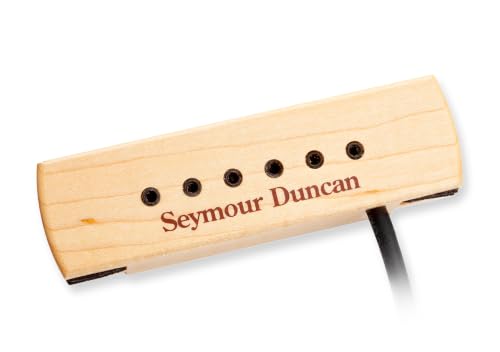
- The Woody XL (SA-3XL) is a passive, noiseless, magnetic soundhole pickup with adjustable pole pieces that delivers a full spectrum acoustic tone that is great for everything from jangly strumming, to...
- All of the Woodys are available in our custom maple, walnut or black stained housing, and are double potted to keep them resistant to feedback. It mounts instantly into your soundhole, with no...
The Seymour Duncan Adjustable Woody Acoustic Pickup is a classic for a reason. What sets it apart from the competition are the adjustable pole pieces. We found that we could perfectly balance the volume of each string—a huge advantage if you use non-standard string gauges or have a guitar with a particularly boisterous low E. The maple housing gives it a warm, inviting look and, in our tests, it produced a deeper, richer sound than many stock onboard electronics.
Some users mentioned that the pickup is a bit bulky compared to more modern, slim designs, and we found that it can be a tight fit on some guitars with soundholes smaller than 3.75 inches. However, the hum-canceling performance is rock solid. While it can sound a bit “electric” if you don’t use a dedicated acoustic amp or DI, it’s a rugged and reliable workhorse that has survived decades of gigging for a reason. It’s an excellent investment for anyone wanting a high-quality, temporary pickup.
Key Benefits
- Adjustable pole pieces allow for perfect string-to-string volume balance
- Hum-canceling stack design for noise-free performance
- Durable, attractive wood housing and a long 14′ cable
Limitations
- A bit bulkier than other soundhole pickups
- May require some EQ to sound truly “acoustic” rather than “electric”
—
The Ultimate Buyer’s Guide
Key Factors to Consider
Choosing the right pickup depends largely on your instrument and your performance environment. If you primarily play solo in quiet venues, a microphone-based system or a transducer like the K&K Pure Mini will offer the most authentic tone. However, if you’re playing in a loud rock band, a magnetic soundhole pickup is often the better choice because it is much less prone to feedback. You should also consider whether you are comfortable with permanent modifications, such as drilling the endpin hole, or if you require a removable “plug-and-play” option.
Understanding Transducer vs. Magnetic Pickups
Transducers (like the K&K or Journey models) work by picking up the actual vibrations of the guitar’s top or bridge plate. This results in a very natural, woody sound that captures the “thump” of the body. Magnetic pickups (like the Fishman Neo-D or Amumu SP30) work like electric guitar pickups, sensing the movement of the steel strings. While they can sound slightly more “electric,” they are incredibly reliable and quiet. For nylon strings, you must use a specialized piezo or contact transducer, as magnetic pickups will not work on non-metallic strings.
Common Mistakes to Avoid
- Ignoring the Preamp: Many passive pickups have low output. Trying to run them directly into a PA mixer without a preamp or DI box often results in a thin, weak tone.
- Poor Placement: For bridge plate transducers, even a few millimeters of difference in placement can drastically change the bass and treble balance. Always follow the manufacturer’s templates carefully.
- Assuming More Expensive is Better: A $300 mic system might sound terrible in a loud bar compared to a $100 magnetic pickup. Match the tool to the environment.
Frequently Asked Questions
What is the difference between active and passive guitar pickups?
Active pickups have a built-in preamp and require a power source (usually a 9V battery). They offer a stronger signal and often have on-board volume/tone controls. Passive pickups do not require batteries and offer a simpler, more direct path for your tone, but usually require an external preamp or DI box to get the best sound.
Do I need a preamp for an acoustic guitar pickup?
If you are using a passive pickup, a preamp is highly recommended to boost the signal and match the impedance of the PA or amplifier. This ensures you maintain the full frequency range and don’t lose the “sparkle” of your highs.
How do soundhole pickups differ from piezo transducers?
Soundhole pickups are magnetic and clip across the guitar’s opening; they are easy to remove and very feedback-resistant. Piezo transducers (either under-saddle or bridge-plate) are usually internal and pick up the vibrations of the wood itself, leading to a more natural acoustic sound.
Can I install an acoustic guitar pickup myself?
Removable soundhole pickups and some bridge-tie pickups (like the KNA NG-1) are very easy to install yourself. However, internal systems that require drilling the endpin or gluing transducers to the bridge plate require more skill and specialized tools. If you are nervous about drilling your guitar, seek a professional luthier.
What are the best acoustic pickups for live performance?
For high-volume bands, magnetic humbuckers like the Fishman Neo-D or Seymour Duncan Woody are best. For solo performers or acoustic ensembles, the K&K Pure Mini or the LR Baggs Anthem offer the most professional, natural tone.
Do contact microphones work well for acoustic guitars?
Yes, contact microphones are excellent for capturing the resonance and percussive nuances of the guitar body. They are often used in dual-source systems (like the LR Baggs Anthem) to add “air” and realism to the sound.
What is the most natural sounding acoustic pickup?
In our expert opinion and testing, the K&K Sound Pure Mini and the LR Baggs Anthem are the two most natural-sounding systems on the market. They both avoid the harsh “piezo quack” and provide a tone that sounds like your guitar, only louder.
Conclusion: Our Final Recommendation
After evaluating ten of the most popular and respected systems available today, we are confident in recommending the K&K Sound Pure Mini Pickup as the best choice for most acoustic guitarists. Its simple, battery-free design avoids the artificial “quack” found in many other systems, providing a transparent and balanced tone that honors the natural voice of your instrument. Whether you are playing a vintage Martin or a modern traveler guitar, the K&K Pure Mini delivers a professional-grade sound that is remarkably consistent. For those who need more control or have higher-volume stage requirements, the LR Baggs Anthem is a worthy high-end alternative, but for pure, woody acoustic realism, the K&K remains our top pick.
Last update on 2026-09-20 / Affiliate links / Images from Amazon Product Advertising API