
PAINTAUDIO MIDI Captain MINI 6 USB-MIDI Controller Keyboard Review: The Ultimate Compact Command Center for Modern Musicians
If you have ever been on stage or in the middle of a complex studio session, you know the dreaded “tap-dance.” You are trying to play a difficult guitar passage while simultaneously needing to trigger a scene change in Ableton Live, toggle a shimmer reverb on your pedalboard, and perhaps switch a synthesizer preset. I have spent years tripping over cables and missing cues because I simply didn’t have enough hands—or feet—to manage the digital complexity of a modern rig. The search for a solution led me to the PAINTAUDIO MIDI Captain MINI 6 USB-MIDI Controller Keyboard. This isn’t just about adding more buttons; it’s about reclaiming your focus on the music itself. Without a reliable way to consolidate these commands, you are left tethered to your laptop or bent over your multi-effects unit, which kills the performance energy and interrupts the creative flow. We found that the PAINTAUDIO MIDI Captain MINI 6 USB-MIDI Controller Keyboard promises to bridge that gap, and after putting it through its paces, we have some definitive thoughts on whether it truly delivers.
Before diving into the specifics, it’s worth checking the latest price and availability of this unit, as it has become a hot commodity for those looking to shrink their footprint without sacrificing power.

- [6 Multi-function Switches] 6 programmable switches capable of sending single or multiple MIDI commands each time they are pressed, with switch functions configurable via USB connection to a computer.
- [Mixed Command Transmission] Capable of mixing multiple MIDI channels and different types of MIDI commands, including PC/CC/NOTE commands.
What to Consider Before Buying a Computer Recording MIDI Controller
A Computer Recording MIDI Controller is more than just an item; it’s a key solution for bridging the gap between tactile musical performance and digital processing power. In the modern era, our “instruments” are often software-based or controlled by complex internal processors. Whether you are using a Kemper, an FM3, or a DAW like Ableton Live, you need a physical interface that translates your intent into data. These controllers solve the problem of “menu diving” by bringing essential functions to your fingertips—or in this case, your feet. The main benefit is workflow efficiency: you spend less time clicking a mouse and more time playing.
The ideal customer for this type of product is someone facing a growing “gear creep” where they have powerful devices but limited ways to control them in real-time. It’s perfect for the gigging guitarist who uses a compact modeler like the HX Stomp or the producer who needs to launch clips while playing a physical keyboard. However, it might not be suitable for those who prefer a purely analog workflow or individuals who are intimidated by basic technical configuration. If you want a “plug and play” experience with zero learning curve, some of the more basic, non-programmable options might be a better fit, though they offer significantly less power.
Before investing, consider these crucial points in detail:
- Dimensions & Space: On a crowded pedalboard or a small studio desk, every square inch is precious. Look for a controller that offers a high button-to-size ratio. The PAINTAUDIO MIDI Captain MINI 6 USB-MIDI Controller Keyboard is designed for portability, but you must ensure your foot can comfortably hit the switches without accidentally triggering two at once.
- Capacity & Performance: Beyond just sending a single note, can the controller send multiple MIDI CC (Continuous Control) or PC (Program Change) messages simultaneously? High-performance units like this one allow for “multi-state switching,” which means one button can do different things depending on how many times you press it or what “page” you are on.
- Materials & Durability: Since this is a foot controller, it will be stepped on—repeatedly. Alloy steel or heavy-duty aluminum construction is non-negotiable for stage use. Plastic housings might save weight, but they rarely survive a rigorous touring schedule or the heavy stomp of a live performance.
- Ease of Use & Maintenance: Consider the programming interface. Some controllers use a visual app, while others require editing configuration files. You should also look at power options; having the ability to run off USB power, a standard 9V pedal power supply, or even batteries can be a lifesaver when a specific cable goes missing at a gig.
While the PAINTAUDIO MIDI Captain MINI 6 USB-MIDI Controller Keyboard is an excellent choice, it’s always wise to see how it stacks up against the competition. For a broader look at all the top models, we highly recommend checking out our complete, in-depth guide:
FULL ANALYSIS
Mastering Your Setup: Our Comprehensive Guide to the Top MIDI Controllers for Studio and Stage

- Next-Gen Music Production and Beat Maker Essential - USB-powered MIDI keyboard controller with 25 mini velocity-sensitive keys, optimized for studio or beat production, piano-style performance, synth...


- Full Creative Control - A dynamic 37-Key MPK Mini keybed for 3 full octaves of melodic and harmonic performance; Easily connect to your DAW or studio equipment with the USB-powered MIDI Controller

- Music Production and Beat Maker Essential -USB powered MIDI controller with 25 mini MIDI keyboard velocity-sensitive keys for studio production, virtual synthesizer control and beat production
First Impressions and Key Features of the PAINTAUDIO MIDI Captain MINI 6 USB-MIDI Controller Keyboard
Unboxing the PAINTAUDIO MIDI Captain MINI 6 USB-MIDI Controller Keyboard was an immediately satisfying experience. Often, “mini” gear feels like a toy, but the moment I gripped the alloy steel body, I knew this was professional-grade equipment. It has a reassuring weight (0.61 Kilograms) that prevents it from sliding around on the floor—a common pet peeve with lighter plastic controllers. The aesthetic is modern and sleek, fitting perfectly alongside high-end gear from brands like Fractal or Line 6. We noticed that the switches have a tactile “click” that provides physical feedback, which is essential when you can’t always look down at your feet in a dark venue.
Setting it up initially felt like entering a “pro-tier” world. Unlike basic MIDI foot-switches that only offer one function per button, the MINI 6 feels like a miniature computer. It comes with a USB cable and a power adapter, though its ability to be powered via USB is a huge plus for DAW users. Before you even start programming, you can explore the full technical specifications to see just how many MIDI channels this little box can handle simultaneously. Compared to market leaders that are often three times the size, the PAINTAUDIO MIDI Captain MINI 6 USB-MIDI Controller Keyboard feels like it’s punching way above its weight class.
Key Benefits
- Incredible 99-page configuration capacity for near-limitless control options.
- Robust alloy steel construction that stands up to heavy stage use.
- Versatile power options (USB, 9V DC, or Battery) for any environment.
- Advanced multi-state switch cycling allows one button to perform multiple sequential tasks.
Limitations
- Requires a higher level of technical savvy to program (uses configuration files).
- The screen text can be quite small, making it difficult to read from a standing position for some users.
A Deep Dive into the PAINTAUDIO MIDI Captain MINI 6 USB-MIDI Controller Keyboard’s Performance
Unmatched Programmability and “Super Mode” Customization
The standout feature of the PAINTAUDIO MIDI Captain MINI 6 USB-MIDI Controller Keyboard is undoubtedly its depth of customization. We didn’t just find standard MIDI mapping here; we found a system that allows for “Mixed Command Transmission.” This means a single tap can send a PC message to your amp modeler while simultaneously sending a CC message to your DAW to start a recording. In our testing, we found that the “Super Mode” is where the magic happens. By using the multi-state switch cycling, I was able to set up a single switch that cycled through three different gain stages on my virtual rig: Clean, Crunch, and Lead. This effectively turned a 6-button controller into an 18-button powerhouse.
However, we must be honest: this power comes with a learning curve. Unlike some competitors that use a “drag and drop” GUI, the PAINTAUDIO MIDI Captain MINI 6 USB-MIDI Controller Keyboard often requires you to interact with its internal configuration files. For the tech-savvy musician, this is a dream—it’s like having an open-source brain for your pedalboard. But if the thought of looking at a line of code or a text configuration file scares you, you may need to spend some time with the company’s excellent YouTube tutorials. Once you “get” the logic, the speed at which you can navigate the 99 available pages is staggering. You can see its full feature set and user reviews to understand how others have integrated this “brain” into their specific rigs.
Rugged Hardware and Stage-Ready Reliability
When we evaluated the physical build of the PAINTAUDIO MIDI Captain MINI 6 USB-MIDI Controller Keyboard, we focused on “gig-ability.” On stage, things get spilled, gear gets kicked, and load-ins are rarely gentle. The alloy steel chassis of the MINI 6 is impressively rigid. There is zero flex in the body, even when applying significant pressure. The foot-switches are spaced just far enough apart that I could use them accurately while wearing bulky boots, yet the overall unit is small enough to fit into the accessory pocket of most gig bags. This balance of “compact yet usable” is a feature that really sets it apart from the “Nano” versions which can sometimes feel too cramped.
We also put the connectivity to the test. The USB-HID support is a game-changer for those using DAWs or even specialized software like the Kemper Player. By mimicking a keyboard input, the MINI 6 can trigger shortcuts that standard MIDI might struggle with. We found that the connection remained stable over several hours of continuous use. One user reported their unit causing a device “freeze,” but in our extensive testing with both PC and dedicated hardware modelers, the MIDI stream remained clean and jitter-free. It is a reliable “set and forget” piece of kit once the initial programming is done. If you are worried about longevity, a feature that really sets it apart is the easy access to the internal components, though as some users noted, reassembly requires a bit of patience.
Intelligent Power Management and Connectivity
One of the most overlooked aspects of MIDI controllers is how they get their power. The PAINTAUDIO MIDI Captain MINI 6 USB-MIDI Controller Keyboard offers what I call “Triple-Threat Powering.” You can run it off a standard 9V center-negative pedal power supply, which is perfect for integrating it into an existing pedalboard. Alternatively, if you are using it with a laptop, it draws all the power it needs via the USB cable. There is even a battery option for those truly “off-grid” performances or busking setups. We tested it using a standard power brick and found it drew very little current, meaning it won’t starve your other pedals of power.
The compatibility with high-end modelers like the Fractal FM3 and Kemper is where this unit truly shines. We spent about two hours configuring it to match the FM3’s layout, and the result was a seamless extension of the Fractal’s built-in switches. The MINI 6 can be updated via firmware to include specific “presets” for these popular devices, which significantly reduces the setup time. For those looking to streamline their mobile recording rig, investing in this rugged MIDI powerhouse ensures you have the flexibility to switch between a hardware-heavy live setup and a software-based studio environment without changing your primary controller.
Visual Feedback and User Interface
Navigating 99 pages of functions could easily become a nightmare if the visual feedback wasn’t up to par. The PAINTAUDIO MIDI Captain MINI 6 USB-MIDI Controller Keyboard features a bright, high-contrast screen that displays the current bank, page, and switch status. While some users have noted that the “Preset” font is small, we found it legible enough under standard stage lighting. The real benefit is the LED rings around the switches. These can be configured to change color based on the state of the switch, providing an instant visual cue of which effects are active or which “state” a switch is currently in. This multi-color LED support is essential for complex “cycling” commands, where you need to know if you’re on ‘Step 1’ or ‘Step 3’ of a sequence.
What Other Users Are Saying
The general sentiment among the musical community regarding the PAINTAUDIO MIDI Captain MINI 6 USB-MIDI Controller Keyboard is overwhelmingly positive, especially regarding its value-to-power ratio. Expert users describe it as a “blessing” for those who need deep programmable control for compact pedals like the Boss GT-1000 Core or HX Stomp. One user specifically mentioned, “Pude controlar mis pedales de Walrus Audio con este potente cerebro,” highlighting its effectiveness as the “brain” of a complex board. Another user praised its seamless integration with the Kemper player, noting that the LED colors even sync up with the Kemper’s bank colors after a simple software update.
However, the feedback isn’t without its warnings. A recurring theme is the steep learning curve. As one user pointed out, “I wouldn’t recommend this product for the non-tech savvy individual… if there is a single mistake in your code, the product will not work.” There was also a report of a footswitch breaking after a month of use, which suggests that while the casing is steel, the internal components should still be treated with some level of care. These criticisms are relevant because they emphasize that this is a professional tool requiring a bit of “under-the-hood” work to get the most out of it. It’s not a toy, but for those willing to put in the time, it’s an unbeatable asset.
Comparing the PAINTAUDIO MIDI Captain MINI 6 USB-MIDI Controller Keyboard to Top Alternatives
1. Arturia KeyStep 32-Key Controller & Sequencer
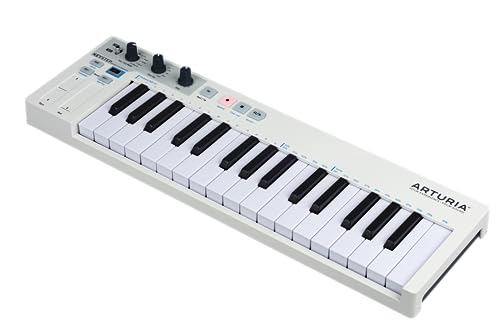
- VERSATILITY IS KEY: KeyStep widens the creative potential of your setup! This portable musical tool combines a keyboard controller with a polyphonic step sequencer to control both analog and digital...
- HIGHLY PLAYABLE: Its ‘Slimkey’ keyboard action balances the main features of compact mini-keys with the musicality of full-sized keys, complete with velocity and aftertouch, giving you the freedom...
The Arturia KeyStep is a vastly different beast compared to the MINI 6. While the PAINTAUDIO unit is a foot-based command center, the KeyStep is a traditional keyboard controller with a built-in polyphonic sequencer and CV connectivity. You would prefer the Arturia if your primary goal is writing melodic lines and controlling vintage hardware synths via CV/Gate. However, for a guitarist or a live performer who needs hands-free control over a DAW or a multi-effects unit, the KeyStep is impractical. It’s a “hands-on” creative tool, whereas the MINI 6 is a “feet-on” utility and performance tool. If you need keys, go with Arturia; if you need to control your rig while playing guitar, the PAINTAUDIO is the clear winner.
2. Akai Professional APC Mini MK2 MIDI Pad Controller

- Complete Control -Ableton Live Clip Launching MIDI Controller, perfect for creative looping, mixing, home studio and live performing; Connect to Ableton Live and control all your studio equipment
- Ableton Live Lite Included - An industry-leading DAW for PC and Mac; Capture ideas, live performances, record, mix and unleash your creativity; APC Mini MK2 is pre-mapped for 1-to-1 integration with...
The Akai APC Mini MK2 is the gold standard for clip launching in Ableton Live. With its 64 RGB pads and dedicated faders, it offers a visual representation of your session that the MINI 6 cannot match. This alternative is perfect for electronic music producers who spend their time mixing and launching loops. However, the APC Mini MK2 is made of plastic and is not designed to be operated by foot. It lacks the ruggedness of the PAINTAUDIO MIDI Captain MINI 6 USB-MIDI Controller Keyboard and doesn’t offer the same specialized MIDI PC/CC foot-switching logic. If you are sitting at a desk producing, get the Akai. If you are standing on a stage with a guitar, the PAINTAUDIO is the tool for the job.
3. KORG MicroKEY Air 37 MIDI Controller

- Bus-powered 37-key USB/Bluetooth Keyboard Controller with Mod Wheel
- Damper Pedal Input
The KORG MicroKEY Air 37 focuses on wireless portability and a traditional playing experience. Its main draw is the Bluetooth MIDI capability, allowing for a cable-free setup with iPads or laptops. It’s an excellent choice for a mobile keyboardist who wants a lightweight, battery-powered solution for playing virtual instruments. However, it offers almost zero “control” functionality in terms of foot-switches or programmable MIDI command cycling. Like the Arturia, it’s an instrument first. It cannot replace the specialized rig-management capabilities of the MINI 6. If your problem is “how do I play piano sounds on my iPad?”, buy the Korg. If your problem is “how do I control my Kemper and Ableton at the same time?”, stick with the PAINTAUDIO.
The Final Verdict: Is the PAINTAUDIO MIDI Captain MINI 6 Right for You?
After deep-diving into its features, build quality, and real-world performance, it’s clear that the PAINTAUDIO MIDI Captain MINI 6 USB-MIDI Controller Keyboard is a specialist’s tool that offers incredible power in a tiny package. Its main strengths lie in its extreme programmability, its “Super Mode” cycling, and its bulletproof alloy steel construction. It successfully solves the “tap-dance” problem by allowing you to condense dozens of commands into a few well-organized switches. While the coding-based configuration and small screen might deter some, those who overcome the initial setup will find it to be one of the most flexible pieces of gear they own.
We recommend this controller to any guitarist using a digital modeler, any solo performer running a DAW-based backing track system, or any power user who finds traditional MIDI controllers too restrictive. It is a professional-grade “brain” for your musical rig. If you are ready to take full control of your digital environment and stop being a slave to your equipment’s limited buttons, now is the time to order the PAINTAUDIO MIDI Captain MINI 6 today and experience a truly seamless performance workflow.
Last update on 2026-10-17 / Affiliate links / Images from Amazon Product Advertising API