
Hughes & Kettner TubeMeister Deluxe Tube Head Review: The Ultimate Lunchbox Versatility King?
For years, I found myself trapped in a classic guitarist’s dilemma: the battle between authentic tube tone and the constraints of modern life. We all crave that harmonic richness and touch-responsive “sag” that only real glass can provide, but cranking a 50-watt half-stack in a home office or a small club is a recipe for an eviction notice or a permanent case of tinnitus. I remember spending hours trying to get my previous heavy-duty heads to sound “right” at lower volumes, only to find the tone thin, fizzy, and completely uninspiring. The problem is that most tube amps need to be pushed to their limits to reveal their soul, yet the opportunities to actually play at those volumes are becoming increasingly rare. This is exactly where the Hughes & Kettner TubeMeister Deluxe Tube Head enters the conversation. It promises to solve the “volume vs. tone” paradox by offering genuine tube warmth in a package that fits into a gig bag, providing a solution for home recordists, weekend warriors, and professional touring musicians alike.

- 2-channel Guitar Head with Selectable 20/5/1 Watts
- Built-in Red Box DI
What to Consider Before Buying Electric Guitar Amplifier Heads
An Electric Guitar Amplifier Head is more than just an item; it’s a key solution for any player who wants to separate their tone-generating “brain” from their speaker cabinet. This modular approach offers unparalleled flexibility, allowing you to pair different heads with different cabs to suit the venue or the studio session. Unlike combo amplifiers, a head allows for easier transport and the ability to customize your “air movement.” Whether you are looking for a high-gain monster or a crystal-clear clean machine, the head you choose dictates the fundamental character of your instrument’s voice. Solving the amplification puzzle is crucial because your amp is responsible for roughly 50% of your total sound; neglecting this choice can make even the most expensive boutique guitar sound mediocre.
The ideal customer for this type of product is someone facing the need for portability without sacrificing professional features, while it might not be suitable for those who prefer the all-in-one simplicity of a combo or those who exclusively play through digital modeling software without the need for physical tubes. If you are a gigging musician who is tired of lugging 80-pound amplifiers up stairs, or a home producer who needs silent recording options, this category is for you. Alternatives like digital modelers exist, but they often lack the physical “push” and organic feel that a real tube circuit provides.
Before investing, consider these crucial points in detail:
- Dimensions & Space: Consider where you will primarily be using the amp. A “lunchbox” head like the Hughes & Kettner TubeMeister Deluxe Tube Head is designed to fit on small desks or atop compact 1×12 cabinets. Its 15.2-pound weight makes it highly portable, but you should still ensure you have a stable surface and proper ventilation, as tubes generate significant heat during operation.
- Capacity/Performance: Wattage isn’t just about volume; it’s about headroom. A 20-watt tube amp can be surprisingly loud—enough to keep up with a drummer—but it will break up sooner than a 100-watt amp. Look for heads with built-in “power soaks” or attenuators that allow you to drop the wattage to 5W or 1W for home use while maintaining the saturated tube feel.
- Materials & Durability: Tube amps are inherently more fragile than solid-state gear. Look for high-quality transformers, sturdy chassis construction, and protective features. The Hughes & Kettner TubeMeister Deluxe Tube Head features a robust metal housing and a plexiglass front, but it’s the internal circuitry—like the Tube Safety Control—that truly protects your investment over the long term.
- Ease of Use & Maintenance: Tube amps eventually need new glass. Consider how easy it is to bias the amp. Some modern heads offer “auto-biasing” features that save you a trip to the technician. Additionally, look for features like an effects loop and a DI output, which simplify your signal chain and make both live performance and recording much more efficient.
While the Hughes & Kettner TubeMeister Deluxe Tube Head is an excellent choice, it’s always wise to see how it stacks up against the competition. For a broader look at all the top models, we highly recommend checking out our complete, in-depth guide:
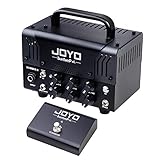
- Channel Switching & Independent Control: The BanTamp XL series features a dedicated footswitch for channel switching and six knobs. This allows you to independently control both the CLEAN and...

First Impressions: The German Engineering of the TubeMeister Deluxe
Unboxing the Hughes & Kettner TubeMeister Deluxe Tube Head is a treat for any gear enthusiast. The first thing you notice is the striking aesthetics—the signature Hughes & Kettner blue glow that emanates from the plexiglass faceplate when powered on. It looks less like a traditional piece of guitar gear and more like a high-end piece of laboratory equipment. At 15.2 pounds, it feels incredibly dense and well-constructed; there are no rattles or loose knobs here. It sits firmly on its rubber feet, and the handle feels secure enough for thousands of trips to the rehearsal space. Before you even plug it in, you can see its full feature set and user reviews that suggest this is a professional-grade tool, not just a practice toy.
Comparing it to market leaders like the Orange Terror series or the Mesa Boogie lunchbox heads, the TubeMeister feels decidedly more “modern.” While Orange goes for a vintage-voiced, mid-forward growl, the Hughes & Kettner TubeMeister Deluxe Tube Head aims for a hi-fi clarity on the clean channel and a tight, aggressive “brown sound” on the lead channel. It doesn’t just feel like a smaller version of a big amp; it feels like a purpose-built solution for the modern player who needs to transition from a bedroom studio to a club stage in seconds. The inclusion of the Red Box DI and the Tube Safety Control (TSC) immediately puts it ahead of many competitors in terms of sheer utility.
Key Benefits
- Exceptional tonal versatility with 20W, 5W, 1W, and 0W power modes.
- Built-in Red Box AE (Ambience Emulation) for studio-quality direct recording.
- TSC (Tube Safety Control) monitors and adjusts bias automatically.
- Ultra-compact and lightweight design for maximum portability.
Drawbacks
- Shared 3-band EQ between Clean and Lead channels can be tricky to balance.
- Lack of a dedicated headphone jack (requires an interface or mixer via Red Box).
Deep Dive Performance Analysis: Living with the TubeMeister Deluxe
The Preamplifier: Clean Sparkle vs. Lead Saturation
When I first fired up the Hughes & Kettner TubeMeister Deluxe Tube Head, I started with the Clean channel. We found that the headroom is surprisingly vast for a 20-watt head. It provides a “boutique” style clean that is glassy and transparent, which serves as a perfect blank canvas for your pedalboard. Unlike some smaller tube amps that get muddy the moment you turn the gain up, the TubeMeister stays articulate. As one user noted, pairing it with an Ibanez TS9 and a Boss reverb adds “massive dimension,” and I couldn’t agree more. The Clean channel doesn’t just sound like a practice amp; it has the depth and chime of a much larger, more expensive head. You can check the latest price and availability to see why this has become a favorite for those who value clean headroom in a small package.
Switching over to the Lead channel is where the “Deluxe” moniker really shines. Hughes & Kettner redesigned this circuit to take inspiration from their flagship TriAmp Mark 3, and it shows. The gain is thick, rich, and harmonically dense. It excels at everything from classic rock crunch to modern high-gain shred. We tested it with a PRS Custom 24 featuring “super hot pickups,” and the result was a punchy, aggressive tone that cut through a mix with ease. The “Boost” feature acts as a third channel of sorts, pushing the Lead channel into even higher saturation for solos. While one user felt the amp lacked a specific “voice,” I found that its “voice” is actually its transparency—it allows the character of your guitar to shine through rather than masking it with a specific EQ mid-hump common in other brands.
The Power Soak: True Tube Tone at Any Volume
The standout feature of the Hughes & Kettner TubeMeister Deluxe Tube Head is undoubtedly its on-board power soak. This is a feature that really sets it apart from almost everything else in its price bracket. You have the choice between 20 watts, 5 watts, 1 watt, or even 0 watts (speaker-off mode). In my home office tests, the 1-watt setting was still impressively loud, but it allowed me to push the EL84 power tubes into that sweet, compressed saturation without bothering the neighbors. This is a massive benefit for home players who want the feel of a cranked amp at “television” volumes.
The 5-watt mode is perfect for rehearsals with a drummer who has a light touch, while the full 20 watts provides enough punch to handle most club gigs when paired with a decent 1×12 or 2×12 cabinet. The power soak isn’t just a volume knob; it actually changes the way the tubes interact, giving you that authentic power-amp distortion that digital modeling often fails to replicate accurately. We found that even at the 1W setting, the low-end remained tight and the highs didn’t get fizzy—a common problem with external attenuators. This internal integration ensures the amp’s circuit remains protected and tonally consistent across all power levels, demonstrating the sheer versatility of the TubeMeister Deluxe.
Red Box AE and Recording Capabilities
For the modern home studio enthusiast, the Red Box AE (Ambience Emulation) DI output is a game-changer. This XLR output sends a frequency-compensated signal directly to your recording interface or a front-of-house mixer. It emulates the sound of a mic’d 4×12 cabinet, and it sounds remarkably good. I spent several hours recording tracks directly into my DAW using the 0-watt (silent) mode. The convenience of not having to set up microphones or deal with room acoustics cannot be overstated. You get the real tube signal path—from the preamp to the power amp—directly into your computer. To understand the full potential of this setup, you can view this amp’s unique technical specifications regarding its direct-out capabilities.
During live performances, the Red Box allows you to send a consistent signal to the PA system while using your on-stage cabinet only for monitoring. This ensures the sound guy gets a perfect signal every time, regardless of how “spirited” the stage volume might be. While some purists might still prefer a SM57 in front of a speaker, the Red Box AE is so close that in a live mix, the difference is negligible. It provides a level of consistency and ease that makes gigging much less stressful. As one recording-focused user mentioned, “For recording purposes, it’s amazing… that DI to the front of house is awesome.”
The TSC: Reliability and Tube Maintenance
Maintaining a tube amp can be a headache, but Hughes & Kettner has mitigated this with the Tube Safety Control (TSC) system. This circuit constantly monitors the bias of the power tubes, ensuring they are always running at peak efficiency. If a tube fails, the TSC will automatically shut down the faulty pair so you can finish your set on the remaining tubes. On the back of the Hughes & Kettner TubeMeister Deluxe Tube Head, there are small LEDs that indicate the status of each tube. You can even check the bias matching with a guitar pick! This is unrivaled reliability for a tube head of this size.
In practice, this means you don’t have to worry about the “dark art” of biasing when it comes time to swap out your EL84s. You can simply plug in a new matched set, and the TSC handles the rest. This feature alone makes the TubeMeister Deluxe a superior choice for players who are new to tube amps or those who simply want a piece of gear that “just works.” We’ve seen many boutique amps fail on stage due to bias drift, but the TubeMeister is designed to be bulletproof. It’s a testament to German engineering—solving a technical problem with a smart, user-friendly electronic solution.
What Other Users Are Saying
The general consensus among the guitar community regarding the Hughes & Kettner TubeMeister Deluxe Tube Head is overwhelmingly positive, especially regarding its features-to-price ratio. One user highlighted that it is a “great entry-level tube/valve head” where the “clean has decent headroom… but boosted lead is lush with harmonics galore.” This sentiment is echoed by many who use it as their primary home practice and recording tool. Another user praised its “massive punch” and suggested that “until you try it, you will never know,” emphasizing the high quality of German manufacturing. It’s often cited as the perfect addition to your studio for those on a budget who still want “real” tube tone.
However, the feedback isn’t without its critiques. A few users pointed out the difficulty of balancing the two channels due to the shared EQ. “Hard to balance the channels with one EQ shared,” noted one reviewer, which is a valid point for players who need drastically different EQ settings for their clean and lead tones. Another user felt the amp lacked a specific “voice” compared to classic Fender or Vox amps, stating it “has no voice of its own.” While this transparency is a benefit for some, it might be a drawback for those seeking a very specific “vintage” coloration. Despite these minor gripes, the majority of users feel the amp is “well worth the money” and a fantastic recording solution.
Comparing the TubeMeister Deluxe to Top Alternatives
1. Orange Micro Dark Terror 20W Guitar Amp Head

- Power: 20Watt (hybrid)
- Tube: one 12AX7 (preamp)
The Orange Micro Dark Terror is a very different beast compared to the TubeMeister. It is a hybrid head, meaning it uses a 12AX7 tube in the preamp but a solid-state power section. It is significantly smaller and cheaper, making it a favorite for those on a tight budget. Tonally, the Orange is much more focused on mid-range “growl” and high-gain aggression. It features a simple “Shape” knob instead of a 3-band EQ. While it lacks the power soak and the sophisticated DI of the Hughes & Kettner, it is an excellent choice for metal players who want a simple, portable “plug-and-play” head with a very specific, dark character.
2. JOYO Zombie-II Mini Tube Guitar Amp
- Channel Switching & Independent Control: The BanTamp XL series features a dedicated footswitch for channel switching and six knobs. This allows you to independently control both the CLEAN and...
- Versatile High-Gain Platform & Clean Pedal Foundation: The ZOMBIE-II excels at lower gain settings and responds brilliantly to your favorite overdrive pedals, letting you push into higher gain with...
The JOYO Zombie-II is part of the BanTamp XL series and is another hybrid head that packs a massive punch for its size. It’s specifically voiced for modern high-gain (inspired by the Mesa Boogie Dual Rectifier). Unlike the Orange, it features two channels with independent controls and even includes Bluetooth connectivity for jamming along to tracks. It’s an incredibly affordable alternative for the bedroom shredder. However, it lacks the all-tube power section and the professional recording features of the Hughes & Kettner TubeMeister Deluxe Tube Head. If you just need a cheap, high-gain practice tool, the JOYO is hard to beat, but it doesn’t offer the same professional versatility.
3. Orange Micro Terror Guitar Amp Head

- Power: 20 watt (hybrid)
- Tube: 1 12AX7 tube preamp with solid state power amp
The original Orange Micro Terror is the ancestor of the Micro Dark. It’s a single-channel hybrid head that excels at classic rock crunch and “British” cleans. It is incredibly simple—Volume, Tone, and Gain. While it’s a fun and surprisingly loud little amp, it feels more like a “backup” or a practice amp than a main professional tool. It lacks the effects loop of the Micro Dark and the feature-rich back panel of the TubeMeister. Someone who wants the simplest possible tube-vibe experience might prefer this, but for serious recording or versatile gigging, the Hughes & Kettner TubeMeister Deluxe Tube Head is in a completely different league.
Final Verdict: Is the TubeMeister Deluxe Right For You?
After putting the Hughes & Kettner TubeMeister Deluxe Tube Head through its paces, the verdict is clear: this is one of the most versatile and feature-packed “lunchbox” heads on the market. It successfully bridges the gap between a high-fidelity recording tool and a capable live performance amplifier. Its greatest strengths lie in its incredible power soak options, the reliable TSC system, and the stunningly good Red Box AE DI output. While the shared EQ can be a minor hurdle, the sheer quality of the Clean and Lead channels—ranging from glassy sparkle to harmonically rich saturation—makes it a tonal powerhouse. It’s the perfect solution for the modern guitarist who demands authentic tube feel but lives in a world where volume control is a necessity. If you are looking for a professional-grade, portable, and reliable tube head that won’t break the bank, this is the one. Get the TubeMeister Deluxe here and experience the “blue glow” for yourself—it’s an investment in your tone that you won’t regret.
Last update on 2026-09-18 / Affiliate links / Images from Amazon Product Advertising API