
PRS HDRX Guitar Amp Head Review: The Ultimate Hendrix Tone in a Modern 20-Watt Package?
If you are anything like me, you have spent countless hours—and probably a small fortune—trying to capture that elusive, “cranked Marshall” tone that defined the late 1960s. We’ve all seen the videos of Jimi Hendrix at Woodstock, standing in front of a wall of 100-watt stacks, producing a sound that was simultaneously terrifying and beautiful. For decades, the problem for the average player has been simple: to get that sound, you needed a 100-watt head and a stadium-sized stage. If you tried to do it in your bedroom or a local club, you’d either be evicted or fired by the sound engineer. Most modern low-wattage amps attempt to mimic this with digital modeling or high-gain preamp circuits, but they often fall short, lacking the “sag” and organic feel of a real tube circuit. This is where the PRS HDRX Guitar Amp Head enters the conversation, promising to deliver that authentic, documented Hendrix circuit in a package that won’t blow your windows out. After spending weeks with this unit, I’m ready to share if the PRS HDRX Guitar Amp Head is a piece of equipment that finally bridges the gap between legendary history and modern practicality.
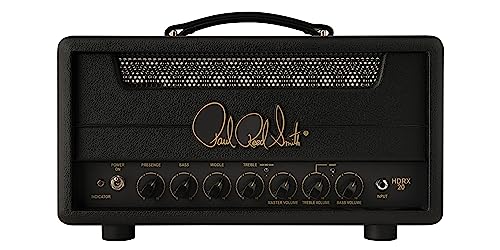
- Features a 3-band TMB tone stack, 2-way bright switch, high-mid gain switch, and presence controls
- Designed with internally bridged channels with individual treble and bass volume controls.

Navigating the World of Tube Heads: What You Need to Know Before Buying a PRS HDRX Guitar Amp Head
An Electric Guitar Amplifier Head is more than just an item; it’s a key solution for guitarists who want to separate their tone-generating “brain” from their speakers. Unlike a combo amp, a head allows you to mix and match with different speaker cabinets, which can radically change your sound. A 20-watt tube head like this one is designed to solve the “volume vs. tone” dilemma. It provides enough headroom for small-to-medium gigs while allowing the power tubes to work hard enough to produce natural compression and overdrive at levels that are manageable for recording or home use.
The ideal customer for this type of product is someone facing the limitation of modern performance spaces—someone who loves the vintage “Plexi” feel but doesn’t have a road crew to carry 80-pound amplifiers. It’s perfect for the tone purist who values touch sensitivity and dynamic range. However, it might not be suitable for those who need a dedicated ultra-clean “pedal platform” with massive headroom for jazz or those who require modern, high-gain “metal” saturated tones without the use of pedals. If you need 100% clean tones at high stage volumes, a higher-wattage model like the 50W or 100W versions might be necessary.
Before investing, consider these crucial points in detail:
- Dimensions & Space: At 23 inches wide and weighing 26 pounds, this isn’t a “micro” head. It has a presence. You need to ensure your speaker cabinet is wide enough to accommodate it comfortably without looking top-heavy. While it’s lighter than a vintage Marshall, you should still explore the full technical specifications here to ensure it fits your current rig setup.
- Capacity/Performance: Wattage is deceptive. 20 watts of tube power is surprisingly loud. This head uses 5881 power tubes, which are known for a smooth high-end and a slightly “American” feel compared to the standard EL34s found in most British-style amps. This affects how the amp breaks up when you dig into the strings.
- Materials & Durability: This amp features a Tolex-covered enclosure and high-quality internal components. PRS is known for meticulous quality control, but because it is a tube amp, it contains glass components that are sensitive to vibration and heat. The 5-year warranty provided by PRS is a significant benefit that speaks to their confidence in the build quality.
- Ease of Use & Maintenance: This is a “player’s amp.” It doesn’t have 50 channels or a built-in computer. It requires you to understand how to blend treble and bass volumes (internally bridged). Maintenance involves the occasional tube replacement, which is standard for any high-performance tube amplifier, but the simplicity of the circuit makes it relatively straightforward for a technician to service.
While the PRS HDRX Guitar Amp Head is an excellent choice for those seeking vintage authenticity, it’s always wise to see how it stacks up against the competition. For a broader look at all the top models, we highly recommend checking out our complete, in-depth guide:
- Channel Switching & Independent Control: The BanTamp XL series features a dedicated footswitch for channel switching and six knobs. This allows you to independently control both the CLEAN and...
Unboxing the Legend: Initial Thoughts on the PRS HDRX Guitar Amp Head
When the PRS HDRX Guitar Amp Head first arrived in the studio, the first thing I noticed was the weight. At 26 pounds, it feels substantial and professional, not like a toy. The black Tolex is applied flawlessly, and the gold piping gives it a regal, vintage aesthetic that immediately commands respect. It looks like a piece of history that’s been polished for the 21st century. Setting it up was a breeze—plug in the IEC power cable, connect it to a 1×12 or 2×12 cabinet (I tested it with a Celestion Vintage 30), and you’re ready to go. Unlike some boutique amps that feel fragile, the switches on the front panel—the 2-way bright switch and the high-mid gain toggle—feel incredibly sturdy with a satisfying “thunk.”
The layout is intuitive, though if you aren’t familiar with “bridged” channels, you might be confused by having two volume knobs. Essentially, PRS has done the work of “jumpering” the channels for you, allowing you to blend the Treble and Bass sides of the preamp to find your perfect balance. My first impression was that this is a “grown-up” amp. It’s not trying to distract you with flashy LEDs or built-in effects; it’s focused entirely on the purity of the signal path. You can see why players are choosing this head as their primary recording tool because it simply looks and feels like a serious professional instrument from the moment you take it out of the box.
Key Benefits
- Authentic “Hendrix” circuit design provides legendary vintage tones at usable volumes.
- Internally bridged channels allow for incredibly precise tone shaping without extra cables.
- 5881 power tubes offer a unique, smooth character that stands out from typical EL84 lunchbox amps.
- Exceptional build quality backed by a reassuring 5-year warranty.
Limitations
- Lack of a built-in effects loop may be a dealbreaker for players who rely on “wet” time-based effects.
- As a single-channel amp, it requires using your guitar’s volume knob to clean up the sound.
Under the Hood: A Comprehensive Performance Analysis of the PRS HDRX Guitar Amp Head
The “Authentic Hendrix” Circuit and Tone Stack
The heart of the PRS HDRX Guitar Amp Head is the “Authentic Hendrix” Touring Circuit. This isn’t just a marketing gimmick; PRS actually had access to one of Jimi’s personal Marshall amps used at Woodstock. They reverse-engineered it to capture the specific component values and circuit modifications that gave Jimi that articulate, screaming tone. In my testing, this translates to an incredible amount of clarity. Even when you have the Treble and Bass volumes pushed high, the notes don’t mush together. You can play a complex chord and still hear every individual string ring out. This is a rare quality in a 20-watt amp, which often tends to get “boxy” or overly compressed when driven hard.
We found that the 3-band TMB (Treble, Middle, Bass) tone stack is highly responsive. Unlike older vintage amps where the knobs sometimes feel like they don’t do anything until they’re at 10, the HDRX 20 allows for subtle adjustments. The 2-way bright switch is a lifesaver when switching between a dark-sounding Les Paul and a bright Stratocaster. It allows you to tailor the “top-end” bite to match your pickups perfectly. This level of control, combined with the internally bridged channels, makes it one of the most versatile single-channel amps I’ve ever used. To truly appreciate the nuances of this circuit, you should check its current price and availability and see if it’s the right fit for your sonic needs.
Master Volume and High-Mid Gain Toggle
One of the biggest hurdles with vintage Plexi-style amps is that they have no Master Volume—they are either “off” or “deafening.” The PRS HDRX Guitar Amp Head solves this with a well-designed Master Volume control that actually works. We were impressed by how much of the amp’s character remains intact even when the Master Volume is turned down to bedroom levels. While no tube amp sounds exactly the same at low volume as it does when it’s breathing fire, the HDRX 20 does a better job than almost any competitor in preserving the “feel” and response at lower decibels.
The High-Mid Gain switch is another standout feature. When flipped, it shifts the frequency response to emphasize those aggressive upper-mids that cut through a band mix. It’s like having a built-in boost pedal that’s perfectly voiced for the amp. In our evaluation, we found that using this switch in conjunction with the Master Volume allowed us to dial in everything from “Wind Cries Mary” cleans to “Voodoo Child” growl. As one user noted, this amp provides the “real scream and hype of a real Plexi” without the massive price tag of the 100-watt USA-built versions. This is a design choice that truly sets it apart from the crowd of budget-friendly “clones.”
Power Tube Character and Headroom
The choice of two 5881 power tubes is a masterstroke by the PRS design team. Most 20-watt heads use EL84 tubes, which have a very specific “chimey” and sometimes “brittle” high-end when pushed. The 5881s in the PRS HDRX Guitar Amp Head feel much bigger. They have a certain “girth” in the low-mids and a sweetness in the highs that feels much more like a 50-watt amp. This contributes to the amp’s ability to handle pedals with ease. Even though there is no effects loop, we found that running delays and reverbs into the front of the amp worked surprisingly well, provided the amp wasn’t totally dimed into high-distortion territory.
The “sag” and response of the power section are what make this amp feel alive. When you hit a power chord hard, you can feel the amp “bloom” as the tubes react to your playing. It’s an organic, tactile experience that digital modelers still struggle to replicate perfectly. If you are looking for an amp that makes you want to play more because of the way it feels under your fingers, this is it. It’s an investment in your long-term tone journey that pays dividends every time you plug in. We also confirmed through various user reports that this amp pairs exceptionally well with a Celestion Vintage 30 speaker, which helps accentuate that “unbelievable” sound that many owners rave about.
What Other Users Are Saying
The general sentiment surrounding the PRS HDRX Guitar Amp Head is overwhelmingly positive, with many users expressing shock at the value for money, especially compared to the $3,000 price tag of the 50W and 100W USA-made siblings. One professional musician noted that it is “by far the best amp I’ve used under $1500,” specifically praising how it sounds when paired with a quality 12-inch speaker. Another user pointed out that while other popular models like the Marshall DSL or Origin series are good, they don’t provide the “real PLEXI feel” that the PRS HDRX delivers with ease.
However, no product is without its critics. Some users have reported issues with the quality of shipping and packaging from certain online retailers. One buyer mentioned receiving a box that appeared to have been previously opened, missing the informational pamphlet and original power cord placement. While this is more of a retailer issue than a product flaw, it’s a reminder to buy from reputable sources to ensure you get a “factory fresh” unit. Additionally, a few players in the UK noted a significant price disparity compared to the US, though they still agreed the tone was superior to the Marshall Studio series. Overall, the consensus is that if you want the Hendrix sound in a modern, reliable package, getting your hands on this Hendrix-inspired powerhouse is a move you won’t regret.
How the PRS HDRX Guitar Amp Head Stacks Up Against Other 20-Watt Contenders
1. Orange Micro Dark Terror Mini Amp Head

- Power: 20Watt (hybrid)
- Tube: one 12AX7 (preamp)
The Orange Micro Dark is a very different beast compared to the PRS HDRX. It is a hybrid amp, meaning it uses a single 12AX7 tube in the preamp but a solid-state power section. It is significantly smaller and more affordable, making it a great choice for metal players who need extreme gain in a lunchbox format. However, it lacks the complex, organic “bloom” and the detailed tone-shaping controls of the PRS. While the Micro Dark is great for high-gain saturation and has an effects loop, it cannot compete with the PRS HDRX when it comes to vintage “Plexi” authenticity and dynamic touch sensitivity. It’s a “fun” amp, whereas the PRS is a “pro” amp.
2. JOYO Zombie-II Mini Tube Guitar Amp
- Channel Switching & Independent Control: The BanTamp XL series features a dedicated footswitch for channel switching and six knobs. This allows you to independently control both the CLEAN and...
- Versatile High-Gain Platform & Clean Pedal Foundation: The ZOMBIE-II excels at lower gain settings and responds brilliantly to your favorite overdrive pedals, letting you push into higher gain with...
The JOYO Zombie-II is another hybrid head that leans heavily into the modern high-gain territory, specifically mimicking a Mesa Boogie-style sound. It offers two channels and even Bluetooth connectivity, which the PRS does not have. This makes it a versatile practice tool for players who want to jam along to backing tracks. However, the build quality and tonal depth are in a different league than the PRS HDRX Guitar Amp Head. The JOYO is a fantastic budget option for those who want modern metal tones on a shoestring, but it lacks the 5881 power tube warmth and the historically accurate circuit design that makes the PRS a true “tone machine” for vintage enthusiasts.
3. Orange Micro Terror Guitar Amp Head

- Power: 20 watt (hybrid)
- Tube: 1 12AX7 tube preamp with solid state power amp
The original Orange Micro Terror is the sibling to the Micro Dark, offering a more classic-rock voiced gain structure. Like the Dark version, it is a hybrid head. It’s incredibly simple—only three knobs—and it’s surprisingly loud for its size. It’s a great “backup” amp or a portable head for casual jamming. But comparing it to the PRS HDRX is like comparing a reliable compact car to a vintage-restored muscle car. The Orange offers a specific “Orange” mid-range growl, but it doesn’t have the headroom, the bridged-channel blending, or the sophisticated “Authentic Hendrix” circuitry that gives the PRS its professional-grade status.
Final Verdict: Is the PRS HDRX Guitar Amp Head Your Next Modern Classic?
After a deep dive into its features and performance, it’s clear that the PRS HDRX Guitar Amp Head is a singular achievement in its price bracket. It manages to capture the “lightning in a bottle” of a modified late-60s circuit without the unmanageable volume or the $3,000 price tag. Its strengths lie in its incredible clarity, the unique character of the 5881 tubes, and its ability to deliver authentic vintage feel at a variety of volume levels thanks to a well-implemented Master Volume. While the lack of an effects loop and its single-channel nature might deter some modern players, those who understand how to use their guitar’s controls and appreciate the purity of a tube-driven signal path will find it nearly perfect.
We recommend this amp to any guitarist who has been chasing the “Plexi” dream but needs a practical solution for the modern age. Whether you are a Hendrix devotee or just someone who wants a high-quality, touch-sensitive tube head for the studio or stage, this amp delivers in spades. It’s a professional-grade tool that honors the past while serving the needs of today’s players. Don’t settle for “close enough” when it comes to your tone—take the next step and experience the legendary sound of the PRS HDRX Guitar Amp Head for yourself.
Last update on 2026-09-18 / Affiliate links / Images from Amazon Product Advertising API