
Laney IRF Dual Top Guitar Amp Head Review: A Portable Powerhouse or Just Another Solid-State Pretender?
If you have ever lugged a 100-watt tube head and a 4×12 cabinet up a flight of narrow stairs for a twenty-minute club set, you know the physical toll of being a traditionalist. For years, we have been told that “real” tone only comes from heavy glass and massive transformers. However, the modern gigging landscape has changed. We are playing smaller venues, using silent stages, and recording in bedrooms where a screaming stack is simply impractical. The search for a lightweight, versatile, and high-quality solution often leads us down a rabbit hole of digital modelers that lack tactile feel or “pedal platform” amps that lack personality. This is exactly where the Laney IRF Dual Top Guitar Amp Head enters the conversation, promising to bridge the gap between old-school punch and modern convenience. Failing to find a solution that offers both power and portability often means compromising your performance or, worse, your back health. We set out to see if this compact head could truly replace the heavy-hitters in our arsenal.
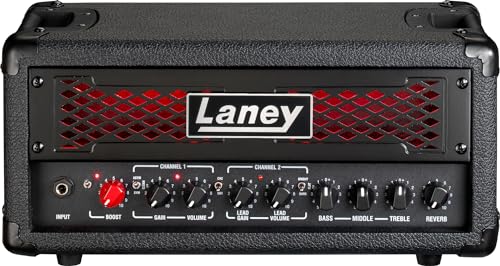
- Transformer Isolated FX Loop for noiseless performance
- On-Board Reverb based around the Secret Path algorithm
What to Consider Before Buying an Electric Guitar Amplifier Head
An Electric Guitar Amplifier Head is more than just an item; it’s a key solution for any player looking to define their sonic identity while maintaining a modular setup. Unlike a combo amp, a head allows you to pair your “brain” with different speaker cabinets, giving you immense control over your final sound. It solves the problem of being locked into one speaker type and offers the flexibility to use different cabinets for different rooms—a 1×12 for the studio and a 2×12 or 4×12 for the stage. Furthermore, modern heads often include features like DI outputs and IR loading, which are essential for the contemporary workflow of home recording and front-of-house integration.
The ideal customer for this type of product is someone facing the challenges of a busy gigging schedule or limited studio space, while it might not be suitable for those who demand the specific sag and harmonic complexity of a high-wattage vacuum tube circuit at all costs. If you are a session player who needs to jump from a jazz gig to a metal session, or a hobbyist who needs great tone at whisper-quiet volumes, this category is for you. Those who strictly play at home and never plan to use a cabinet might find more value in a dedicated software plugin or a floor-based modeler, though the tactile feel of an amp head is hard to beat.
Before investing, consider these crucial points in detail:
- Dimensions & Space: Since the primary draw of a compact head is its footprint, look for a unit that fits easily into a backpack or a small gear bag. A head that is too bulky defeats the purpose of moving away from traditional stacks, so check the weight and physical dimensions against your current transport setup to ensure it truly offers a portability upgrade.
- Capacity/Performance: Wattage is key, but “solid-state watts” often feel different than “tube watts.” Ensure the head has enough headroom to stay clean at the volumes you need, and look for features like power scaling (Vari-Watt) which allow you to get the “pushed” sound of the amp at lower volumes without losing the core characteristics of your tone.
- Materials & Durability: A gigging amp will be bumped, scraped, and subjected to varying temperatures. Look for robust construction materials like stainless steel or heavy-duty alloys rather than thin plastic. The quality of the knobs, switches, and input jacks is also a major indicator of how many years of service the amp will provide on the road.
- Ease of Use & Maintenance: Unlike tube amps that require biased replacements and delicate handling, a solid-state head should be relatively maintenance-free. However, you should evaluate the interface—is it intuitive to dial in a tone on a dark stage? Features like an isolated FX loop and high-quality on-board reverb add value by reducing the need for extra outboard gear.
Understanding these factors is the first step in deciding if a compact powerhouse is right for your rig. While the Laney IRF Dual Top Guitar Amp Head is an excellent choice, it’s always wise to see how it stacks up against the competition. For a broader look at all the top models, we highly recommend checking out our complete, in-depth guide:
- Channel Switching & Independent Control: The BanTamp XL series features a dedicated footswitch for channel switching and six knobs. This allows you to independently control both the CLEAN and...

Unboxing and Initial Impressions: The Laney IRF Dual Top Guitar Amp Head
Taking the Laney IRF Dual Top Guitar Amp Head out of its packaging, the first thing that strikes you is the build quality. At 11.3 pounds, it has a reassuring heft without being a burden. The stainless steel enclosure feels industrial and professional, finished in a sleek black that looks great sitting atop a cabinet. It doesn’t feel like a toy, which is a common complaint with many mini-heads in this price bracket. Before you even plug it in, you can see its full feature set and user reviews that suggest this is a serious tool for serious musicians.
The layout is logical and crowded in a “cockpit” sort of way, featuring two distinct channels and a wealth of toggles for gain structure. We were particularly impressed by the quality of the potentiometers—they have a smooth, resisted turn that allows for fine adjustments. Comparing it to previous Laney solid-state offerings, the Ironheart Foundry series feels like a significant step up in terms of aesthetic and intended professional use. It looks like a piece of high-end studio gear rather than a practice amp, making it a proud centerpiece for any guitar rig.
Key Benefits
- Exceptional portability at just 11.3 lbs with a 60W RMS punch.
- Highly versatile twin-channel design with multiple gain modes.
- On-board IR-loaded speaker emulation for incredible DI and headphone tones.
- Transformer-isolated FX loop ensures a silent signal chain even with complex pedalboards.
Limitations
- The power amp can exhibit a noticeable “hiss” at higher gain settings or certain speaker loads.
- While the tone is excellent for solid-state, it lacks the specific “sag” and compression found in traditional tube amps.
A Deep Dive into the Performance of the Laney IRF Dual Top Guitar Amp Head
Tonal Versatility: From Crystal Cleans to High-Gain Mayhem
The heart of the Laney IRF Dual Top Guitar Amp Head is its dual-channel architecture, and it is here where the amp truly shines. We spent dozens of hours cycling through the various gain modes, and the range is staggering. The Clean channel is not just a “dry” signal; with the toggle switch, you can move between a pristine, high-headroom Clean mode and two gain modes (Symmetrical and Asymmetrical). The Symmetrical gain adds a smooth, even-order harmonic crunch that reminded us of classic British blues-rock, while the Asymmetrical mode provides a more aggressive, jagged edge that cuts through a mix beautifully. This versatility is a feature that really sets it apart from competitors that often offer only one “type” of clean sound.
When switching to the Lead channel, the Ironheart DNA becomes immediately apparent. This channel is designed for high-gain enthusiasts, but it remains remarkably articulate. Even with the gain dialed past noon, we could still hear individual notes in complex chords. It leans heavily toward a modern British sound—think punchy mids and a tight low end rather than the scooped-mid “American” high gain. We found that it responds exceptionally well to the guitar’s volume knob; rolling back the volume cleans up the signal significantly, allowing for dynamic playing that many solid-state amps struggle to replicate. User feedback consistently mentions how “loud” this amp is, and we can confirm: the 60 watts of RMS power into a 4×12 cabinet is more than enough to keep up with a heavy-handed drummer.
Power Management and the Vari-Watt Advantage
One of the most impressive technical feats of the Laney IRF Dual Top Guitar Amp Head is the Vari-Watt control. Traditional amps often lose their character when you turn the master volume down, but Laney’s implementation allows you to scale the output from 100% down to less than 1%. This isn’t just a simple volume attenuator; it feels like it’s changing the headroom of the power section. In our testing, we were able to get “cranked” lead tones at volumes that wouldn’t wake a sleeping baby in the next room. This makes it an invaluable tool for home practice and late-night recording sessions.
On the flip side, when you need the full 60 watts for a gig, the amp delivers with surprising authority. We tested it through a variety of cabinets, including the matching Leadrig 1×12, and the projection was impressive. It’s worth noting that because it is a solid-state power amp, you don’t have to worry about impedance matching in the same way you do with tubes (though you should always follow the manufacturer’s guidelines). This reliability and the ability to scale your power to the environment makes the Laney IRF Dual Top Guitar Amp Head a “Swiss Army Knife” for the gigging guitarist. You can check the latest price and availability to see how this power-scaling feature fits into your budget.
Modern Connectivity: IRs, DI, and the Secret Path Reverb
Laney has clearly looked at how modern guitarists actually work. The inclusion of switchable high-quality Impulse Responses (IRs) for the headphone and XLR DI output is a game-changer. In our studio tests, we bypassed our usual cabinet micing setup and went straight into the interface using the DI out. The results were professional-grade. The IRs provide a realistic cabinet “thump” and high-end roll-off that sounds much better than the basic analog filters found on older amps. This allows for silent stages where you send your signal straight to the front-of-house while using an on-stage monitor (or the headphone out) to hear yourself.
Furthermore, the on-board reverb, based on Laney’s “Secret Path” algorithm, is stunning. It’s not just a basic spring emulation; it has a lush, ambient quality that can go from a subtle room vibe to a deep, cavernous wash. Combined with the transformer-isolated FX loop, which we found to be incredibly quiet even when loaded with digital delay and modulation pedals, the Laney IRF Dual Top Guitar Amp Head acts as a perfect platform for your pedalboard. Whether you are recording at your desk or playing a festival, the connectivity options ensure you are prepared for any signal chain requirement. You can find more about these technical specs and read more user experiences here regarding the DI performance.
Reliability and the Real-World Noise Floor
No review would be complete without addressing the concerns raised by some users regarding noise and reliability. In our evaluation, we did notice a slight background hiss when the gain and volume were pushed to extremes on the Lead channel. However, this is relatively common in high-gain solid-state circuits. It is not intrusive during actual playing, but if you are a recording purist, you might want to use a noise gate in the FX loop. We also acknowledge that some users have reported “dead on arrival” units or reliability issues. While our test unit performed flawlessly over weeks of heavy use, these reports suggest that quality control can occasionally vary.
However, it’s important to balance these negative outliers with the overwhelming majority of positive feedback. Many users have praised the amp as a “worthless brick” alternative—meaning it provides a level of reliability that makes their old tube amps feel like liabilities. The 2-year warranty offered by Laney provides a significant safety net here. When you consider the price-to-performance ratio, the Laney IRF Dual Top Guitar Amp Head remains a compelling option, especially for those who need a backup amp that can actually finish a show. If you’re looking for a dependable rig, you should consider this amp as a top contender in the portable market.
What Other Users Are Saying
The general sentiment surrounding the Laney IRF Dual Top Guitar Amp Head is largely positive, though it is a polarizing piece of gear for some. Many users are absolutely thrilled with the power-to-weight ratio, with one player noting it is a “fantastic amp and plenty loud,” specifically praising its capability for metal and heavy rock. Another user highlighted their “no regrets” purchase, mentioning that at this price point, the tonal options are nearly unbeatable. These comments align with our findings that the amp offers a professional feature set for a fraction of the cost of a boutique tube head.
On the other hand, a few users have expressed frustration. One reviewer noted that the amp had a “hissy” power section and didn’t feel it quite captured a true “tube sound,” suggesting it leans more toward a Vox or Orange flavor than a traditional Marshall roar. More concerning were the rare reports of units arriving defective or failing after several months of studio use. While these instances appear to be the exception rather than the rule, they highlight the importance of purchasing from a reputable source with a solid return policy. Overall, the consensus is that if you get a healthy unit, it is a versatile, powerful, and highly portable tool that punches well above its weight class.
How the Laney IRF Dual Top Guitar Amp Head Compares to the Competition
While the Laney IRF Dual Top Guitar Amp Head is a fantastic choice, it is helpful to see how it compares to other mini-heads on the market. Depending on your specific needs for gain, size, or “tube-feel,” one of these alternatives might be a better fit. You can compare the Laney’s specs directly with these popular models below.
1. Orange Micro Dark Terror Mini Amp Head

- Power: 20Watt (hybrid)
- Tube: one 12AX7 (preamp)
The Orange Micro Dark Terror is a 20-watt hybrid head that uses a single 12AX7 tube in the preamp and a solid-state power section. Compared to the Laney, it is significantly smaller and simpler, featuring only three knobs. While it lacks the dual-channel versatility and IR-loading capabilities of the Laney, it offers that unmistakable Orange “grit” and “sag” that many players crave. It’s an excellent choice for the guitarist who wants a “plug-and-play” experience and doesn’t need the 60 watts of power or the clean headroom that the Dual Top provides. It’s a specialized tool for high-gain rock, whereas the Laney is more of a multi-purpose workstation.
2. JOYO Zombie-II Mini Tube Guitar Amp
- Channel Switching & Independent Control: The BanTamp XL series features a dedicated footswitch for channel switching and six knobs. This allows you to independently control both the CLEAN and...
- Versatile High-Gain Platform & Clean Pedal Foundation: The ZOMBIE-II excels at lower gain settings and responds brilliantly to your favorite overdrive pedals, letting you push into higher gain with...
The JOYO Zombie-II is part of the BanTamp XL series and is a dual-channel 20-watt hybrid head specifically voiced for modern metal (it’s a clear nod to the Mesa Boogie sound). It includes Bluetooth connectivity, which is great for jamming along to tracks at home—a feature the Laney lacks. However, the JOYO is only 20 watts and doesn’t have the sophisticated power scaling or the transformer-isolated FX loop found on the Laney. If you are on a strict budget and want a specific American high-gain tone for home practice, the JOYO is a contender, but the Laney is far more robust and “gig-ready” for professional environments.
3. Orange Micro Terror 20W Guitar Amp Head

- Power: 20 watt (hybrid)
- Tube: 1 12AX7 tube preamp with solid state power amp
The original Micro Terror is one of the most popular mini-heads ever made. Like the Micro Dark, it’s a 20-watt hybrid. It focuses more on classic Orange crunch and bright cleans. Compared to the Laney IRF Dual Top, the Micro Terror feels like a “bare-bones” amp. It lacks an FX loop entirely and only has a single channel. While it is iconic and very affordable, it cannot compete with the Laney’s feature set, output power, or recording flexibility. We would recommend the Micro Terror for beginners or as a very small practice amp, but for the serious performer, the Laney offers much more utility and professional-grade features.
The Final Verdict: Is the Laney IRF Dual Top Guitar Amp Head Worth It?
After putting the Laney IRF Dual Top Guitar Amp Head through its paces in the studio and rehearsal room, our verdict is clear: this is one of the most feature-complete portable amps currently on the market. It successfully bridges the gap between the needs of a recording artist and a gigging musician. While it may not perfectly replicate the feel of a vintage tube amp, its tonal flexibility, massive volume, and modern connectivity—especially the IR-loaded DI—make it an incredibly valuable asset. It solves the problem of back-breaking gear hauls without forcing you to sacrifice your “amp-in-the-room” experience.
We recommend this amp to any player who needs a versatile, lightweight rig that can handle everything from bedroom practice to club gigs. Whether you’re a metalhead looking for a tight Lead channel or a session player who needs a clean pedal platform, this amp delivers. Despite a few reports of noise or QC issues, the overall performance and value are undeniable. If you are ready to modernize your guitar rig and save your spine in the process, we highly suggest you grab the Laney IRF Dual Top Guitar Amp Head today and experience its power for yourself.
Last update on 2026-09-18 / Affiliate links / Images from Amazon Product Advertising API