
Orange Gain Twin Channel Guitar Head Review: The 100-Watt Solid-State Revolution Your Pedalboard Has Been Waiting For
For years, guitarists have been caught in a relentless tug-of-war. On one side, we crave the organic, harmonically rich saturation of a tube amp pushed to its limits. On the other, we desperately want the reliability, portability, and consistency that only solid-state technology can provide. I’ve spent countless hours hauling 60-pound tube heads up narrow club stairs, only to have a power tube fail during the second song. It’s a frustrating cycle of maintenance and physical strain. When I first heard about the Orange Gain Twin Channel Guitar Head, I was skeptical. Could a solid-state head really deliver the “Orange sound” while providing enough headroom for a loud drummer? Solving this dilemma is crucial for the modern gigging musician who needs a “workhorse” that sounds like a boutique masterpiece but fits in a gig bag. If you don’t find the right balance, you’re either stuck with a thin, sterile tone or a chiropractor bill that exceeds your session fees.
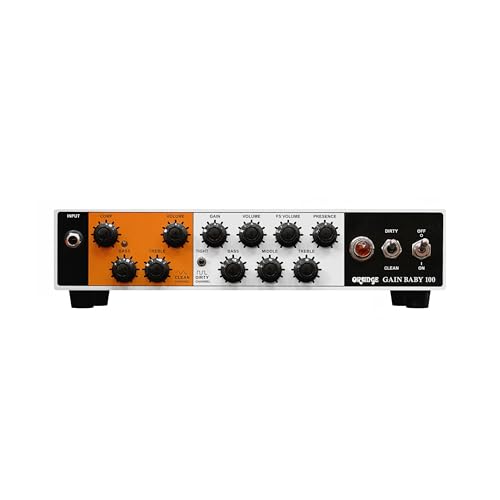
- Single-ended Jfet preamp stage
- Clean and Dirty channel (foot switchable)

What to Consider Before Buying Electric Guitar Amplifier Heads
An Electric Guitar Amplifier Head is more than just an item; it’s the heart of your signal chain and a key solution for shaping your identity as a musician. It takes your guitar’s weak electrical signal and transforms it into a powerful, moving wall of air. Choosing the right head determines whether your pedals will sing or fizzle out, and whether you’ll be heard over the crash of cymbals in a rehearsal room. The right amplifier doesn’t just make you louder; it inspires you to play differently, responding to your touch and dynamics.
The ideal customer for this type of product is the active gigging musician, the home studio producer, or the dedicated hobbyist who needs professional-grade tones without the temperamental nature of vintage glass. It is perfect for those who value “plug-and-play” simplicity and portability. However, it might not be suitable for the absolute purist who refuses to play anything without a glowing vacuum tube, or the bedroom player who strictly uses software plugins and has no intention of ever connecting to a real speaker cabinet. For the latter, a simple audio interface might be a more logical investment.
Before investing, consider these crucial points in detail:
- Dimensions & Space: Consider where the amp will live. If you’re a touring musician, every inch of space in the van matters. Look for a compact design like the Orange Gain Twin Channel Guitar Head which is rack-ready and comes with a gig bag. A smaller footprint doesn’t have to mean a smaller sound, especially with modern Class D or high-wattage solid-state designs.
- Capacity/Performance (Wattage): Wattage isn’t just about volume; it’s about headroom. A 100-watt head ensures that your clean tones stay crystal clear even at high volumes, which is vital if you use a lot of reverb or delay pedals. If you play in a loud metal band or a jazz fusion group, that extra power ensures your transients aren’t squashed prematurely.
- Materials & Durability: A guitar head takes a beating. Look for high-quality enclosures—stainless steel or heavy-duty aluminum are preferred over plastic. The internal components should be well-shielded to prevent interference. Durable switches and high-quality potentiometers (knobs) are the difference between an amp that lasts a decade and one that fails after three months on the road.
- Ease of Use & Maintenance: One of the biggest draws of solid-state technology is the lack of maintenance. You won’t need to bias tubes or replace them every year. Furthermore, check for modern features like a balanced DI output and a buffered FX loop, which make the amp much easier to integrate into modern recording and live setups without needing extra gear.
While the Orange Gain Twin Channel Guitar Head is an excellent choice, it’s always wise to see how it stacks up against the competition. For a broader look at all the top models, we highly recommend checking out our complete, in-depth guide:
Our Comprehensive Guide to the Best High-Performance Guitar Amplifier Heads for Professionals
- Channel Switching & Independent Control: The BanTamp XL series features a dedicated footswitch for channel switching and six knobs. This allows you to independently control both the CLEAN and...

- Channel Switching & Independent Control: The BanTamp XL series features a dedicated footswitch for channel switching and six knobs. This allows you to independently control both the CLEAN and...
First Impressions and the Iconic Orange Aesthetic
Unboxing the Orange Gain Twin Channel Guitar Head was an experience in compact engineering. Weighing in at just under 5kg (4.61 kg to be precise), it feels incredibly solid—dense in a way that suggests high-quality internal components. The stainless steel enclosure is finished in that classic Orange styling, though this model sports a sleek red and black motif that looks aggressive and modern. It’s a departure from the traditional “picture frame” wooden sleeves of the AD30 or Rockerverb series, but it feels every bit as premium. It’s also rack-ready right out of the box, which is a massive plus for touring pros.
When I first plugged it in, the most striking thing was the lack of “hiss” usually associated with high-gain amps. For those interested in seeing its physical footprint, you can check the latest price and availability online to see how it compares to larger, more cumbersome units. In comparison to previous solid-state efforts like the Super Crush series, this feels more refined. While the Super Crush is a fantastic amp, the Orange Gain Twin Channel Guitar Head seems to have solved the “mids” voicing issue that some players found a bit too honky in earlier models. It feels like Orange took everything they learned from the Crush and Terror series and distilled it into this 100-watt powerhouse.
Pros
- Massive 100-watt headroom that maintains clarity at stage volumes.
- Single-ended JFET preamp stage provides a genuinely tube-like touch response.
- Integrated VCA compressor on the clean channel adds professional “finish” to your tone.
- Compact, lightweight stainless steel design with an included gig bag.
Cons
- The modern, tight voicing might be too aggressive for vintage blues purists.
- Requires a high-quality speaker cabinet to truly appreciate the low-end response.
A Deep Dive into the Performance of the Orange Gain Twin Channel Guitar Head
The JFET Preamp: Replicating the Tube Experience
The heart of the Orange Gain Twin Channel Guitar Head is its single-ended JFET preamp stage. In our testing, this is where the amp truly separates itself from “budget” solid-state gear. JFETs (Junction Field-Effect Transistors) are known for their ability to mimic the clipping characteristics of vacuum tubes. When I dug in hard with my pick, the amp responded with that familiar “growl” and slight compression I usually expect from a tube amp. It doesn’t feel “stiff” under the fingers, which has long been the Achilles’ heel of solid-state design. Instead, there’s a sag and a bloom to the notes that makes it a joy to play.
We found that this preamp stage handles pedals exceptionally well. Often, solid-state amps can get “fizzy” when you hit them with a high-output overdrive, but the Orange Gain Twin Channel Guitar Head remained musical. It’s a sophisticated circuit that manages to capture the essence of the Orange Rockerverb’s DNA. If you’re looking for an amp that feels alive, you should definitely see its full feature set and user reviews to understand how other players are finding this touch-sensitive response. It’s not just a marketing claim; the JFET technology here is doing heavy lifting to ensure your playing dynamics are preserved.
The Dirty Channel and the “Tight” Switch
Moving over to the Dirty Channel, we were met with four distinct stages of high gain. This isn’t just a “distortion” knob; it’s a complex gain structure that can go from a subtle “British crunch” to a full-on modern metal saturation. One feature that really sets it apart is the “Tight” switch. Many high-gain amps suffer from “flubby” low end when the gain is cranked—the bass frequencies become loose and muddy. By engaging the Tight switch, we noticed an immediate focus in the lower-mid frequencies. It makes palm-muted chugs feel punchy and percussive, which is perfect for modern metal or technical rock styles.
The secondary foot-switchable volume on the Dirty Channel is a godsend for live performance. I’ve often struggled with needing a slight volume boost for solos without changing my gain level. With this feature, you can set your rhythm gain and volume, then hit a switch to jump out in the mix for your lead work. This level of utility shows that Orange really listened to gigging guitarists when designing the Orange Gain Twin Channel Guitar Head. You can a feature that really sets it apart when compared to other heads in this price bracket that usually require external boost pedals for the same effect.
The Clean Channel and Integrated VCA Compressor
Clean channels on high-gain amps are often an afterthought, but that isn’t the case here. The clean side of the Orange Gain Twin Channel Guitar Head is sparkling and expansive. What really impressed us was the integrated VCA compressor. Most guitarists use a compressor pedal at the start of their chain, but having one built directly into the amp’s clean circuit provides a much more cohesive sound. It levels out the transients, making funk rhythms pop and arpeggiated chords ring out with consistent volume. It adds a “studio-produced” quality to the live sound that is hard to achieve otherwise.
The 2-band EQ (Bass and Treble) on the clean channel is surprisingly powerful. Even without a dedicated Mids knob on this side, the voicing is so well-balanced that I never felt I was missing anything. Whether I was using a bright Stratocaster or a darker Les Paul, I could dial in a usable tone in seconds. For those who rely on their clean channel as a platform for time-based effects like delay and reverb, this head offers a massive amount of “clean headroom.” You can push the master volume quite high before the clean channel starts to break up, ensuring your effects stay pristine. This makes it an ideal choice for pedalboard enthusiasts who need a reliable, neutral-but-warm canvas.
Professional Connectivity and Gig-Ready Design
The back panel of the Orange Gain Twin Channel Guitar Head is where its professional pedigree really shines. It features a buffered FX loop, which is essential for keeping your signal path clear when using long cable runs to and from your pedalboard. We also spent significant time testing the Balanced DI XLR output. In a modern live setting, being able to send a signal directly to the Front of House (FOH) mixer without needing a microphone is a game-changer. The cabinet emulation on the DI out sounds remarkably realistic, capturing the “thump” of a 4×12 cabinet. This also makes it a fantastic tool for silent recording in the studio.
The dual speaker outputs allow you to drive two cabinets simultaneously, which, combined with the 100 watts of power, means this head can easily handle the largest stages. Despite all this power, the unit remains incredibly portable. The fact that it includes a gig bag and is rack-ready means it can adapt to whatever your touring setup looks like. We’ve found that many 100-watt heads are too heavy to be practical for the average musician, but this unit strikes the perfect balance. To see the full technical specifications and dimensions, you can check the manufacturer’s details here.
What Other Users Are Saying
The consensus among the guitar community is overwhelmingly positive, with many users noting that the Orange Gain Twin Channel Guitar Head is a serious contender for the “best value” in the 100-watt market. One user, who owns a Rockerverb 50 mkIII, noted that this unit is “almost as good, but also different, in a good way,” highlighting its tighter and more modern voicing. We found this sentiment to be very accurate; while it carries the Orange DNA, it’s optimized for the modern player who needs precision.
Other users have compared it favorably to the Super Crush and the Dark Terror series. One reviewer mentioned that the Super Crush felt like it was “lacking low end” and that the mids were voiced too high, whereas the Orange Gain Twin Channel Guitar Head feels more “full-range.” A common minor critique from users is that it can sound “thin” if used with low-quality cabinets, which echoes our finding that this head demands a good speaker to really shine. Overall, the feedback confirms our expert view: this is a professional-grade tool that punches well above its weight class.
Comparing the Orange Gain Twin Channel Guitar Head to Top Alternatives
1. Orange Micro Dark Terror Mini Amp Head

- Power: 20Watt (hybrid)
- Tube: one 12AX7 (preamp)
The Micro Dark Terror is a fantastic entry-level or backup amp, but it operates in a completely different category than our main product. With only 20 watts of hybrid power (a 12AX7 tube in the preamp and a solid-state power amp), it lacks the massive clean headroom of the 100-watt Orange Gain Twin Channel Guitar Head. While the Micro Dark is incredibly portable and has a great high-gain “shape” control, it is a single-channel amp. Players who need a dedicated, crystal-clear clean channel and a separate dirty channel for gigging will find the Micro Dark too limited for professional stage use, whereas the Gain Twin Channel is a complete touring solution.
2. JOYO Zombie-II 20W Mini Tube Amp Head
- Channel Switching & Independent Control: The BanTamp XL series features a dedicated footswitch for channel switching and six knobs. This allows you to independently control both the CLEAN and...
- Versatile High-Gain Platform & Clean Pedal Foundation: The ZOMBIE-II excels at lower gain settings and responds brilliantly to your favorite overdrive pedals, letting you push into higher gain with...
The JOYO Zombie-II is a very popular “lunchbox” amp that aims for a modern high-gain sound (specifically the Mesa Boogie vibe). Like the Micro Dark, it is a 20-watt hybrid. It does offer two channels and Bluetooth connectivity, which is a nice touch for practicing at home. However, in a live band setting, 20 watts—even with a hybrid circuit—often struggles to keep up with a loud drummer without the tone becoming “mushy.” The Orange Gain Twin Channel Guitar Head provides five times the power and a much more sophisticated JFET preamp. The JOYO is great for bedroom practice, but the Orange is a professional instrument for the stage and studio.
3. Orange Micro Terror Guitar Amp Head

- Power: 20 watt (hybrid)
- Tube: 1 12AX7 tube preamp with solid state power amp
The original Micro Terror is a classic for a reason: it’s tiny, affordable, and surprisingly loud for its size. However, it is a very basic “plug-and-play” amp with just Volume, Tone, and Gain controls. It doesn’t have an FX loop, a DI out, or multiple channels. Compared to the Orange Gain Twin Channel Guitar Head, the Micro Terror feels like a toy. While it’s a great choice for beginners or as a “just in case” backup in your gig bag, it doesn’t offer the professional features—like the VCA compressor, the Tight switch, or the dual foot-switchable volumes—that make the Gain Twin Channel a centerpiece for a professional guitar rig.
The Final Verdict: Is the Orange Gain Twin Channel Guitar Head Worth It?
After extensive testing and comparison, it’s clear that the Orange Gain Twin Channel Guitar Head is a landmark product for the brand. It successfully bridges the gap between the affordability/reliability of solid-state and the tonal richness of high-end tube amps. Its 100-watt output provides the headroom needed for any musical scenario, from pristine clean jazz to bone-crushing modern metal. The inclusion of the VCA compressor and the Tight switch shows a deep understanding of what guitarists actually need in the 21st century. While purists might still miss the literal glow of tubes, the sheer practicality and sound quality here are undeniable.
If you are tired of hauling heavy gear and want an amp that delivers a consistent, high-quality tone every single time you flip the switch, this is the head for you. It’s a versatile, rugged, and inspired piece of gear that belongs on any serious stage. We highly recommend you pick up the Orange Gain Twin Channel Guitar Head today and experience the next evolution of the Orange sound for yourself. Your back—and your audience—will thank you.
Last update on 2026-09-19 / Affiliate links / Images from Amazon Product Advertising API