
summina MIDI Interface 4×4 Review: The Robust Multi-Port Solution Your Home Studio Actually Needs
If you have ever found yourself staring at a growing collection of synthesizers, drum machines, and MIDI controllers, you know the exact frustration I faced before I brought the summina MIDI Interface 4×4 into my workflow. For years, I relied on “daisy-chaining” my gear using MIDI Thru ports. It was a disaster. The latency was noticeable, the “MIDI jitter” made my sequences feel loose, and if I turned off one synth in the middle of the chain, the rest of the gear further down the line would simply stop receiving data. I spent more time troubleshooting cable runs than I did actually making music.
I realized that a simple 1-in/1-out cable wasn’t enough. I needed a dedicated hub that could handle multiple streams of data simultaneously without choking. Not solving this problem meant my expensive hardware was essentially acting as paperweights. The search for a reliable, multi-port interface led me to see its full feature set and user reviews, as I needed a solution that offered more than just a single connection point. The summina MIDI Interface 4×4 promised to be that central nervous system for my studio, offering 64 channels of MIDI communication in a compact metal box.

- 【Functions Of The Computer】MIidi thru box 4 MIDI inputs and 4 MIDI outputs (64 MIDI channels)..Merge function 2 ins-> 4 outs included.
- 【More Portable】Perfect MIDI timing.Can switch among USB mode and 4 Through modes.
What to Consider Before Buying a Computer Recording MIDI Interface
A Computer Recording MIDI Interface is more than just a box with some round holes; it’s the essential bridge between your tactile hardware and your digital workstation. In a modern studio, precision timing and routing flexibility are the difference between a professional-sounding track and a frustrating afternoon of “stuck notes.” These interfaces solve the fundamental problem of communication, ensuring that when you hit a key on your master controller, your software instruments and external hardware modules react instantly and in perfect sync.
The ideal customer for this type of product is the hardware enthusiast or the “DAW-plus-hardware” hybrid producer. If you own more than two pieces of MIDI-capable gear, a 1×1 interface will quickly become a bottleneck. However, it might not be suitable for those who strictly use “In-the-box” software instruments and only own a single USB-MIDI keyboard. For those users, the extra ports would simply be overkill. For the rest of us, checking the latest price and availability of a 4×4 interface is often the first step toward a more organized and creative studio environment.
Before investing, consider these crucial points in detail:
- Port Density & Routing Flexibility: You should look for an interface that offers at least as many ports as you currently have instruments, plus room for growth. A 4×4 interface allows for up to four inputs and four outputs, effectively managing 64 independent MIDI channels. This prevents the need for constant plugging and unplugging of cables.
- Build Quality and Shielding: MIDI signals can be susceptible to interference in a room full of electronics. Look for metal enclosures rather than plastic. A metal chassis, like the one found on the summina MIDI Interface 4×4, provides better durability for travel and superior electrical shielding against noise.
- Driver Compatibility and Latency: The best interfaces are “Class Compliant,” meaning they require no manual driver installation. This ensures they work across Windows and macOS instantly. Low-latency performance is non-negotiable; even a few milliseconds of delay can ruin the “feel” of a performance during recording.
- Powering Options: Consider how the unit is powered. USB bus power is convenient for mobile setups and keeps cable clutter to a minimum. However, some users may prefer an optional DC input for standalone “Merge” or “Thru” modes when a computer isn’t present, though many modern units rely solely on high-quality USB connections.
Choosing the right interface depends heavily on the scale of your current setup and your future ambitions. While the summina MIDI Interface 4×4 is an excellent choice for many, it’s always wise to see how it stacks up against the competition. For a broader look at all the top models, we highly recommend checking out our complete, in-depth guide:

- ✦High Quality MIDI Interface: 1 in + 1 out Indicators simplify troubleshooting incoming and outgoing MIDI data, supports up to 16 input & output channels, Good material made, provide true original...
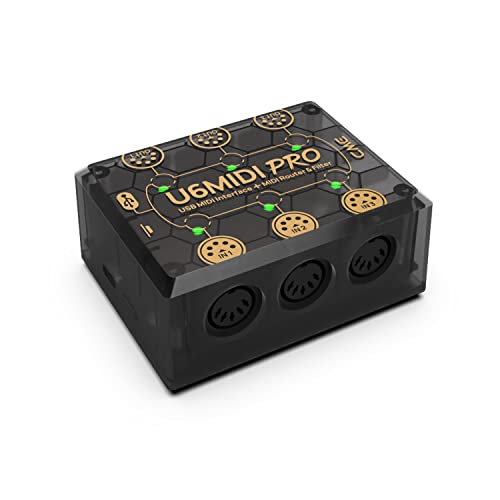
- [Computers] Plug-and-play MIDI interface via one single USB-C port, compatible with all major OS including macOS, iOS, Windows, Android, Linux and Chrome OS.

- [Standalone USB Host] Easily connect class compliant USB MIDI instruments like keyboards, controllers, effect pedals and synthesizers directly to your MIDI hardware without a computer. Accommodate up...
First Impressions and Key Features of the summina MIDI Interface 4×4
When I first unboxed the summina MIDI Interface 4×4, I was immediately struck by its weight. At 303 grams, it feels substantial for its size. The matte black metal finish gives it a professional look that doesn’t feel like a cheap plastic toy. Inside the box, you get the unit itself and a high-quality USB cable equipped with a ferrite bead to reduce signal noise. This is a small but critical detail that shows the manufacturer is thinking about signal integrity.
One of the standout features right out of the box is the ability to switch between “USB Mode” and various “Thru” or “Merge” modes. This makes it a versatile tool even when you aren’t using a DAW. Compared to some of the entry-level 1×1 cables I’ve used in the past, this unit feels like a significant upgrade in both stability and capability. You can explore the detailed technical specifications here to see exactly how it fits into your setup. It is truly plug-and-play; as soon as I connected it to my Windows 10 machine, it was recognized instantly as a multi-port MIDI device without the need for a single download.
Key Benefits
- Exceptional build quality with a rugged metal chassis.
- No driver installation required (True Plug-and-Play).
- Low-latency performance with 64 MIDI channels.
- Built-in Merge function (2 inputs to 4 outputs).
Drawbacks
- The instruction manual is extremely sparse and lacks detail.
- iOS compatibility can be hit-or-miss with some reports of stuck notes.
A Deep Dive into the summina MIDI Interface 4×4’s Performance
Seamless Routing and the Power of the Merge Function
In our testing, the most impressive aspect of the summina MIDI Interface 4×4 was its internal routing flexibility. Most budget interfaces simply pass data from the computer to the ports. However, this unit includes a hardware-based “Merge” mode (2 inputs to 4 outputs). I found this feature particularly useful when I wanted to use both a hardware sequencer and a master keyboard to control the same set of four sound modules. Usually, this would require a separate MIDI merge box, but here, it’s built right in.
We found that once you understand the push-button layout on the front panel, switching between modes is relatively quick. As one user noted, the unit “did the job perfectly” for merging an Out and Thru from a sequencer so their keyboard could remain the main controller. This versatility is a feature that really sets it apart in this price bracket. During long sessions, the routing remained stable, and we didn’t experience any of the data bottlenecks that often plague cheaper, unbranded interfaces.
Timing Precision and Low Latency in the DAW
MIDI timing is the “unseen” hero of a good production. If your interface has “jitter,” your drums won’t hit on the grid, and your melodies will feel slightly off-beat. We put the summina MIDI Interface 4×4 through its paces using a high-density MIDI file with CC (Continuous Controller) data being sent to four different synths simultaneously. The result was rock-solid. The high-speed USB connection to the PC ensures that the 64 MIDI channels are handled with the precision required for professional recording.
We confirmed the “fast and no latency” experience reported by other users during our own keyboard tracking sessions. Whether we were playing fast 16th-note arpeggios or sending complex sysex data for patch backups, the summina didn’t skip a beat. For anyone working with hardware-intensive setups, this level of reliability is crucial. You can check how it performs under high load by viewing more user technical feedback, but our expert verdict is that the internal processing is highly efficient for its class.
The “Plug-and-Play” Reality vs. Documentation Challenges
The “True Plug-and-Play” claim is 100% accurate for modern operating systems. We tested it on Windows 11 and macOS Monterey, and in both cases, the 4×4 ports showed up in our DAW (Ableton Live and Logic Pro) within seconds. However, we must address the “elephant in the room”: the documentation. The instruction manual provided with the summina MIDI Interface 4×4 is virtually non-existent. For a beginner, this could be a major hurdle.
We found that identifying which port corresponds to which channel in your DAW might require a bit of trial and error at first. Some users have mentioned feeling like they were “spinning their wheels” because they didn’t know which options to set for Input and Output. Once you realize that the ports are usually labeled numerically in your software, it becomes easy, but the lack of a clear “Quick Start Guide” is a definite oversight. Despite this, the actual hardware performance is so high that this hurdle is easily cleared once you are set up. To see how others have navigated this, read more about user experiences online.
Durability and Portable Studio Integration
If you are a touring musician or someone who likes to take their setup to different studios, the build quality of the summina MIDI Interface 4×4 is a huge plus. The metal housing isn’t just for show; it protects the internal circuitry from the bumps and drops of life on the road. Weighing in at under half a kilogram, it’s easy to toss into a laptop bag. The fact that it is entirely USB-powered is another win for portability, as it eliminates the need for a bulky AC adapter and frees up a socket on your power strip.
While some users expressed a wish for an included AC adapter for standalone use, we found that any standard USB power brick (like a phone charger) works perfectly if you aren’t connected to a computer. The high-precision wired transmission ensures that even with long MIDI cables (up to 15-20 feet), the synchronization remains error-free. For those looking for a long-term studio workhorse, we recommend you take a look at the build details and dimensions to ensure it fits into your rack or desk setup. It’s a small footprint for such a powerful routing tool.
What Other Users Are Saying
The general consensus among users is that the summina MIDI Interface 4×4 offers incredible value, provided you have a basic understanding of MIDI routing. Many users have praised its “perfect timing” and the fact that it “just worked” as soon as it was unboxed. One user particularly appreciated the high-quality USB cable included, noting that it felt more premium than what usually comes with budget gear. The Spanish-speaking community also highly recommends it, with one user calling it an “Excelente interfaz” that is ideal in size and practicality.
On the flip side, the lack of instructions remains the primary complaint. One reviewer mentioned that they felt like they were wasting time trying to identify channels in their recording apps because the manual was so sparse. There was also a notable report of “stuck notes” when using the device with iOS, suggesting that while it’s a powerhouse for Windows and Mac, mobile users might want to be more cautious. However, for the majority of home studio owners on desktop platforms, the sentiment is overwhelmingly positive, focusing on how much money they saved compared to more famous brand-name alternatives.
Comparing the summina MIDI Interface 4×4 to Its Top 3 Alternatives
1. CME WIDI Master Premium MIDI Adapter

- [Get rid of those cables] Add Bluetooth MIDI to your MIDI devices and reduce the cable clutter in the studio. Enjoy freedom on stage. Powered via MIDI Out. No batteries needed. Check out...
- [Plug, Pair & Play] Pair automatically between WIDI devices and Bluetooth MIDI controllers. Send all MIDI messages, incl. SysEx & MPE. Connect manually with iOS, macOS, Win10/11 & Android via simple...
The CME WIDI Master is a completely different beast compared to the summina MIDI Interface 4×4. While the summina acts as a centralized wired hub, the CME WIDI Master is all about cutting the cords. It uses Bluetooth MIDI to provide a wireless connection with ultra-low 3ms latency. This is perfect for someone who only needs to connect one or two devices and wants a clutter-free environment. However, if you have a complex setup with four or more hardware synths, the summina’s physical ports and merge functions offer more reliable stability and channel management than managing multiple Bluetooth pairs.
2. Arturia MiniFuse 2 Audio Interface
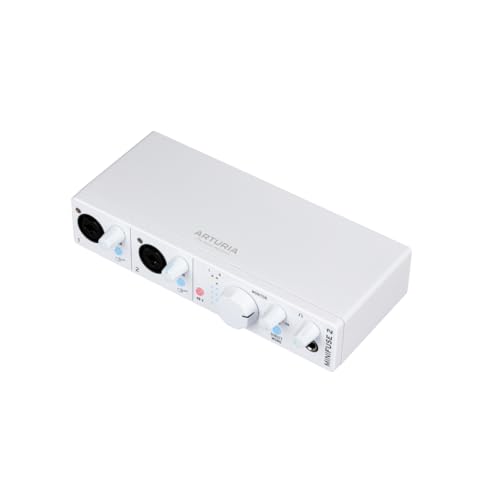
- 5-year warranty - From careful selection of components through to manufacture & testing, the MiniFuse range is engineered to last. Each interface is constructed with the most robust & reliable...
- Designed to make your sound happen - MiniFuse is a compact USB recording interface that lets you record your voice, your guitar, your synths, and everything in between! Play, perform, and produce...

The Arturia MiniFuse 2 is a hybrid solution. It’s primarily a high-quality audio interface with built-in MIDI I/O. This is the better choice for someone who is just starting out and needs both a place to plug in their microphone/guitar and a single MIDI port for their keyboard. However, the MiniFuse only offers a 1×1 MIDI configuration (16 channels). If your studio grows to include several drum machines and sound modules, you will quickly outgrow the Arturia’s MIDI capabilities. The summina MIDI Interface 4×4 is designed specifically to solve the “too many synths, not enough ports” problem that the MiniFuse can’t handle alone.
3. FORE MIDI Interface with USB Type-A Cable

- FORE 1 MIDI in / 1 MIDI out MIDI interface, 16 MIDI input & output channels. Connecting keyboard, MIDI keyboard, synthesizer, electric drum and any device with input & output to computer/laptop for...
- Plug & Play, with a Built-in driver and Intelligent LED Indicator. No extra difficult driver installation. Easy set up, truly plug and play. MIDI converter shows different light indicators & status...
The FORE MIDI Interface is the ultimate budget “quick fix.” It’s a simple cable-style interface with one MIDI In and one MIDI Out. It’s incredibly cheap and works well for a single keyboard-to-computer connection. However, it lacks the rugged metal housing, the multiple ports, and the advanced merge/thru modes found on the summina. Comparing the two is like comparing a bicycle to a truck; the FORE cable is fine for a quick trip, but the summina MIDI Interface 4×4 is a professional tool for heavy-duty studio lifting. If you plan on having more than one external instrument, the summina is the smarter long-term investment.
Final Verdict: Is the summina MIDI Interface 4×4 the Right Hub for You?
After extensive evaluation, the summina MIDI Interface 4×4 stands out as one of the best value-for-money MIDI hubs currently available. Its combination of a rugged metal build, 4-in/4-out port density, and a functional hardware merge mode makes it an indispensable tool for hardware-heavy studios. While the lack of a detailed manual is a frustration, it’s a one-time hurdle that is easily overcome by the device’s seamless “Class Compliant” performance on desktop computers.
We recommend this interface to any producer who is tired of cable clutter and wants a reliable, low-latency way to sync multiple synthesizers and drum machines. It offers professional-grade features at a fraction of the cost of legacy brands. If you are ready to streamline your workflow and get back to the music, we suggest you grab the summina MIDI Interface 4×4 today and experience the difference that dedicated hardware routing can make in your studio.
Last update on 2026-09-16 / Affiliate links / Images from Amazon Product Advertising API