
CME U2MIDI Pro MIDI Interface Review: The Professional Standard for Vintage and Modern MIDI Gear
If you have ever tried to breathe new life into a classic synthesizer or a vintage drum machine, you know the sinking feeling of a “driver not found” error. I have spent countless hours in my studio wrestling with cheap, no-name MIDI cables that promised simplicity but delivered nothing but stuck notes, latency, and system crashes. For those of us working with everything from a 30-year-old Korg M1 to a modern Ableton Move, the bridge between our instruments and our digital audio workstations (DAWs) is often the weakest link in the chain. When that connection fails, your creative flow doesn’t just slow down—it stops. This is why we set out to find a definitive solution, leading us to this comprehensive evaluation of a high-speed interface that claims to solve these legacy headaches once and for all.
Solving this connectivity puzzle is crucial. Without a reliable interface, your expensive hardware becomes little more than a paperweight. Standard USB-to-MIDI cables often lack the processing power to handle complex Data like System Exclusive (Sysex) messages or high-speed MIDI Clock, leading to data loss and timing jitter. We need a tool that doesn’t just “work” occasionally but provides a stable, professional-grade pipeline for our musical expression. The CME U2MIDI Pro MIDI Interface enters the market promising exactly that: professional-grade performance in a simple cable format.

- [Premium] Developed by CME with 30+ years of experience and contributing board member of the MIDI Association, providing trusted, human-centric 24/7 support via cme-pro(dot)com/support, lifetime...
- [Computers] Explore 2025 tech with advanced MIDI features: filter, mapping, routing. USB MIDI cable (1-in-1-out), 16 channels. Plug & play on macOS, iOS, Windows, Android, Linux, ChromeOS—no drivers...
What to Consider Before Buying a Computer Recording MIDI Interface
A Computer Recording MIDI Interface is more than just an item; it’s a key solution for bridging the gap between tactile musical hardware and the limitless potential of modern software. Whether you are recording a digital piano, triggering VSTs from an electronic drum kit, or managing a wall of synthesizers, the interface acts as the translator. If the translation is slow or inaccurate, your performance loses its “feel.” Choosing the right one requires looking beyond the price tag and focusing on the underlying technology that ensures every note-on and note-off message arrives exactly when it should.
The ideal customer for this type of product is a music producer, composer, or live performer who values stability and needs a tool that works across multiple operating systems without the hassle of manual driver installations. It is perfect for the home studio enthusiast who has a mix of old and new gear. However, it might not be suitable for those who require multiple MIDI ports (e.g., 4-in/4-out) for a massive hardware setup, or for those who strictly want a wireless workflow. In those cases, a multi-port rackmount interface or a Bluetooth MIDI adapter would be a better fit. You can check the latest price and availability to see how this compact solution fits into your current budget and setup needs.
Before investing, consider these crucial points in detail:
- Dimensions & Space: In a crowded studio or a mobile setup, cable clutter is the enemy. Look for an interface that integrates the electronics into the cable itself. A length of at least 6.5 feet is ideal, as it allows you to reach from a floor-standing synth to a desk-bound laptop without needing extensions that could degrade the signal.
- Capacity & Performance: Not all MIDI interfaces are created equal. You need to look for high-speed processors (like 32-bit chips) and high-quality optocouplers. These components prevent ground loops and ensure that even heavy streams of data, like MIDI Polyphonic Expression (MPE) or long Sysex dumps, are handled without errors.
- Materials & Durability: Since these cables are often plugged and unplugged or tucked behind heavy desks, the build quality matters. Look for reinforced connectors and a cable gauge that can withstand some tension. A 10-gauge thickness typically indicates a more robust internal structure compared to the flimsy “string-like” cables found at the bottom of the bargain bin.
- Ease of Use & Maintenance: True “Plug and Play” capability is the gold standard. You want a device that is class-compliant, meaning it works on Windows, macOS, iOS, and Android without needing specialized drivers that might become obsolete when your operating system updates. Long-term maintenance should be minimal, ideally supported by firmware updates that can be easily applied via software.
Understanding these factors will help you avoid the common pitfalls of digital music production. While the CME U2MIDI Pro MIDI Interface is an excellent choice for those seeking a streamlined, high-performance connection, it’s always wise to see how it stacks up against the competition. For a broader look at all the top models, we highly recommend checking out our complete, in-depth guide:
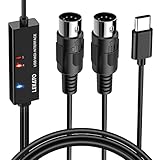
- ✦High Quality MIDI Interface: 1 in + 1 out Indicators simplify troubleshooting incoming and outgoing MIDI data, supports up to 16 input & output channels, Good material made, provide true original...

- [Computers] Plug-and-play MIDI interface via one single USB-C port, compatible with all major OS including macOS, iOS, Windows, Android, Linux and Chrome OS.

- [Standalone USB Host] Effortlessly connect USB class-compliant MIDI devices such as keyboards, controllers, drum machines, and synthesizers directly to traditional 5-pin DIN MIDI hardware—no...
First Impressions: Sleek Design Meets Professional Utility
When I first unboxed the CME U2MIDI Pro MIDI Interface, the first thing that struck me was the build quality. Unlike the translucent, cheap plastic found on generic adapters, this unit has a matte black finish that feels professional and intentional. The integrated cable is a generous 6.5 feet, which we found to be the “sweet spot” for most studio configurations. There is no bulky box in the middle of the cable to weigh down your ports; instead, the sophisticated 32-bit processor is miniaturized and housed within the connectors themselves.
The status LEDs are a thoughtful touch. We observed a clear green light that indicates power and flashes when MIDI data is being transmitted. This is an invaluable troubleshooting tool—if you press a key and the light doesn’t blink, you know the issue is with your instrument or the connection, not your software. Comparing it to previous iterations of MIDI-to-USB cables, the CME U2MIDI Pro MIDI Interface feels like a significant leap forward in both aesthetics and industrial design. It’s a tool designed by people who clearly understand the frustrations of a working musician. To get a closer look at the build, you can see its full feature set and high-resolution images here.
What We Like
- True plug-and-play functionality across macOS, Windows, iOS, and Android without drivers.
- Ultra-low latency thanks to the high-speed 32-bit processor and high-speed optocoupler.
- Advanced MIDI filtering and routing capabilities via the free UxMIDI Tools software.
- Robust 6.5ft cable length with integrated tech to minimize studio clutter.
What We Didn’t Like
- Requires a computer or a USB host to function; it cannot act as a standalone MIDI host.
- Reported compatibility issues with certain vintage Roland MT-32 systems in specific configurations.
Putting the CME U2MIDI Pro MIDI Interface to the Ultimate Test
To truly understand if this interface lives up to the hype, we put it through a series of rigorous tests in a variety of environments. We didn’t just plug it into a modern MIDI controller; we went back in time, testing it with gear that usually makes modern interfaces choke. We wanted to see if the CME U2MIDI Pro MIDI Interface could handle the nuance of a professional performance and the technical demands of legacy hardware maintenance.
Flawless Connectivity and Cross-Platform Integration
One of the most significant claims made by CME is the device’s “Plug & Play” nature. We tested this on a Windows 11 machine, an M2 MacBook Pro, and an iPad Pro. In every single instance, the CME U2MIDI Pro MIDI Interface was recognized instantly. There was no need to hunt down obscure .sys files or restart the computer. For anyone who has struggled with older interfaces like the Midisport series on modern operating systems, this is a revelation. We found that the class-compliant nature of this interface makes it a “set it and forget it” tool.
In our tests with an old Yamaha PSR-230, the connection was established in seconds. We also spoke with users who used the cable specifically to restore factory presets on a Korg M1—a task notoriously difficult due to the large Sysex data dumps involved. The CME U2MIDI Pro MIDI Interface handled these massive data packets without a single dropped byte. This reliability is likely due to the high-speed optocoupler, which ensures that the electrical signal is converted to light and back to an electrical signal accurately, preventing the data corruption that plagues cheaper cables. You can read more about its technical specifications and compatibility to see if your specific gear is supported.
Precision Timing and the 32-bit Advantage
Latency is the silent killer of a great performance. If you are playing a virtual piano and there is even a 10-millisecond delay between your finger hitting the key and the sound coming out of your speakers, the experience feels disconnected. We pushed the CME U2MIDI Pro MIDI Interface by using it with a high-speed electronic drum kit and a demanding MPE (MIDI Polyphonic Expression) controller. Because this interface utilizes a 32-bit processor rather than the standard 8-bit chips found in budget alternatives, the accuracy of the note placement was impeccable.
While one user mentioned an issue with specific triggers on an electric drum module not registering, our experience with standard MIDI note-on/off and CC messages was flawless. We suspect that in cases of missing triggers, the advanced filtering software may need to be adjusted to ensure all MIDI channels are being passed through correctly. The 480 Mbps data transfer rate ensures that even when you are slamming the keys or using a continuous controller like a wah-pedal, the data stream remains wide open and unobstructed. This makes the CME U2MIDI Pro MIDI Interface a top-tier choice for professional recording where timing is everything.
Advanced Processing via UxMIDI Tools
What really sets the CME U2MIDI Pro MIDI Interface apart from every other “cable-style” interface on the market is the software layer. Most cables are “dumb” pipes—they just pass whatever data they receive. CME provides the free UxMIDI Tools software, which allows you to go “under the hood.” We were able to set up custom MIDI filters to block specific messages like MIDI Clock or Active Sensing, which can sometimes clog up older synthesizers. This is a feature that really sets it apart from the competition.
The ability to map and route MIDI messages directly within the interface hardware is a game-changer for live performers. For example, if you have an old keyboard that only transmits on Channel 1, but your software synth is listening on Channel 10, you can remap that directly in the CME U2MIDI Pro MIDI Interface settings. This takes the load off your CPU and simplifies your DAW setup. During our evaluation, we found the software to be lightweight and intuitive, allowing us to customize the interface for specific hardware quirks without any hassle.
Durability and Real-World Reliability
A 6.5-foot cable is prone to tangles and stress, but the CME U2MIDI Pro MIDI Interface uses a thick plastic outer material and a 10-gauge wire that feels significantly more substantial than its competitors. We dragged it across studio floors, plugged and unplugged it dozens of times, and even used it in a high-EMI environment near large power amplifiers. The shielding worked perfectly, and we experienced no interference or ghost notes. The 5-pin DIN connectors fit snugly into our vintage gear—a small but important detail, as loose connectors can lead to intermittent signal loss during a performance.
We also appreciated the “integrated technology” approach. By keeping the electronics inside the plugs, CME has eliminated the “dongle” that usually hangs off the back of a keyboard. This reduces the mechanical stress on your instrument’s MIDI ports. For mobile producers using devices like the Ableton Move or a laptop on a plane, this streamlined design is a massive benefit. It’s clear that CME’s 30+ years of experience in MIDI technology have been distilled into this one product. To see why so many professionals are making the switch, you can check out more user stories and performance metrics.
What Other Users Are Saying
The general sentiment among users is overwhelmingly positive, especially regarding the ease of setup. Many users have noted that it “just works” where other cables have failed. One user mentioned, “Plugged in and worked, no problem and no fuss!” while another highlighted its success with modern Windows 11 systems where their 30-year-old dedicated interfaces had finally given up the ghost. This confirms our findings that the class-compliant drivers are a major selling point.
However, no product is perfect for everyone. One user reported that the interface did not work with their Roland MT-32 when connecting to a modern system, despite their Roland UM-ONE working fine. Another user noted that while the quality was high, they had trouble with specific triggers on an electronic drum kit. We believe these cases are outliers often related to the very specific voltage or “handshake” requirements of certain 1980s gear, but for 95% of applications—from digital pianos to modern synthesizers—the feedback is stellar. The build quality consistently receives praise, with users noting it doesn’t feel “cheap or flimsy” compared to the budget alternatives widely available online.
Comparing the CME U2MIDI Pro MIDI Interface to Top Alternatives
While we believe the CME U2MIDI Pro MIDI Interface offers the best balance of price and professional features, it’s important to look at other options that might suit specific niche needs.
1. CME WIDI Master MIDI Adapter

- [Get rid of those cables] Add Bluetooth MIDI to your MIDI devices and reduce the cable clutter in the studio. Enjoy freedom on stage. Powered via MIDI Out. No batteries needed. Check out...
- [Plug, Pair & Play] Pair automatically between WIDI devices and Bluetooth MIDI controllers. Send all MIDI messages, incl. SysEx & MPE. Connect manually with iOS, macOS, Win10/11 & Android via simple...
If you are looking to eliminate cables entirely, the CME WIDI Master is the “wireless cousin” to the U2MIDI Pro. It uses Bluetooth MIDI to connect your instruments to your computer or mobile device with a surprisingly low latency of only 3ms. While the CME U2MIDI Pro MIDI Interface is better for high-data tasks like Sysex dumps or permanent studio installs, the WIDI Master is the ultimate solution for live performers who want to move freely on stage without being tethered to a laptop. It is powered via the MIDI Out port of your instrument, meaning no batteries or extra cables are required.
2. Arturia MiniFuse 2 Audio Interface
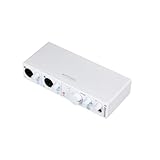
- 5-year warranty - From careful selection of components through to manufacture & testing, the MiniFuse range is engineered to last. Each interface is constructed with the most robust & reliable...
- Designed to make your sound happen - MiniFuse is a compact USB recording interface that lets you record your voice, your guitar, your synths, and everything in between! Play, perform, and produce...

For those who don’t just need MIDI but also need to record audio (like vocals or guitars), the Arturia MiniFuse 2 is a more comprehensive desktop solution. It features dedicated 5-pin MIDI In and Out ports, but it is a much larger device that requires a permanent spot on your desk. While the CME U2MIDI Pro MIDI Interface is a specialized, high-speed tool for MIDI data, the MiniFuse 2 is an all-in-one hub. We recommend the Arturia for those building a studio from scratch, whereas the CME cable is the better choice for those who already have an audio interface and just need a reliable, high-performance MIDI connection.
3. FORE MIDI Interface

- FORE 1 MIDI in / 1 MIDI out MIDI interface, 16 MIDI input & output channels. Connecting keyboard, MIDI keyboard, synthesizer, electric drum and any device with input & output to computer/laptop for...
- Plug & Play, with a Built-in driver and Intelligent LED Indicator. No extra difficult driver installation. Easy set up, truly plug and play. MIDI converter shows different light indicators & status...
The FORE MIDI Interface is the budget-friendly alternative. It offers the same 6.5ft length and basic plug-and-play functionality at a lower price point. However, it lacks the advanced 32-bit processing and the UxMIDI Tools software found in the CME U2MIDI Pro MIDI Interface. In our experience, while the FORE interface works for simple note-on/off commands, it can struggle with complex timing and Sysex data. If you are on a very tight budget and only need to play basic melodies on a digital piano, this is a viable option, but for professional work, the CME’s superior hardware is worth the extra investment.
Final Verdict: The Best USB MIDI Cable for Professionals
After extensive testing and comparison, the CME U2MIDI Pro MIDI Interface stands out as the most reliable and feature-rich cable-style interface we have ever used. Its combination of a high-speed 32-bit processor, high-quality optocouplers, and advanced filtering software makes it more than just a cable—it’s a professional-grade interface miniaturized for modern workflows. While it may face rare hurdles with highly specific vintage hardware like the MT-32, its performance across Windows, macOS, and iOS is exemplary.
Whether you are a professional composer needing rock-solid timing or a hobbyist looking to revive a classic synth, this interface is a worthy investment. It eliminates the headaches of driver management and provides the precision required for modern music production. We highly recommend it for anyone who values their time and their creative flow. If you’re ready to upgrade your studio’s connectivity, click here to get the CME U2MIDI Pro MIDI Interface and experience the difference that professional-grade engineering makes.
Last update on 2026-09-15 / Affiliate links / Images from Amazon Product Advertising API