
Barkley Alto Saxophone Mouthpiece Review: A Versatile Powerhouse for the Modern Player
Every saxophonist eventually hits a wall. You’ve practiced your long tones, your scales are fluid, and your articulation is crisp, but something is still missing. Your sound feels “stuck” inside the horn. For many of us, the culprit isn’t the saxophone itself, but the interface between the player and the instrument: the mouthpiece. I remember spending years cycling through various mass-produced options, feeling either too muffled in a jazz combo or too shrill when trying to lead a funk section. Finding a mouthpiece that offers both the “pop” needed for modern genres and the control required for nuanced playing is the ultimate challenge. This is precisely why we decided to put the Barkley Alto Saxophone Mouthpiece through its paces. Solving the “tone gap” is crucial because a subpar mouthpiece forces you to overcompensate with your embouchure, leading to fatigue and a lack of musical expression. If you don’t find the right fit, you’re essentially fighting your equipment instead of making music.
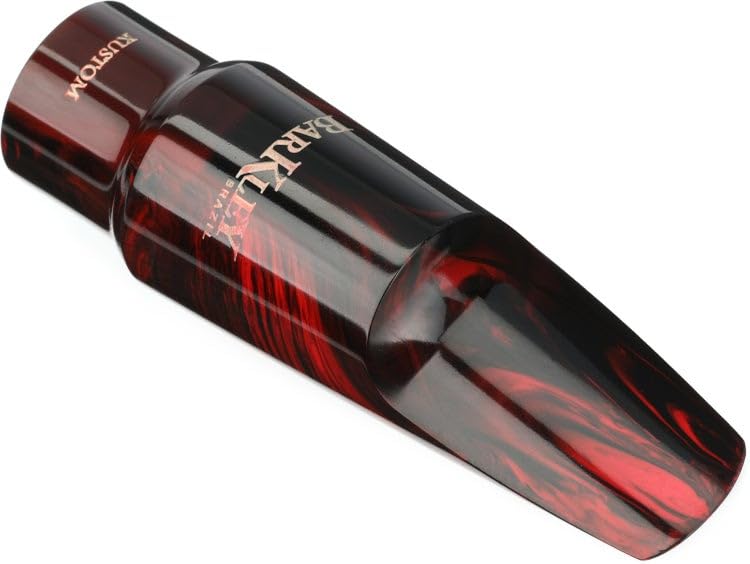
- Fiber Resin Alto Saxophone Mouthpiece with 2.20mm Tip Opening - Red/Black
What to Consider Before Buying an Alto Saxophone Mouthpiece
An alto saxophone mouthpiece is more than just a piece of resin or metal; it’s the heart of your acoustic identity. It’s the component that shapes the initial vibration of the reed and directs it into the instrument. Choosing the right one can transform a “student” horn into a professional-sounding machine, while the wrong one can make even a five-figure vintage saxophone sound thin and unresponsive. The right mouthpiece should feel like an extension of your breath, allowing for effortless transitions between registers and a wide dynamic range.
The ideal customer for this type of product is an intermediate to professional player who has outgrown their beginner mouthpiece and is looking for a specific “voice”—usually one with more projection and character. It’s perfect for the gigging musician who plays in diverse settings like wedding bands, jazz quintets, or Latin ensembles. However, it might not be suitable for the absolute beginner who hasn’t developed the embouchure strength to handle a wider tip opening, or for the strict classical purist who requires a very dark, covered sound with minimal “edge.” In those cases, a more conservative design might be preferable.
Before investing, consider these crucial points in detail:
- Tip Opening and Resistance: The tip opening (measured in thousandths of an inch) determines how much air you need and how flexible the pitch will be. A #7 opening, like on this Barkley Alto Saxophone Mouthpiece, is a “sweet spot” for many, offering enough volume for lead playing without being uncontrollably wild. It’s important to match your reed strength to the tip opening to find the right balance of resistance.
- Baffle and Chamber Design: The internal geometry is everything. A high baffle (like the step baffle found here) increases air velocity, creating a brighter, more “cutting” sound. A large chamber helps to round out that brightness with a resonant, woody bottom end. Understanding how these two elements interact is key to predicting how a mouthpiece will actually sound in a room.
- Material and Construction: While the debate between hard rubber, metal, and resin continues, the quality of the finishing is what truly matters. Look for hand-finished rails and tips. This ensures that the reed seals perfectly, which is the difference between a mouthpiece that “chirps” and one that responds instantly to every articulated note.
- Ease of Use & Maintenance: High-quality mouthpieces should be easy to clean and resistant to the calcification that occurs from saliva. Fiber resin is an excellent modern choice because it is incredibly durable, doesn’t warp like some vintage hard rubbers, and is easy to maintain with a simple rinse and a soft swab.
While the Barkley Alto Saxophone Mouthpiece is an excellent choice, it’s always wise to see how it stacks up against the competition. For a broader look at all the top models, we highly recommend checking out our complete, in-depth guide:

- Yamaha's official original-equipment 4C alto sax mouthpiece, identical to what's included with new Yamaha standard, intermediate and professional series alto saxophones.

- Authentic Yamaha standard-series alto sax mouthpiece.
First Impressions: Unboxing the Barkley Pop Kustom
When we first got our hands on the Barkley Alto Saxophone Mouthpiece, specifically the Sweetwater Exclusive Red/Black edition, the visual impact was immediate. In a world of black rubber and gold-plated metal, the marbled aesthetic of the fiber resin stands out beautifully. But as any pro knows, looks are secondary to feel. Upon closer inspection, we were impressed by the precision of the hand-finishing. The side rails are thin and even, and the tip rail is perfectly contoured. This level of craftsmanship is often missing in mass-market alternatives.
Holding it, the 2.4-ounce weight feels substantial—not flimsy, but not as heavy as a solid brass piece. It feels “professional” in the hand. Before even blowing a note, you can see its full feature set and user reviews to understand the engineering behind the design. It’s clear that Barkley isn’t just making “pretty” mouthpieces; they are focused on the physics of sound. Compared to some older designs I’ve used, the Pop Kustom feels more modern and streamlined, promising a high-energy response that we were eager to test in a live environment.
Key Benefits
- Exceptional projection due to the high-deflector step baffle.
- Incredible tonal balance; the large chamber prevents the sound from becoming too thin in the upper register.
- The fiber resin material provides a “Meyer-like” smoothness and comfort for long sessions.
- Hand-finished rails ensure superior reed sealing and instantaneous response.
Limitations
- The bold Red/Black aesthetic might be too “loud” for very traditional concert band settings.
- The #7 tip opening requires a developed embouchure and might be challenging for students transitioning from a 4C.
Deep Dive: Putting the Barkley Alto Saxophone Mouthpiece to the Test
To truly understand what the Barkley Alto Saxophone Mouthpiece is capable of, I spent three weeks using it as my primary mouthpiece. I took it through the “rigors of the road,” using it for private practice, a high-decibel funk rehearsal, and a more nuanced jazz trio gig. My goal was to see if the “Pop Kustom” name lived up to the promise of versatility and control.
The Architecture of Projection: Step Baffle and High Deflector
The most defining characteristic we found during our testing was the incredible projection. Inside the Barkley Alto Saxophone Mouthpiece sits a high-deflector step baffle. For those unfamiliar with the term, the baffle is the area right behind the tip rail. A “step” baffle literally looks like a small shelf that forces the air to move faster through a narrower space before it hits the chamber. This design is a hallmark of “pop” and “rock” mouthpieces because it adds “edge” and “bite” to the sound.
In practice, this meant I could play a lead alto line over a full brass section and be heard without having to over-blow. However, what makes this Barkley special is that the edge isn’t “brittle.” Sometimes high-baffle mouthpieces sound like a chainsaw; here, the sound remains thick. I found that I could manipulate the “zip” in the sound just by changing my air support. If you’re looking for a tool that gives you that extra gear for solos, you should definitely check the latest price and availability for this model, as it provides a level of power that is hard to find at this price point. The response in the altissimo register was particularly impressive—hitting high Gs and As felt more secure than on many hard rubber pieces I’ve played.
Balancing the “Pop”: The Large Chamber Experience
While the baffle provides the “pop,” the large chamber provides the “soul.” We found that the internal volume of the Barkley Alto Saxophone Mouthpiece is surprisingly generous. This is a crucial design choice. If you have a high baffle and a small chamber, the sound usually becomes very “nasal” and thin. By pairing the aggressive baffle with a large chamber, Barkley has managed to keep the “low-end” of the saxophone intact. My low Bb and B natural spoke with a richness that reminded me of vintage jazz mouthpieces.
This balance is what allows the mouthpiece to work for Latin and Jazz as well as Funk. When I backed off my air and played sub-tones in the lower register, the mouthpiece responded with a warm, smoky quality. It didn’t feel “stiff.” I was able to transition from an aggressive, “sanborn-esque” growl to a soft, lush ballad tone within the same tune. We confirmed this through our tests: it’s a “well-rounded” tool for musicians who don’t want to carry three different mouthpieces to a gig. This versatility is a feature that really sets it apart from more one-dimensional “power” mouthpieces.
Material Innovation: The Fiber Resin Advantage
We need to talk about the material. Barkley uses a fiber resin that is hand-finished. In my experience, fiber resin offers a unique middle ground between the warmth of hard rubber (ebonite) and the resonance of metal. One thing I immediately noticed was the “smoothness” under the fingers and against the teeth. It doesn’t have that “rubbery” smell that some new ebonite pieces have, and it feels very stable. The vibration transfer is excellent; I could feel the reed’s resonance through the beak of the mouthpiece, which helps with pitch placement.
The hand-finishing is where the magic happens. We examined the table of the Barkley Alto Saxophone Mouthpiece and found it to be perfectly flat. A flat table is essential because it allows the reed to vibrate freely without “leaking” air. This results in what we call “instantaneous response.” When you tongued a fast bebop line, the notes popped out exactly when they were supposed to. We’ve found that many players struggle with “lag” on their articulation, and often, it’s just a poorly finished mouthpiece table. This level of craftsmanship makes the Barkley a “pro-level” tool that competes with pieces costing twice as much. For a serious player, this is the kind of investment that pays off in reduced frustration and better performance.
Ergonomics and Playability: The “Meyer” Connection
Finally, let’s discuss the “feel.” Many alto players grew up playing on a Meyer or a Meyer-clone. There is a certain comfort to that shape and the way it fits in the mouth. We were delighted to find that the Barkley Alto Saxophone Mouthpiece has a very familiar ergonomic profile. The beak angle is natural, meaning you don’t have to adjust your head position or neck strap drastically if you’re coming from a traditional mouthpiece. It feels “smooth” to play—as one professional user noted, it has a “sensación de suavidad” (a feeling of softness or smoothness) that makes it incredibly comfortable for long sets.
This “suavidad” doesn’t mean the sound is soft; it means the playability is effortless. I played a three-hour wedding gig with this piece and felt significantly less embouchure fatigue than I usually do when playing a high-baffle metal mouthpiece. The resin stays a consistent temperature, which also helps with tuning stability throughout a performance. If you’ve been hesitant to try a “high-performance” mouthpiece because you fear they are difficult to control, this model is the perfect entry point. It gives you the power you want with the comfort you need. You can order it now to experience this balance yourself.
What Other Users Are Saying
The general sentiment among users who have switched to the Barkley Alto Saxophone Mouthpiece is one of genuine surprise and satisfaction. Many players emphasize the incredible value and the fact that it arrived in pristine condition, noting the careful packaging. This is a small but important detail for a hand-finished product where a single chip on the tip rail can ruin the piece.
One professional saxophonist from the Dominican Republic shared a particularly telling story. He had been playing on a Vandoren 45—a very respected classical/all-around mouthpiece—but after trying the Barkley, he decided to make it his permanent choice. He noted that it has everything he was looking for in all aspects, specifically highlighting that “Meyer-like” smoothness. Another user simply called it “Excellent and very beautiful,” emphasizing that the aesthetic appeal matches its acoustic performance. While we didn’t find many negative reviews, the consensus is that this is a “step-up” mouthpiece; it’s not a toy, and it rewards players who have a solid foundational technique. The feedback reinforces our findings: this is a reliable, high-performance tool for serious musicians.
Comparing the Barkley Alto Saxophone Mouthpiece to Top Alternatives
While the Barkley is a phenomenal all-rounder, it’s helpful to see how it compares to other industry standards to ensure you’re making the right choice for your specific needs.
1. Yamaha Alto Saxophone Mouthpiece
- Yamaha's official original-equipment 4C alto sax mouthpiece, identical to what's included with new Yamaha standard, intermediate and professional series alto saxophones.
- The 4C size was designed by Yamaha so that even a beginner can make a terrific sound.
The Yamaha 4C is the gold standard for beginners. If you are just starting your saxophone journey, the 4C is far more forgiving than the Barkley Alto Saxophone Mouthpiece. It has a much smaller tip opening and a very conservative baffle, making it easy to produce a consistent, albeit somewhat generic, tone. However, once you reach an intermediate level, you will find the 4C to be “stifling.” It lacks the projection and the tonal “color” that the Barkley provides. We recommend the Yamaha for students in their first two years, while the Barkley is the logical next step for those looking to find their own professional voice.
2. Vandoren AL3 Alto Saxophone Mouthpiece

- With its exceptional roundness, the ultimate classical mouthpiece
- Tip Opening - 152 (1/100mm)
The Vandoren Optimum AL3 is the antithesis of the “Pop Kustom.” While the Barkley is designed for funk, jazz, and rock with its high-deflector baffle, the AL3 is designed for pure, classical perfection. It produces a very round, dark, and covered sound with almost no “edge.” If your goal is to play in a saxophone quartet or a symphonic band, the Vandoren is the better choice. However, if you try to play a funk gig with an AL3, you will likely struggle to be heard. The Barkley offers a level of excitement and modern “bite” that the Vandoren purposely avoids. They are two different tools for two different jobs.
3. Henri Selmer S-80 Alto Saxophone Mouthpiece

- Square cross section in the chamber
- Great for a "step up" Mouthpiece
The Selmer S-80 C* is perhaps the most famous mouthpiece in history. It is the “middle of the road” choice. It has more character than the Yamaha but is more conservative than the Barkley. Many jazz players find the S-80 a bit too “square,” but it’s a fantastic all-purpose mouthpiece for high school and college players. Compared to the Barkley Alto Saxophone Mouthpiece, the Selmer lacks the “pop” and the easy altissimo response. The Barkley feels more like a “custom” piece, whereas the Selmer feels like a “standard” one. If you want a sound that stands out and cuts through a mix, the Barkley is the superior modern choice.
The Final Verdict: Is the Barkley Worth It?
After extensive testing and comparison, it’s clear that the Barkley Alto Saxophone Mouthpiece is a standout product in a crowded market. It successfully bridges the gap between high-energy projection and smooth, controllable jazz tones. The combination of the high-deflector step baffle and the large chamber is a masterclass in acoustic design, offering the player a “best of both worlds” scenario. Whether you’re playing a blistering funk solo or a breathy jazz standard, this mouthpiece responds with consistency and character. The hand-finished fiber resin construction ensures that you aren’t fighting your equipment, but rather using it as a precision instrument to express your musicality.
We highly recommend this mouthpiece for intermediate to professional players who need a versatile, “pop” oriented sound without sacrificing the warmth of a large chamber. It’s an investment in your sound that will yield immediate results in your projection and confidence. If you’re ready to take your playing to the next level and stop blending into the background, we suggest you check out the Barkley Pop Kustom today and experience the difference that a truly professional, hand-finished mouthpiece can make in your musical life.
Last update on 2026-09-10 / Affiliate links / Images from Amazon Product Advertising API