
BOSS Acoustic Guitar Hardware AD-10 Review: The Professional’s Secret to Studio-Quality Tone on Any Stage
If you have ever plugged a high-end acoustic guitar into a PA system or a standard amplifier, you know the sinking feeling that follows. That beautiful, woody, resonant tone you hear in your living room suddenly transforms into a thin, brittle, and “quacky” mess. This is the notorious “piezo quack,” a phenomenon where the pickup fails to capture the complex vibrations of the guitar’s body, leaving you with a sterile electronic sound. I have spent years trying to combat this, lugging around expensive microphones that cause feedback or settling for EQ settings that never quite hit the mark. The frustration of having a $3,000 instrument sound like a $100 toy is enough to make any musician want to give up on live performance. This is why the search for a comprehensive preamp and DI solution is so critical. Without the right hardware to restore the natural resonance of your instrument, you are essentially fighting a losing battle against physics. When we first unboxed the BOSS Acoustic Guitar Hardware AD-10, we were looking for more than just an EQ pedal; we were looking for a way to make our guitars sound like guitars again.
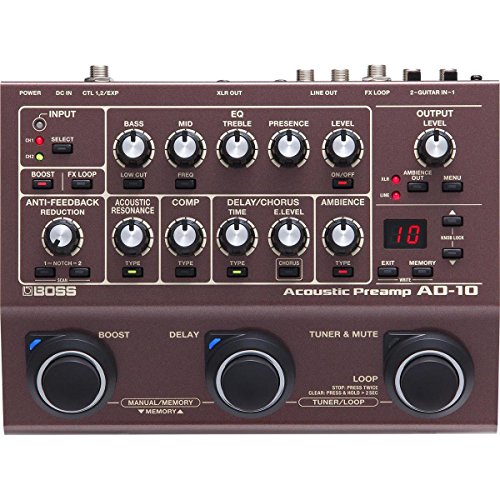
- Professional Preamp and DI Design: Professional preamp/DI for performing and recording with acoustic-electric guitar
- Acoustic Resonance Technology: Acoustic resonance restores the warm and rich resonance lost with most pickup systems
What to Consider Before Buying Acoustic Guitar Effects
An acoustic guitar effects processor is more than just a luxury item; it’s a key solution for bridging the gap between an unplugged instrument and a professional sound system. These devices are designed to handle the specific impedance of acoustic pickups, provide clean gain, and offer tools like feedback suppression and resonance restoration. In my experience, a good acoustic processor acts as the “brain” of your live rig, ensuring that whether you are playing in a small coffee shop or a massive auditorium, your tone remains consistent and natural. If you ignore this part of your signal chain, you risk sounding amateurish, no matter how good your playing technique is.
The ideal customer for this type of product is a performing singer-songwriter, a session musician, or a member of an acoustic ensemble who needs a reliable, “set-and-forget” solution for their stage sound. It is particularly beneficial for those who use multiple instruments during a set, as it allows for precise tailoring of each guitar’s voice. On the other hand, it might not be suitable for those who strictly play at home through a dedicated acoustic amp that already has these features built-in, or for casual hobbyists who don’t mind the raw sound of their pickup. If you are looking for pure “electric” style effects (like heavy distortion), you might consider a dedicated multi-effects unit instead.
Before investing, consider these crucial points in detail:
- Dimensions & Space: Since this will likely sit on the floor or a pedalboard, you need to ensure it fits your setup. A professional-grade unit like the BOSS Acoustic Guitar Hardware AD-10 is compact enough for a gig bag but large enough to house sturdy, easy-to-hit footswitches. Consider if you have room for a dedicated unit or if you need something that can integrate with other pedals.
- Capacity & Performance: Look for the “bit-depth” and processing power. High-end units offer 32-bit processing which ensures that the delicate harmonics of an acoustic guitar are not lost in the digital conversion. You also want to check if it has dual inputs for multiple guitars, which can be a lifesaver during a live set.
- Materials & Durability: Stage gear takes a beating. Look for metal chassis construction rather than plastic. The footswitches should feel “soft-touch” but firm, and the knobs should have enough resistance that they won’t be easily bumped out of place during a performance.
- Ease of Use & Maintenance: A unit that requires a 200-page manual just to get a basic sound is a liability on stage. You want an interface that is intuitive, with dedicated knobs for EQ and effects, while still offering “deep dive” menus for those who want to save specific presets for different venues.
Transitioning from a basic DI box to a professional preamp system is the single biggest upgrade you can make to your live acoustic sound. It transforms your performance from a struggle for clarity into a professional showcase of your instrument’s true voice.
While the BOSS Acoustic Guitar Hardware AD-10 is an excellent choice, it’s always wise to see how it stacks up against the competition. For a broader look at all the top models, we highly recommend checking out our complete, in-depth guide:
Our definitive ranking of the best acoustic guitar simulator pedals for stage and studio

- Transform any guitar into a ToneWoodAmp smart guitar! No Amp Required: Acoustic guitar effects that work directly from your guitar's body without needing an amplifier

- Analog Preamp and Digital Reverb
- 80 preset patches and 80 user patches, enough for creating your sound library. You can save any preferred tones by simply pressing down the SAVE button.
First Impressions and the “Tank-Like” Build of the BOSS Acoustic Guitar Hardware AD-10
Taking the BOSS Acoustic Guitar Hardware AD-10 out of the box, the first thing I noticed was the weight. It feels substantial, finished in a professional deep brown that suggests it belongs in a high-end studio rather than just a rehearsal space. Unlike some lighter plastic pedals, this unit feels like it could survive a tumble down a flight of stairs and still perform perfectly at a gig that night. The layout is remarkably clean for a device with so much horsepower. You have dedicated knobs for the most important functions—EQ, Acoustic Resonance, and Comp/EQ—meaning you don’t have to “menu-dive” while you’re in the middle of a soundcheck.
Compared to previous versions of Boss acoustic preamps, the BOSS Acoustic Guitar Hardware AD-10 feels like a significant leap forward in both audio fidelity and functionality. It’s designed to be the only thing between your guitar and the PA. Before you even plug it in, you can see its full feature set and user reviews to understand why this has become a gold standard for professional acoustic players. The soft-touch footswitches are a particularly nice touch, as they don’t produce a loud “click” that can be picked up by vocal mics in a quiet acoustic setting.
What We Like
- The Acoustic Resonance feature genuinely restores the “woody” tone lost in piezo pickups.
- Dual independent inputs allow for two different guitars with separate EQ settings.
- The multi-band compressor (MDF technology) is incredibly transparent and smooth.
- Professional-grade connectivity with XLR balanced outputs and a USB audio interface.
What We Didn’t Like
- The looper is a single-button operation, which can be tricky for complex live loops.
- The user interface for deep editing can be a bit cryptic without the manual handy.
A Performance Deep Dive: Why the BOSS Acoustic Guitar Hardware AD-10 Rules the Stage
Acoustic Resonance: The Magic of Tone Restoration
The standout feature of the BOSS Acoustic Guitar Hardware AD-10 is undoubtedly the Acoustic Resonance technology. Most acoustic preamps simply apply a global EQ to try and “fix” the sound, but Boss has taken a more sophisticated approach. This feature uses advanced digital modeling to analyze your input signal and then adds back the complex resonant characteristics of a guitar’s wooden body. We found that by turning the Resonance knob, the “plastic” sound of an undersaddle pickup began to dissolve, replaced by a sense of air and depth that you usually only get from a high-quality condenser microphone.
During our testing, we used a mid-range acoustic-electric that typically sounds quite harsh when plugged in. By applying the “Standard” resonance setting, the guitar suddenly felt like it was breathing. As one user noted in their feedback, it makes a $500 guitar sound like it’s worth $5,000. This isn’t just hyperbole; the way the BOSS Acoustic Guitar Hardware AD-10 handles the mid-range frequencies and the “thump” of the low end is significantly more natural than a standard EQ. It allows you to achieve a studio-quality sound in seconds, which is a massive advantage when you’re working with a sound guy who might not be an acoustic specialist.
Dual Channels and Tailored EQ: The Multi-Instrumentalist’s Dream
Another area where the BOSS Acoustic Guitar Hardware AD-10 truly shines is its input flexibility. Many professional acoustic players switch between a standard six-string, a 12-string, or even a mandolin during a set. Traditionally, this meant either having two separate preamps or having to re-adjust your EQ every time you switched instruments. We were incredibly impressed by the AD-10’s dual independent inputs. You can plug two instruments in and set unique EQ and gain levels for each. One user who plays in a roots country band mentioned that they use a Gibson J-185 and an Eastman, two guitars with vastly different output levels and tonal requirements. The AD-10 handled this perfectly, allowing them to switch between instruments with a single footswitch without any volume jumps or tonal inconsistencies.
The four-band EQ is also a masterclass in musicality. It includes a parametric midrange, which is essential for finding and cutting those “honky” frequencies that often plague acoustic guitars. There is also a variable low-cut filter, which is a feature I never realized I needed until I had it. It allows you to clean up the “mud” in your sound without losing the warmth of your low E-string. This level of control makes it much easier to customize your tone for any venue, whether it’s a boomy church or a sterile studio room.
Advanced Feedback Protection and Dynamic Control
Feedback is the mortal enemy of the acoustic guitarist. The moment you turn up the volume to compete with a drummer, your guitar starts to howl. The BOSS Acoustic Guitar Hardware AD-10 features a sophisticated anti-feedback system that goes beyond a simple notch filter. It has two separate notch filters that can be set manually or automatically to “hunt” for the offending frequency and kill it without destroying your overall tone. We found this to be remarkably effective in high-volume rehearsals. Instead of having to stand in one specific spot to avoid feedback, we could move around freely.
Additionally, the built-in multi-band compressor using Boss’s proprietary MDF (Multi-Dimensional Processing) technology is a game-changer. Most compressors squash your whole signal, which can make an acoustic guitar sound “pumping” or unnatural. The MDF technology compresses different frequency bands independently. This means your low-end stays tight and controlled while your high-end remains sparkly and dynamic. It’s a “set-and-forget” feature that makes your playing feel more polished and professional. You can experience this transparent compression for yourself and see how it evens out your fingerpicking and heavy strumming.
The All-in-One Performance Toolkit
Finally, we have to talk about the “extra” features that turn the BOSS Acoustic Guitar Hardware AD-10 into a complete workstation. The built-in effects—Ambience, Delay, and Chorus—are all specifically tuned for acoustic guitar. The Ambience, in particular, is beautiful; it’s a reverb that adds space without washing out the core sound of the instrument. The looper, while simple, is a great tool for practice or adding a quick rhythm layer behind a solo. One minor drawback we noticed, and which was echoed by some users, is that you can’t delete just the last loop; you have to clear the whole thing. However, for most solo performers, it’s a solid inclusion.
The addition of a high-speed, accurate tuner and a dedicated Boost function (perfect for taking a solo) means you really don’t need any other pedals on the floor. Plus, the BOSS Acoustic Guitar Hardware AD-10 acts as a two-in/two-out USB audio interface. This means you can plug it directly into your computer and record your processed acoustic sound straight into your DAW. This is a massive plus for home recordists who want to get that “finished” sound without the hassle of setting up mics. This versatility is a feature that really sets it apart from simpler DI boxes or basic preamps.
What Other Users Are Saying
The general sentiment among users is overwhelmingly positive, especially regarding the unit’s ability to “save” a bad pickup sound. One user shared a story about their old Ovation Celebrity, a guitar known for its difficult-to-manage plugged-in tone. After running it through the BOSS Acoustic Guitar Hardware AD-10, they found the tone control and feedback reduction worked far better than they had initially expected. Another professional performer highlighted that the unit is “idiot-proofed,” making it easy to get a great sound even when the person running the soundboard isn’t experienced with acoustic instruments.
However, no product is without its critics. A few users mentioned the learning curve, noting that while the basic knobs are intuitive, getting into the deeper memory settings requires a thorough reading of the manual. One user was frustrated by receiving a power supply with the wrong regional plug, though this is more of a shipping issue than a flaw with the pedal itself. Another reviewer noted that while the looper is functional, its one-button design limits its use for complex live performances. Overall, the consensus is that for pure sound quality and stage reliability, the AD-10 is hard to beat. It’s clear that users value the professional-grade build and audio quality above all else.
How the BOSS Acoustic Guitar Hardware AD-10 Compares to Top Alternatives
1. SONICAKE Acoustic Guitar Effects Pedal
- Analog Preamp and Digital Reverb
- Built-in Notch Filter and Mute with gain and frequency range adjustment capabilities to quickly eliminate whistling and shape your sound in detail
The SONICAKE Acoustic Guitar Effects Pedal is a much more budget-friendly, “mini” alternative. While it provides an analog preamp and a decent digital reverb, it lacks the advanced “Acoustic Resonance” and “Multi-Band Compression” found in the AD-10. It’s a great choice for a casual player or someone with a very small pedalboard who just needs a basic DI with a bit of “flavor.” However, it doesn’t offer the dual-input flexibility or the deep feedback fighting tools of the Boss unit. If you are a professional playing high-stakes gigs, the AD-10’s extra features are worth the investment.
2. MOOER Acoustikar Acoustic Guitar Simulator

- [Warm Sound] Restore the sound of the acoustic guitar. Play the sound texture of an acoustic guitar with an electric guitar.
The MOOER Acoustikar is a tiny pedal designed to make an electric guitar sound like an acoustic, but it can also be used to “reshape” an acoustic signal. It offers three modes: Piezo, Standard, and Jumbo. While it’s impressively compact and does a decent job of changing the tonal character, it is a single-function pedal. It doesn’t have an EQ, a tuner, a looper, or an XLR output. It’s a fun tool for a specific sound, but it cannot replace the comprehensive stage-management capabilities of the BOSS Acoustic Guitar Hardware AD-10.
3. ToneWoodAmp SOLO Multi-Effect Processor
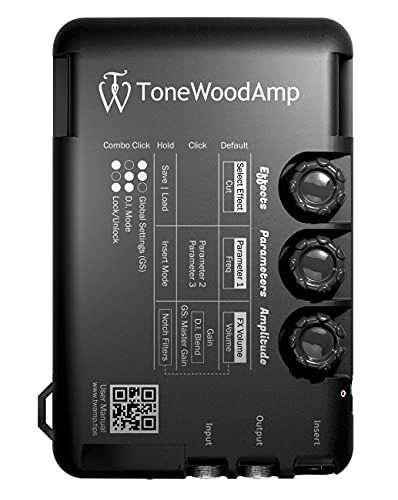
- 【One Of A Kind Experience】The ToneWoodAmp works on virtually any acoustic guitar! Adds beautiful sounding organic guitar effects to your acoustic* and acoustic-electric guitar, NO AMP REQUIRED...
- 【No Amp Required】 XXXX Get Reverbs like Hall, Room, Plate, Delay, Leslie, Auto-Wah, and Chorus, no amp required! All sounds come from the soundhole of your guitar organically. Buy one ToneWoodAmp...
The ToneWoodAmp SOLO is a completely different beast. Instead of sitting on the floor and going to a PA, it attaches to the back of your guitar and uses the guitar’s own body to produce effects like reverb and delay *unplugged*. It is an incredible tool for inspiration and practice. However, when it comes to live performance through a PA system, it lacks the DI functions, the precise multi-band EQ, and the advanced feedback suppression of the AD-10. For the gigging musician, the AD-10 is the practical choice, while the ToneWoodAmp is the creative, experimental choice.
Final Verdict: Is the BOSS Acoustic Guitar Hardware AD-10 the Right Choice for You?
After putting the BOSS Acoustic Guitar Hardware AD-10 through its paces, I can confidently say it is one of the most comprehensive and high-quality acoustic preamps on the market. Its ability to restore natural resonance is not just a gimmick; it’s a fundamental shift in how your guitar interacts with a sound system. While it has a few minor quirks, like the single-button looper and a slightly steep learning curve for the deep menus, these are small prices to pay for the sheer audio quality and “tank-like” reliability you get in return. It truly solves the problem of the “piezo quack” and gives you the confidence to play any stage, knowing your tone is locked in.
If you are serious about your acoustic sound and want a unit that can grow with you from small club gigs to professional studio sessions, this is the tool for the job. It replaces several other pedals on your board and provides a level of control that few other units can match. Stop fighting against your pickup and start playing with a sound you actually love. You can check the current price and secure your BOSS AD-10 today to finally unlock the true voice of your instrument.
Last update on 2026-10-25 / Affiliate links / Images from Amazon Product Advertising API